


“Experimenting on yourself is insane. An experiment on a single person, with no controls, tells you nothing. It is incapable of predicting anything.” Or... is it?
Such is the premise of Spare Parts, the darkly comedic and deeply twisted new drama currently shaking up Theatre Row through April 30th — and subverting our standards of what we think science can achieve.
With humor, heart and a touch of madness, the play examines ethics, morality, privilege, truth to power, humanity and identity, all in an effort to answer the question: what does it cost to live forever?
At the center of it all is two-time Tony nominee Rob McClure, who plays scientist Dr. Chris Coffey, coerced into funding the fundamental experiment, against his beliefs and, ostensibly, all other odds. Below, the actor, also known for recent roles in Chaplin and Mrs. Doubtfire, gets candid about leaning into the comedy of the show, why new theatre is imperative in this moment, where the arts stand in the era of AI, and why this “deliciously horrifying” production is in a league of its own.
What drew you to this project? Why, for you, was this “the one” to do?
A show like this is a phenomenal exercise in standing still, listening, and telling the truth. It’s important to take time to challenge myself in [that discipline]. To work the smaller muscles. To recalibrate.
How is this production different from other works out there? Why should someone come to see it?
Simple. This production is singular in its scientific credibility. Nothing [discussed] in the show is made up — it’s all really happening right now. This isn’t science fiction... it’s just science.
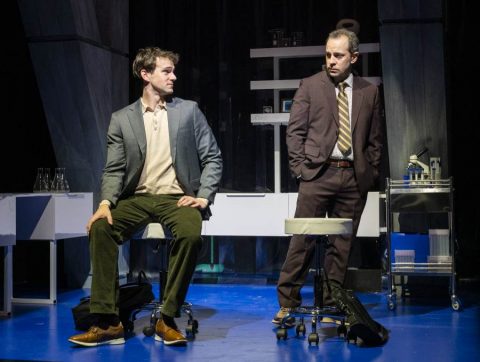
Your playwright, David Glass is a leading aging researcher and scientist as well, and you’ve spoken about playing “a version of [him]” as you play your character, Coffey. Did you find it helpful to have that scientific research and background… and so readily available? If so, in what ways? Did it help you to tap into and understand the scientific aspect of the piece?
Working with David was the other main reason I decided to do this play. His expertise is unmatched and having him in rehearsals was massively helpful, not just for his understanding of the material, but for his behavior… his demeanor.
And yes, that’s right – I’m essentially playing a version of him. So, [it’s about studying] “what makes him tick? What lights him up? What brings him down?” And to have him there… invaluable.
Can you talk about how this play intersects, or blurs, the line between science and art? What does this say about the world today? Where are we headed?
This play is an imminent warning – the science is basically settled. We can increase our lifespans. Now, the question is: should we? And, perhaps more importantly, at what cost? Both financially and, of course, morally.
Do you think adding the comedy makes this “unsettling” if not, timely, topic easier to digest? What does the element of comedy allow the show (and the players) that would be lost if it were missing? How, if at all, does adding the comedy makes this “unsettling” if not, timely, topic easier to digest? What does the element of comedy allow the show (and the players) that would be lost if it were absent?
Comedy is the way in. Jerry Zaks [director of Mrs. Doubtfire] taught me that the sound of an audience laughing is the sound of them falling in love. Once you’ve cracked them open with laughter, you can subversively get into their souls and get to work.
You’ve been known throughout your career to play somewhat eccentric comedic characters. How do you feel Coffey compares?
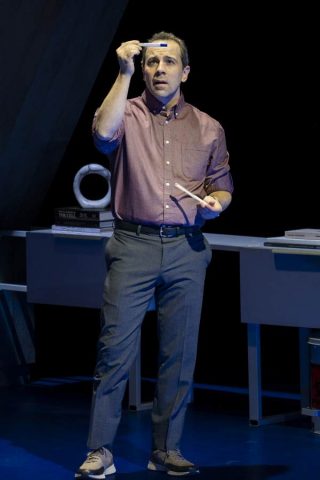
I don’t know how eccentric Coffey is. (Laughs). But I do know that his passions are unmatched. His love of facts. His love of discovery. His love of ethics. All of which are viciously tested throughout this piece. The audience can decide if he passes.
This show is very much of the moment, highlighting morality, ethics, AI, etc. — it’s very “2026.” Compared to the classics, why do you think it is important to have new works like this one, that reflect the world as we see it today? And why should audiences support new theatre?
People didn’t know that the classics were classics at the time. They were artists writing with the sociological compass of their moment. As are we [today]. It just so happens that, right now, our compass is largely pointed toward fear of technology. Time will tell what becomes “classic,” if anything.
But new theater – both to make and to see – especially about our world as we see it in this moment, is not just important. It’s vital. And now more than ever.
In the spirit of the production, what message might you have for a hypothetical Rob McClure clone?
If, and when, a Rob McClure clone shows up… leave him be. How remarkable would it be to see who he becomes?! My advice to him would be to live his life singularly regardless of his genetic affiliation. He’s his own.
Why, in your opinion, is it important for artists — or anyone — to speak out against AI?
Can AI focus on curing cancer and cleaning the oceans? Please?! Leave the arts jobs alone. It has no lived experience, which is the very well that art is pulled from. The water in the well of AI is stolen. AI has never tasted it. It can’t create. It can only rehash.
Finally, what do you hope to instill in audiences as they come away from this show?
I hope audiences leave recognizing that the clock on their lives is not a limitation, but rather, the clock is what gives it such sacred value.
Thumbnail Photo Credit: Emilio Madrid
Spare Parts, directed by Michael Herwitz, plays Theatre Three at Theatre Row (410 W. 42nd Street) through April 30th. For tickets and/or more information, visit sparepartsplay.com.