


The Tony Awards celebrate their 22nd return to the iconic venue, continuing a decades-long Broadway tradition.
Raise your glass… because the Tonys are back and returning to Radio City Music Hall!!
And what a “f**kin’ perfect” show it’ll be, with Grammy winner — and “lifelong theatre fan” — P!NK poised to take the stage as ringmaster for the very first time.
“This year, [I decided] I’m gonna just say ‘yes’ to things that I wouldn’t normally say ‘yes’ to,” said the singer, in an interview earlier this week, of her decision to host. Teasing aerial stunts (natch), self-deprecating comic bits, and a “bonkers” opening number featuring more than 170 performers onstage at once, P!NK maintains, “My whole point this year is to celebrate [the community], who I deem the literal hardest-working people in show business. These people give magic every single day, and I cannot wait to celebrate them with the entire world. We’re gonna have so much fun.”
It’s all happening tonight at the legendary “showplace of the nation.” Hungry for the history of this hallowed hall in the meantime? Here’s everything you need to know!
IT WAS THE MUSIC OF SOMETHING BEGINNING…
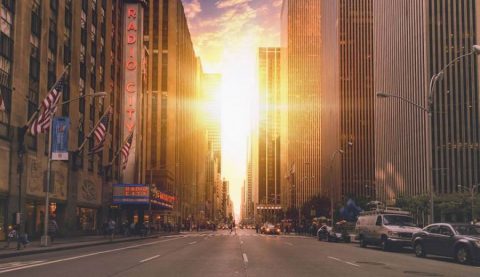
The iconic Radio City Music Hall was the brainchild of designers Edward Durell Stone and Donald Deskey. Originally intended to be the site of a new Metropolitan Opera House, those plans were canceled in light of the Great Stock Market Crash of 1929; instead, the property captured the eye of John D. Rockefeller, who made a deal with Radio Corporation of America – a company whose NBC radio programs and popular motion pictures were attracting huge audiences in their own right – to develop Rockefeller Center into a mass media complex for the ages.
In the depths of the Depression, Rockefeller aimed to achieve the “highest ideals of architecture and design” while offering Americans “a symbol of optimism and hope” for the future.
Rockefeller’s financial expertise and RCA’s media prowess brought impresario S. L. “Roxy” Rothafel into the mix. A successful theatre operator renowned for his domination of the city’s movie industry – blending “silent movies, extravagant stage shows, and the most opulent theatres he could build” – Rothafel proposed building two theatres: a large vaudeville “International Music Hall”on the northernmost block, with more than 6,200 seats, and the smaller 3,500-seat RKO Roxy movie theatre on the southernmost block.
In planning, the impresario refused to allow the theatre to have a large balcony over the box seating, or rows of box seating facing each other. His final plan ultimately used three tiers of balconies, cantilevered from the back wall. Second, Roxy specified that the stage feature a central section with three movable parts so the sets could be easily changed. The impresario wanted red seats, as he believed that color denoted success, and asked for the auditorium to be oval-shaped to allow for better acoustics. Finally, he wanted to build at least 6,201 seats in the Music Hall, so it would be larger than his previous Roxy Theatre.
The International Music Hall eventually became known as “Radio City,” after the original Radio Corporation of America that helped fund it.
While on an ocean liner traveling home from Europe, Roxy was taken aback by the sight of the setting sun against the water. He was so in love with the image that he had it serve as the inspiration for his theatre, which is why its famous proscenium arch resembles a setting sun.
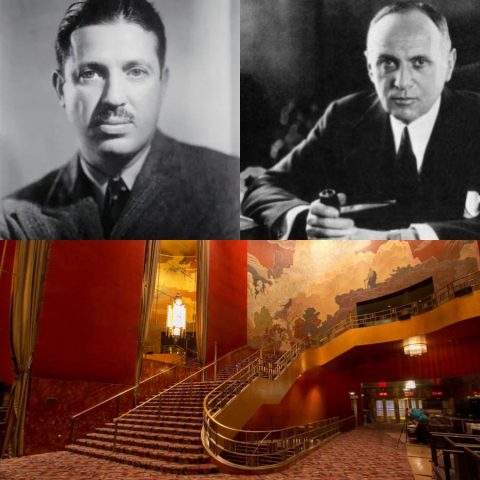
Construction on the newly-named Radio City Music Hall began in December 1931, and was completed in August 1932.
Choosing “elegance over excess,” Deskey designed more than thirty separate spaces, including eight lounges and smoking rooms, each with its own motif. He also designed furniture and carpets himself, thoughtfully coordinating railings, balustrades, signage, and decorative details to complement the theatre’s interior spaces.
A remarkable example of contemporary design in its day, it remains “an elegant, sophisticated, unified tour de force” that still has the power to take its visitors’ breath away.
After more than three years of planning, preparation, and construction, Radio City Music Hall opened to the public on December 27, 1932, replete with “more than one hundred thousand requests for tickets” to the bash from Broadway and Hollywood royalty alike.
“There’s truly no room like it anywhere else in the world. Nobody had ever seen anything like it. There was certainly nothing in the city like it,” said architect Hugh Hardy, whose many New York revitalization projects included the construction of the famed showplace. Staff even had difficulties getting patrons to their seats “because they wanted to see the building… they were amazed by all the [goings-on.]” Guests were quick to note the breathtaking attention to detail, enamored with “the majesty they found themselves part of.”
The “show” was as much about the architecture as the nightly offering.
“Walking into the Grand Foyer, it seems overwhelming, but it becomes very intimate, once the crowd starts to come in,” says Radio City Senior Vice President and General Manager Clinton Neils. Designed, again, to be reminiscent of an ocean liner, “it’s one of those things [where] you just have to pause (which is actually sometimes an issue)....People stop at the doors because they can’t believe what they’re seeing in front of them, stepping off the street and literally coming into another world.”
RCMH BY THE NUMBERS
With over 6,000 seats, Radio City Music Hall is the largest indoor theatre in the world... and the first auditorium ever to be built with air conditioning! More than 300 million people have visited the Music Hall to enjoy stage shows, concerts, movies and special events.
Built in Indiana limestone, the theatre features a marquee that measures a full city-block long, displaying its name in bold, neon letters on both sides of Sixth Avenue and 50th Street. The neon tubing that makes up Radio City’s marquee totals six miles. Above its entrance, muralist Hildreth Meiere crafted six small bronze plaques of musicians playing different instruments. Three larger plaques, depicting elements of dance, drama and song, capture the theatre’s purpose, preparing audiences for the magic they are about to witness inside. Though no longer intact, the theatre’s rooftop garden once included a tennis court.
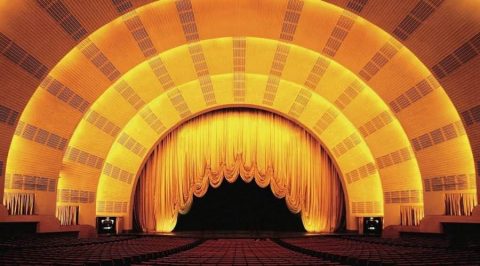
Inside, from back to stage, its auditorium measures 160 feet. The Great Stage, designed by Peter Clark, is framed by a huge proscenium arch that measures 60 feet high and 100 feet wide. The shimmering gold stage curtain, the largest of its kind in the world, weighs over two tons. The ceiling reaches 84 feet in height, formed by a series of sweeping arches designed to mimic the slope of a sunrise, signaling the dawn of a new day – a new era – for the United States. The arches are also designed to help conceal over 5,000 stage lights from audience view. And, perhaps most significant to audience members, there are no columns to obstruct views.
The stage itself is made up of three hydraulically-powered elevators, “each able to soar 13 feet above stage level, or plunge 27 feet below” – a technical marvel, especially considering it was engineered in 1930-1931. During WWII, the government had agents stationed here, as they were using similar technology for elevators on aircraft carriers, “in case any spies came to see how complicated and wonderful the equipment was and steal it for the Germans.”
As time moves on, and the productions – both then and now – become more and more technologically advanced, everything onstage is still controlled from a panel original to 1932.
YOU’VE GOTTA HAVE ART
An Art Deco gem in every detail, Radio City’s grand foyer and lounges are adorned with murals, statues, and other creative works highlighting the talents of Depression-era artists.
Upon guests’ arrival in the Grand Foyer, Neils explains with a smile that the three most frequently asked questions are: “Where is the restroom?”, “How do I get to my seat?” and “Can you please take my picture in front of this beautiful aesthetic?”
“Beautiful” is clearly an understatement. The chandeliers displayed in the foyers, courtesy of Edward F. Caldwell, span two and a half stories, stand 29 feet tall, and weigh approximately 4,000 pounds.
“Quest for the Fountain of Eternal Youth,” the 2,400-square-foot mural above the Grand Stairs depicting a fable from a Native American tribe in Oregon, was designed by Ezra Winter.
The murals on the wall of the grand lounge, collectively known as “Phantasmagoria of the Theater,” depict five eras of theatrical history, all painted by Louis Bouche.
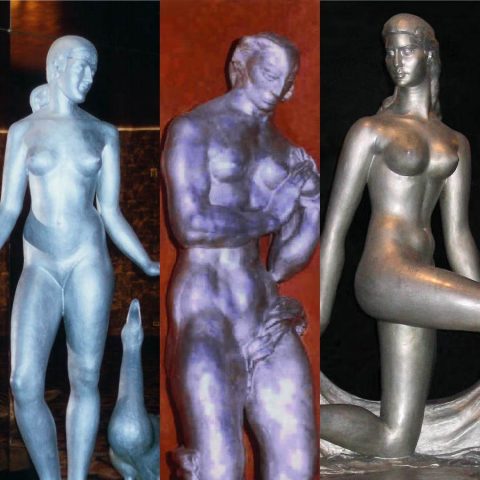
Three nude aluminum sculptures were originally commissioned for the theatre, but Roxy rejected two of them, deeming them inappropriate for a family venue. Robert Laurent’s “Girl and Goose” was the only sculpture displayed on opening night; the other two, Gwen Lux’s “Eve” and William Zorach’s “Spirit of the Dance,” were eventually returned to the theatre, and all three remain part of the building’s artistic landscape today.
Stuart Davis’ Men Without Women, a 1932 mural depicting masculine pastimes, was donated to the Museum of Modern Art in 1975 and returned to Radio City in 1999 following the theatre’s restoration. It now hangs in the downstairs men’s lounge.
“Every detail of RCMH really adds to the joy and experience of art,” says Rockette Sydney Mesher. “There’s so much relating back to costuming, performance, dance, music… [There are] details in the bathrooms… the metal leaves that you see on the doors… it all pertains back to theatre.”
“It reminds you of a time that was much more romantic,” adds Tony winner, and decorated Grande Dame of the stage and screen, Liza Minnelli, “[and of] a time where the attention to detail was much more [prominent] and immense.”
LET’S GO TO THE MOVIES
Initially, Roxy swore off showing movies at his new venue. According to a report, he “had this madcap idea that there would be an audience for a kind of higher form of vaudeville,” and began booking live entertainment acts in hopes of attracting a greater audience… with little success.
To rebound from his poorly-received premiere event, Roxy reinstated movies just two weeks later, and the theatre was reinvigorated, bolstered by the world premiere of King Kong and the New York premiere of Disney’s Snow White and the Seven Dwarfs.
Premieres of Breakfast at Tiffany’s, To Kill a Mockingbird (starring former Radio City usher Gregory Peck), Mary Poppins and The Jungle Book followed, and Rothafel paired each with an elaborate live stage show, dubbed a “spectacular.” With this shift, according to a report, it wasn’t long before “studios were fighting to get on its oversized screen,” the Hall now restored as a magnet for movie stars, dignitaries, and socialites alike.
Eventually, the theatre welcomed six million audience members per year – twice as many as had visited the Empire State Building, the Statue of Liberty, and the United Nations combined.
Roxy continued to oversee all aspects of the venue until his death in 1936. In addition to its movie screenings, Radio City hosted a religious holy hour in 1933, and then began offering opera the following year. Easter services were added in 1940, and a WWII fundraiser – deemed “the most elaborate benefit performance ever held in New York” – followed in 1941.
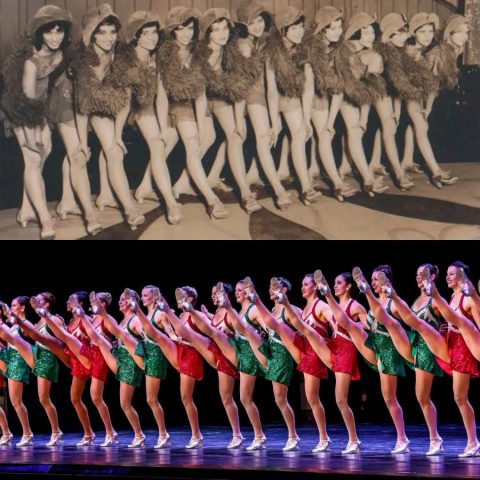
But until 1979, when moviegoing and movie premieres yielded to a new focus, this “double feature” format of a movie-and-a-show remained strong. To pull off this feat, Rothafel hired two additional collaborators to help keep the steam rolling – Leon Leonidoff and Vincent Minnelli, the latter the future husband of Judy Garland, and father to Liza; the former, the eventual creator of the Radio City Christmas Spectacular, a Music Hall staple since 1933, not least because it spotlights Roxy’s signature precision-dance troupe: 36 happy-tappy leggy ladies “masquerading as a single entity.”
THE ROCKETTES HIGH-KICK RADIO CITY TO NEW HEIGHTS
The Rockettes were founded in St. Louis in 1925 by dancer/choreographer Russell Markert. Inspired by the Tiller Girls, a similar 1890s precision-dance company based in the UK, Markert expressed a vision of “the girl-next-door-type” in look and stature. In other words, “taller [women] with longer legs…more complicated routines…and [to be] distinctly American.”
Known initially as the Missouri Rockets, they performed at the Missouri Theatre in St. Louis, before being recruited by Roxy, who first dubbed them “Roxy-ettes,” and later, christened them with their current memorable moniker.
“Seven days a week, for 45 years, the Rockettes performed five shows a day,” with some dancers remaining in the troupe for as long as 35 years, performing over 1,000 kicks per show.
Of note, the troupe, which recently wrapped the centennial of its annual Yuletide tradition, made their Tony Awards debut in 2004 opposite a high-kicking Hugh Jackman, who served as that year’s host and won Best Actor in a Musical for his performance in The Boy from Oz.
And speaking of Tonys, of course, most pertinent to Broadway and theatre folks, Radio City Music Hall has been host to the annual Tony Awards celebration since 1997. Though recent years have seen some swaps in venue, bringing the bash to the Beacon Theatre, the Winter Garden Theatre, the United Palace in Washington Heights, and the Koch Theatre in Lincoln Center, RCMH still holds the distinction of being the most frequent home of the annual celebration, capping off lucky #22 this year.
A NEW DAY HAS BEGUN
By its 30th anniversary in 1962, Radio City had welcomed nearly 200 million – more than the entire U.S. population at the time. But as the decades passed, the Music Hall struggled to keep pace with evolving entertainment tastes.
In 1977, RCMH faced bankruptcy and closure was imminent. Rumors swirled of new plans for the property, stating it could become a department store, shopping center, a theme park, or “an environmental study center” under the leadership of Jacques Cousteau.
The Rockettes, under the leadership of RCMH Ballet Company Dance Captain Rosemary Novellino, took to the streets between shows, collecting signatures and urging everyday New Yorkers – “those who had been filling the theatre seats for decades” – to help them fight to save their beloved showplace…. to no avail.
On March 28, 1978, Radio City was granted landmark status.
Following the annual Easter show on April 12, 1978, RCMH was set to shut down for good. And then, miraculously, the next morning… a reprieve.
In order to keep Radio City running strong, movie showings were dropped in favor of a return to Roxy’s original vision: “a theatre dedicated to the ultimate in entertainment,” welcoming “the world’s greatest holiday shows and the world’s biggest [musical] acts.” Everyone from Frank Sinatra to Celine Dion, John Mulaney to Jon Bon Jovi, Stevie Wonder to Sara Bareilles, Aerosmith to Adele, and many, many others have graced the hallowed hall over the decades, continually ensuring that vision lives on. Even P!NK has taken to the legendary stage — first in 2002, before collecting her very first Video Music Award, and, most recently, alongside her daughter Willow, as a special guest during the aforementioned Hugh Jackman’s Radio City residency last summer.
And what prompts these performers — and their audiences — to keep coming back? The alluring ambience, of course.
As Liza puts it (as only she can): “It’s a sexy, sexy place.”
The 79th Annual Tony Awards will be held at Radio City Music Hall (1260 Avenue of the Americas), concurrently airing on CBS & Paramount Plus, on June 7th, 2026. For more information, please visit www.tonyawards.com.