


The sun is shining, it’s a lovely day… to celebrate the 17th anniversary of 2003-2004’s surprise smash hit musical, Avenue Q. And that’s just what theatre personalities Seth Rudetsky and James Wesley did, appropriately, on the July 31st edition of their acclaimed quarantine variety show, Stars in the House. Using the Internet for porn, ahem, what it was meant for, they invited a colorful cast to their screens, including original cast members John Tartaglia, Stephanie D’Abruzzo, Jordan Gelber, Ann Harada, Jennifer Barnhart and cast member and puppet designer Rick Lyon, who dished and divulged several backstage secrets, and detailed how the piece evolved throughout its development. Here are a few of our faves:
The show was originally conceived as a TV series.
Having met at the Lehman Engel-BMI Musical Theatre Workshop, composer-lyricists Jeff Marx and Robert Lopez first collaborated on a mock class project: Kermit, Prince of Denmark, a speculative Muppet movie based on Hamlet. When the project was eventually pitched to the Henson Company and rejected, Marx and Lopez came to a conclusion: “Forget the Muppets. Let’s create our own puppet characters, and then nobody can stop us.”
The idea that emerged was Avenue Q, conceived as a variety-format show, not unlike Sesame Street, consisting of three consecutive episodes, woven together by a common theme and, of course, like its Muppet counterpart, a word for the day.
Early readings and pitch presentations to potential investors and producers followed as Marx and Lopez worked to get the project off the ground. “We were still pitching it as a TV show,” designer, puppeteer and original cast member Rick Lyon comments, but adds that everyone acknowledged “we were [presenting] and performing it publicly in a theatrical space.”
Inevitably, following one such reading in 2000, producers Jeffrey Seller and Robyn Goodman approached the duo with a question: “So, we like what you’re doing, but have you thought about making it a theatre piece?”
Lightbulb.
Librettist Jeff Whitty was then brought in to help devise a longer, multi-threaded story, tying the existing songs and sketches together, renaming characters, and building the “cumulative emotional momentum” that would become the basis for the Avenue Q we know and love today.
Another defining element born from that initial reading? The decision—or perhaps necessity—to leave the puppeteers in full view of the audience.
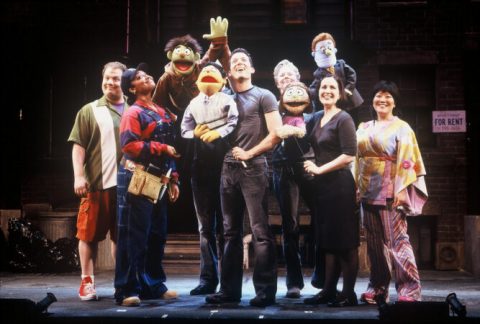
“People were so fascinated with that… how we did it,” says original Princeton & Rod John Tartaglia. “Of course, we all take that for granted because it’s part of our every day… but when you go on the set of Sesame Street or The Muppet Show, and you can actually see how it’s done, it is really fascinating. And I remember everyone was talking about that afterward, like ‘see how he moved his right hand? How did that work? And the rods… and everything else.’”
“It was just a reading with music stands,” adds original Kate Monster Stephanie D’Abruzzo. “When you’re doing a reading with music stands, you don’t have a set, and you can’t try to hide the puppeteers, so there was no reason to hide us.” And with that decision cemented, the road to Broadway was officially paved.
Brian Yorkey, eventual Tony-winning lyricist for Next to Normal, was the first Brian in early readings of the show.
“That’s why his name is Brian,” D’Abruzzo reveals, “and that’s also why he wears cargo shorts. That’s Brian Yorkey’s look.” She also recalls that the team, having not yet secured Ann Harada, was “very close” to having Robert Lopez play Christmas Eve in that first reading. (“It’s terrible,” she says, of the recording she has of Lopez in action. “it’s very inappropriate.”)
Trekkie Monster was originally conceived and designed as a Trekkie.
Again, like Brian, hence the name. “That [concept] eventually disappeared because the producers were afraid that Paramount would sue us,” Lyon explains. “They are famously litigious… very protective of their IP, but the original Trekkie Monster was very much a direct satire of Cookie Monster from Sesame Street.” In fact, almost uncannily so — outfitted with same face shape, signature googly eyes and, fitting for his moniker, Spock ears and a Star Trek uniform. “It was eventually decided that he was too much [of a] satire of Sesame Street, and he needed to be his own [iteration],” the puppeteer continues. “So, that puppet never even saw Off-Broadway. He was just used in those first workshops.”
Original cast member Jennifer Barnhart was the only one who had to audition.
Tartaglia, D’Abruzzo, Lyon, Harada, Jordan Gelber & Natalie Venetia Belcon were all “offer only.”
“There’s a Fine, Fine Line” was written after Kristen & Robert Lopez broke up.
Consumed with writing the then-untitled “puppet musical,” Lopez proposed that they see each other only on Fridays, when the work week was done and he would ideally have more time to spend with her. Anderson-Lopez replied, verbatim: “There’s a fine, fine line, between love and a waste of time,” which obviously served as the inspiration for Kate Monster’s somber Act I finale.
“My whole body turned hot and red [upon my realization],” Anderson-Lopez recalls. “He just put our breakup into his musical,” that he then, despite their separation, invited her to watch. “I think this is his way of trying to get me back,” she surmised. Needless to say, it worked…. and after Lopez proposed to her onstage at the opening night curtain call of the show’s Broadway bow, it’s clear the rest was history.
Brian marrying Christmas Eve under a chuppah was Jordan Gelber’s idea.
“What [from our personal lives] did we bring to the characters?” Gelber asks, referencing a question Rudetsky posed earlier in the discussion. “Because I am of Jewish faith, [I pitched] Brian marrying Christmas Eve under a chuppah in the show.” They also wore yarmulkes featuring the Rising Sun Flag of Japan, courtesy of costume designer Mirena Rada — also at Gelber’s suggestion.
“Isn’t it cool that you got to make an imprint on this character forever?!” an awed Rudetsky asks.
“A little bit of Judaism,” Gelber responds, nodding. “That’s a little bit of what I able to throw into the pot.”
The infamous “F-bomb” at the Tonys was mouthed.
“Here’s the thing: I wasn’t allowed to [say it out loud],” reveals D’Abruzzo when Rudetsky asked her to explain how she felt reciting the expletive. As for the reasoning, she explains: “Had I actually said [the word] and they [weren’t able to] drop out the mic, we would have had a Janet Jackson situation,” referring to the incident that had occurred during the Super Bowl that previous February. 
“It’s very hard to sing a song and [manipulate] a puppet,” she goes on, “and I had to mouth it, too, to let the audience know [what Kate was] saying. But not actually say it,” a seemingly difficult task for someone who’s committed saying it to memory eight times a week for the last two years.
Additionally, “I knew I had to keep [Kate] really still because it was an ultra-closeup, and we didn’t have monitors... I could see the Jumbotron barely out of the corner of my eye. So, I had to keep her super-still, to fill her frame in the shot without being able to see it, lip-sync me and her, without, again, actually saying the word… it was stressful, for sure. But,” she says, smiling, “I guess I earned my bones.”
They knew they had something…. special.
No, not like that. But upon their transfer from the Vineyard Theatre to Broadway, “people were talking about how [quickly] we were gonna close,” comments Tartaglia. “Of course, we were [ecstatic] as a family [to be coming to Broadway]… but I was seeing columns and headlines like, ‘It’ll last for two months.’ There was a lot of debate about [whether] this weird, little seven-person unit-set, puppet musical work on Broadway?”
But the cast knew exactly what they had. “I just thought it was so special,” Harada added. “I never thought anybody would think it was as funny as I thought it was, and then when I heard the songs, I just thought they were so great. The beauty of seeing all the puppeteers embody these characters, it was so magical. It was the most exciting table read of my life. And I was just like, ‘I just want to hang on to this show.’”
So, even though it may seem that everything in life is only for now, as this unconventionally irreverent production has proven year after year, some things really can last forever.
Avenue Q opened at the Golden Theatre (246 W. 44th Street) on July 31st, 2003. Stars in the House, hosted by Rudetsky and Wesley, airs daily Tuesday-Saturday at 8pm. For more information and/or make a tax-deductible donation to the Actors’ Fund, please visit www.starsinthehouse.com.