


10 GBP
The Schwarzman Centre Cultural Programme presents a performance of MAN WOMAN on Wednesday, September 16, 2026 at 7PM at the Schwarzman Centre, Radcliffe Observatory Quarter, Woodstock Road, Oxford OX2 6GG. Tickets start at £10 and can be purchased at https://www.schwarzmancentre.ox.ac.uk/whats-on/man-woman-jg6y.
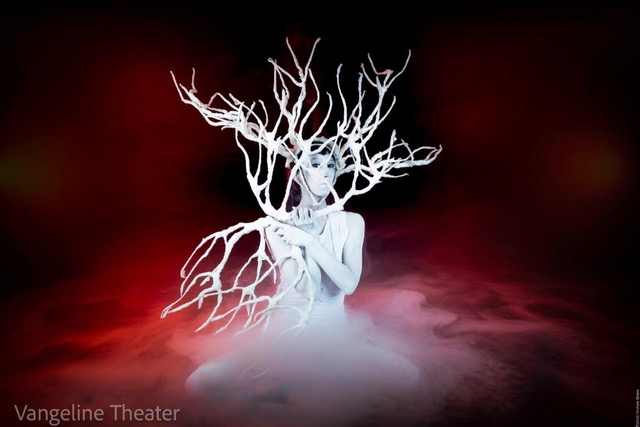
MAN WOMAN is a visually striking new dance performance by New York-based choreographer and performer Vangeline. Inspired by Eikoh Hosoe’s famous Man and Woman photo series featuring Butoh pioneers Tatsumi Hijikata and Motofuji, the performance reimagines these celebrated images through a contemporary feminist lens.
Butoh is a Japanese avant-garde dance form known for its highly expressive movement exploring transformation, identity and the body’s ability to cross boundaries. Drawing on Hosoe’s photographs as inspiration, MAN WOMANcombines Vangeline’s distinctive movement language with costumes by visionary queer artist Machine Dazzle and a richly textured electro-acoustic score by Ray Barragan-Sweeten.
Placing the female body at the centre, MAN WOMAN reimagines Hosoe’s work from a contemporary feminist perspective, asking what happens when women are no longer defined in relation to a male presence, but become the authors of their own stories.
“Vangeline … becomes a complete being – male and female, animal, vegetable and mineral, down to earth and out of time.” – DanceViewTimes
MAN WOMAN premiered in New York in spring 2026 at La MaMa E.T.C.
A live discussion will follow after the performance with the artist and Dr Baldock (women’s roles in Butoh history), deepening the enquiry into gender, memory and queer aesthetics.
We are committed to creating a welcoming and inclusive space and ask everyone to contribute to a respectful discussion during the Q&A.
Machine Dazzle has been dazzling stages via costumes, sets, and performances since his arrival in New York in 1994. Credits include Julie Atlas Muz’s I Am The Moon And and You Are The Man On Me (2004), Big Art Group’s House Of No More (2006), Justin Vivian Bond’s Lustre (2008) and Re:Galli Blonde (2011), Chris Tanner’s Football Head (2014), Soomi Kim’s Change (2015), Pig Iron Theater’s I Promised Myself To Live Faster (2015), Bombay Ricky (Prototype Festival 2016), Opera Philadelphia’s Dito and Aeneus (2017) and Spiegleworld’s Opium (Las Vegas 2018). With Taylor Mac, Machine has collaborated on several projects including The Lily’s Revenge (2009), Walk Across America For Mother Earth (2012) and the Pulitzer Prize-Nominated A 24-Decade History of Popular Music (2016-Present). Conceptualist-as-artist meets DIY meets “glitter rhymes with litter,” Machine was a co-recipient the 2017 Bessie Award for Outstanding Visual Design and the winner of a 2017 Henry Hewes Design Award.
Ray Barragan-Sweeten is a visual artist and composer based in New York and Rhode Island whose work moves fluidly between sound, image, and performance. His creative life began in childhood through a long distance musical exchange with his father in Peru: Ray and his older brother recorded themselves on small Casio keyboards, mailing cassettes southward and receiving tapes of accordion and organ in return. These early transmissions — intimate, improvised, mediated by technology — formed the roots of a practice that treats sound as both connection and inquiry. Ray later formalized this trajectory at the Oberlin Conservatory’s TIMARA program, where he deepened his exploration of how electronic systems and human gesture shape one another across both music and moving image.
In 2010, Ray co-founded DataSpaceTime with visual artist Lisa Gwilliam, a collaborative project exploring the culture of informatics, software, and data as material. Their work has been exhibited, performed, and screened internationally at Centre Pompidou, the Parrish Museum, City Center NY, Microscope Gallery, AS220, the Next Festival at BAM, Florida Atlantic University, and CICA Museum. The duo has also served as guest artist faculty at Sarah Lawrence College. DataSpaceTime is represented by Microscope Gallery in New York.
Vangeline is a New York–based teacher, choreographer, and dancer specializing in Japanese Butoh. As the artistic director of the Vangeline Theater/New York Butoh Institute, she is widely recognized for her rigorous, research-driven approach to Butoh and for expanding the form’s relevance in the 21st century. Her work actively champions diversity and inclusion within the field, creating space for historically underrepresented voices. She carries forward the legacy of Butoh while infusing it with contemporary relevance—through activism, research, and performance.
Through her all-female dance company, Vangeline creates socially engaged, innovative choreographic works that unite Butoh with activism. She is the founder of both the New York Butoh Institute Festival, which uplifts the work of women in Butoh, and Queer Butoh, a festival centering LGBTQ+ voices within the form. She is also the visionary behind The Dream a Dream Project, an award-winning program now in its 18th year that brings Butoh to incarcerated individuals in correctional facilities across New York State.
At the heart of Vangeline’s philosophy is the belief that Butoh can be a tool for both personal and collective transformation. Her work reflects a deep commitment to integrating the many dimensions of the human experience—beauty and darkness alike—and reintegrating society’s marginalized voices.
Vangeline’s choreography has been presented internationally in Chile, Germany, Italy, France, Finland, Denmark, the UK, Mexico, Hong Kong, Singapore, and Taiwan. She is the recipient of a 2022 National Endowment for the Arts Dance Award for her groundbreaking project The Slowest Wave, which explores the intersection of Butoh and neuroscience. She was also a 2022–2023 Gibney Dance in Process resident artist, a 2018 NYFA/NYSCA Fellow in Choreography for Elsewhere, and the winner of the 2015 Gibney Dance Social Action Award and the 2019 Janet Arnold Award from the Society of Antiquaries of London.
Her work has been widely acclaimed, both nationally and internationally, with critics praising its power, precision, and emotional resonance. Reviews have appeared in publications including The New York Times (“captivating”) and the Los Angeles Times (“moves with the clockwork deliberation of a practiced Japanese Butoh artist”), to name just a few.
Her work extends to film as well, including a starring role opposite James Franco and Winona Ryder in Jay Anania’s feature film The Letter (Lionsgate, 2012). She has also been commissioned by Grammy Award–winning artists Esperanza Spalding, Skrillex, and David J. (Bauhaus).
Vangeline is the author of the critically acclaimed book Butoh: Cradling Empty Space, which delves into the connection between Butoh and neuroscience. She led the first-ever scientific study measuring the effects of Butoh on the brain (The Slowest Wave). Her work has been profiled in CNN’s Great Big Story (“Learning to Dance with Your Demons”), featured on the BBC’s Deeply Human podcast (with host Dessa), and explored in her own podcast, Butoh Musing with Vangeline.
She was recently awarded a prestigious fellowship at Wadham College, University of Oxford, for the 2026–2027 academic year. She looks forward to performing MAN WOMAN at the Schwarzman Centre, University of Oxford, in September 2025 and premiering her new solo NAIAD METAL at Lincoln Center in August 2026. www.vangeline.com
VANGELINE THEATER/ NEW YORK BUTOH INSTITUTE aims to preserve the legacy and integrity of Japanese Butoh while carrying the art form into the future, with a special emphasis on education, social justice, research, and archiving. For more info, visit: www.vangeline.com
The Schwarzman Centre is a stage set for boundless creativity. Under one remarkable roof, academia and culture are breaking a new kind of common ground – bringing seven humanities faculties and research institutes together with world-class libraries, collections, exhibitions, cinema, music, theatre, and performance. Based at the University of Oxford, open to all. The ambitious programme invites outstanding artists, writers, and thinkers to share their vision with the public, informed by humanities research. Learning through teaching and research is the University of Oxford’s reason for being. The Schwarzman Centre’s leading learning facilities open up new possibilities for research and teaching. Created with inclusivity at its core, the building’s design itself makes sure the invite extends to everyone. Aligned with the University of Oxford’s net zero carbon emissions and biodiversity net gain, the Centre follows principles of Passivhaus – the design standard for buildings with ultra energy efficiency. The highly insulated, all-electric venue with solar roof panelling and biodiverse landscaping is set to become the UK’s largest Passivhaus scheme, and the world’s first Passivhaus concert hall.
#