



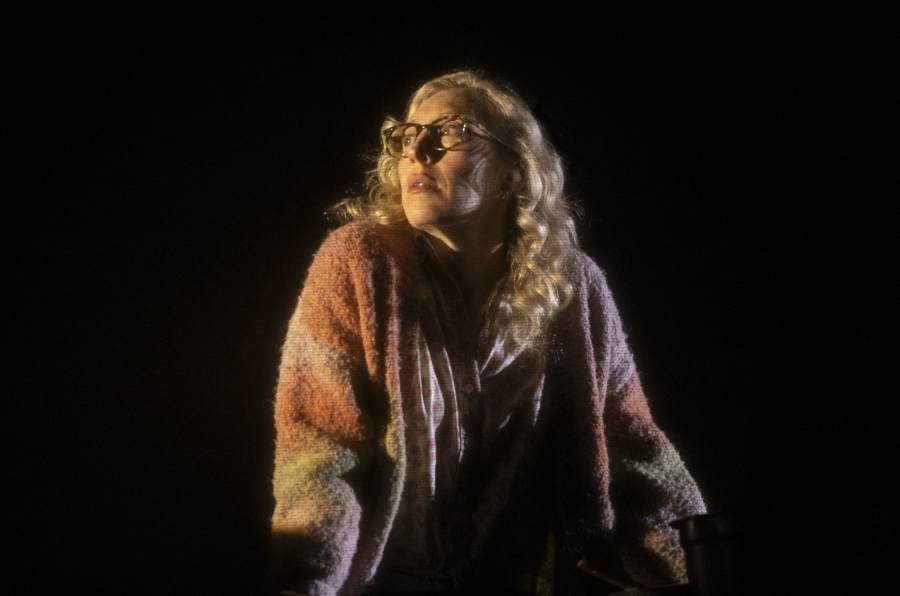
I expected ANON, Anne Washburn's new play, to be about the dangers of people posting anonymously online. Anonymity allows the poster to say whatever they wish, true or not with no fear of retribution. Actually the main character in the world premiere of the play is just the opposite. Jean Richards (well-portrayed by Crystal Finn) craves attention and constantly checks to see how many views her posts have garnered. Jean has a mission to save the world and tracks the number of her followers, hoping that she will make a TikTok post that goes viral. She sadly recalls when she had more than 100,000 followers on X, formerly Twitter.
Jean has become so obsessed with her messages that she is alienating her family. Ironically, Jean is reluctant to stop using her devices while her 15 year old daughter Delia (very talented Izabel Mar) is reading books. In the first scene, Delia storms into the house and slams her bedroom door. Sitting at their kitchen table, Jean texts her, rather than going in to speak with her.
The plot unfolds when the new neighbors, Adam (Jeff Biehl) and Will (Jeremy Shamos), recently transplanted from Philadelphia, read Jean’s posts on TikTok. Emotions escalate on both sides when the couple hangs a gay pride flag outside their home.
The two men become concerned about what their fanatic neighbor will do. So Mike buys a Glock because it’s easy to have a gun in a suburb of San Antonio,Texas. The flag becomes a symbol of much that Jean opposes and represents something she can use to make a viral statement. Borderline hysterical, she goes out in a raging storm to pull it down.
Based upon Q-Anon, a far-right conspiracy movement, “Anon” makes the movement more human as the play shows how individuals react to the theories. This is “Bidens’ America,” Jean explains to her few followers as she continues, “We The People aren’t going to put up with it much longer.”
While Jean is fixated on conspiracy theories, her bright daughter Delia is working on an assignment to write a soliloquy for a character from King Lear. Washburn skillfully juxtaposes Lear and his paranoia against Jean’s behavior. The play also invites a comparison of a TikTok post to a soliloquy. (Delia’s definition says “A soliloquy is the place where thoughts are forged into weapons. Which we turn against another, or ourselves.”
King Lear becomes mad as a storm rages outside. For Jean, the storm is internal as well as external. But she isn’t the only one who is growing increasingly paranoid because so is her neighbor Will.
It is natural to compare the Q-Anon movement of 2016 which believed society was being controlled by a group of billionaire elites in the Democratic party to the present day. It is also easy to understand how fear and paranoia can lead to potential violence. The projection design (Jared Mezzocchi) and lighting design (Cha See) with floating projections of days and times make it easier to not lock in a specific time frame.
The performances are good, especially Finn who grows increasingly disturbed and slightly scary as she becomes more immersed in her internet world. When not recording her own messages, she listens to podcasts. Urged by her husband Michael (Andrew Garman) to get a job, she refers to what she is doing as her work. Jean even has a dream sequence where she’s praised by a fictional Vice President for being an Information Warrior and Patriot.
Directed by Anne Kaufman, the play has confusing elements in the script which are never clarified. Michael visits the neighbors requesting they save their boxes for him after they unpack. Is he leaving? The characterizations seem a bit less than believable. Will, seemingly the calmer one of the couple, becomes fierce as he prepares to defend them from the rabid neighbor and 15 year old Delia seems much too mature, scolding her mother for reposting unchecked facts (read that as lies) about the Holocaust and appearing to be Pro-Hitler.
The Shakespearean references, though well-written and well-performed by Mar, become a distraction and take up too much stage time. While thought- provoking, the use of Shakespeare could have been more direct.
The play also made a point of why Will bought a Glock. Many in the audience were expecting him to actually use it, especially as Jean was standing outside their home on a stormy night. The play ended with Will standing in Jean’s front door as the rain poured down. Was he going to use the gun? In our deeply divided country, how will neighbors with such disparate views survive?
MCC Theater’s Newman Mills Theater
511 W 52nd Street,
New York, NY 10019