



The problem with bringing a movie to the stage is expectations. People buy tickets because they liked the movie, but then they come to a theater and are often disappointed because often the adaptation to the stage doesn’t live up to those expectations. Based on a true event Aaron Sorkin heard from his sister, a JAG attorney, A Few Good Men was first a stage play which then became an award-winning movie in 1992. Now, directed by Michael Arden, it’s back on the stage at the Vivian Beaumont Theater at LCT. Sorkin’s story about the military and blind obedience continues to fascinate, but it feels much smaller on stage than on the screen.
.
The play deals with the military protocol and the death of Pvt. Santiago, at the hands of two of his fellow squad members (Lavel Schley and Collin Kelly-Sordelet) at Gitmo (Guantanamo Bay) in the 1980s. Feeling threatened the entire time he was stationed at Gitmo, Santiago wrote a series of letters, begging to be transferred. Knowing his immediate superiors would quash his requests, he avoided the chain of command and sent the letters to high-ranking officers.
When his actions are discovered, Santiago becomes a pariah in his unit. In typical marine style, the unwritten punishment of a 'Code Red’ was ordered. In military parlance, Code Red means the men in the squad discipline their own. While they only meant to teach Santiago a lesson, an extenuating medical condition led to his death. Although never specifically stated, the two soldiers understood the orders, especially when Lt. Kendrick (a fierce John Zdrojeski) yelled that they “should get their house in order.”
Did the men assume the task on their own or were they following orders? Like the Germans in World War II who claimed they were “just following orders”, should soldiers blindly follow the directives of their superiors? Sorkin, known for his rapid-fire realistic dialogue, usually delivers a message with a moral dilemma. The show made me recall the video that Senator Mark Kelly and the other Democratic lawmakers made in 2025 urging servicemen and women to “refuse illegal orders."
The military sends in a pair of JAG attorneys, LTJG Daniel Kaffee (Tom Blyth) and LTJG Sam Weinberg (Nick Blaemire) to defend the two servicemen. Then Krysta Hernandez as LCDR Joanne Galloway arrives and insinuates herself into the trial making a couple of major errors which almost seems to be expected. A singing and dancing Broadway veteran, she seems miscast in this heavy dramatic role. As Davenport, she insinuates herself into the trial making a couple of major errors which almost seems to be expected. As Kaffee’s second, Blaemire is funny yet wise and experienced, offering quiet guidance to Kaffee.
At first, it seems like an open and shut case since the two soldiers aren’t disputing what happened. As the lead attorney, Kaffee (Tom Blyth) is an attractive wisecracking young officer who only joined the military to pay for his law degree. The selection of him is an obvious ploy by the Navy to expedite the case. Blyth slowly grows into the role. He is a bit lightweight to begin with but does get stronger as his character becomes invested. However, he never becomes dynamic. Even when Kaffee begins a defense, it’s not because of his legal skills; it’s because the second-in-command Maj Matthew Martinson (excellent Thom Sesma) ‘hands’ him the evidence he needs.
The commander of the base is Lt. Col Nathan R. Jessep portrayed by Bradley Whitford, a capable steady actor, who gives a good performance. He’s most effective when he digs at Kaffee, calling him “Danny” and advising him to have sex with a superior officer, referring to Davenport. He’s so nasty that he’s repugnant. Later, it’s difficult to accept that this cocky egotistical soldier would have reacted so quickly to Kaffee’s baiting in the courtroom. At times, it's hard to separate Whitford from his other roles where he is intelligent, soft-spoken and dependable, not vicious and hostile.
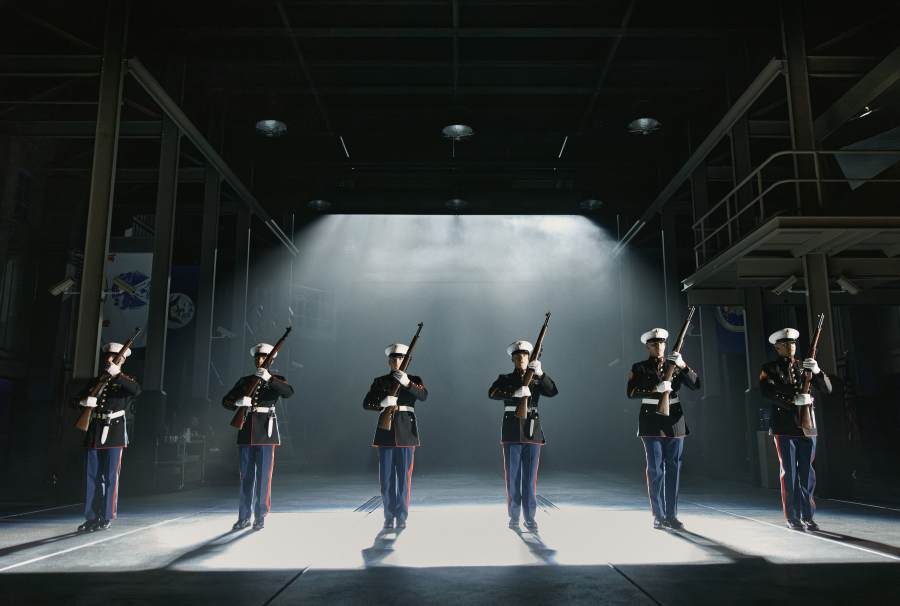
Throughout, the audience awaits the famous courtroom scene when Kaffee pitted against Jessep and works on his huge ego and Jessep blows up. The scene still works but lacks the drama of the movie. Film allows for close ups, clearly showing the anger, disgust and emotion of the two characters as the face off in the famous court room scene. The stage at the Beaumont is wide and deep, so we don’t get the close ups. The movements and physicality need to be bigger and more animated, so we don’t get the same emotion as in the film version. Director Michael Arden uses the pageantry of the military to stage Santiago’s funeral and the US army drills to fill the Beaumont stage.
Making a stage play from a movie has its drawbacks. Movies employ techniques that shows can’t always use -panoramas, special effects and close-ups even though technology has become more sophisticated. We entered the theater waiting for Jessep's famous line “you can't handle the truth.” However, no matter how good the movie is, it can't beat the thrill of a live performance.
Vivian Beaumont Theater
150 W 65th Street
New York, NY