



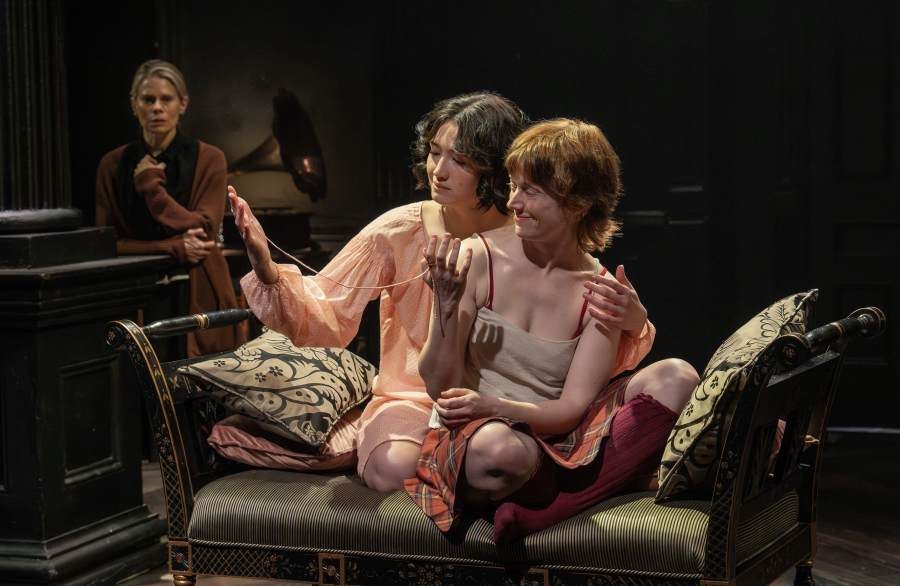
The play Antigone (This Play I Read in High School) by Anna Ziegler is not the play you and I read in high school. Although the major characters are the same, the play, directed by Tyne Rafaeli, feels modern because of a major change to the storyline.
In the Sophocles’story, Antigone refuses to betray her principles and despite the law forbidding it, buries her dead brother. Antigone is the daughter of Oedipus who unknowingly married his mother Jocasta. In Ziegler’s play, the brother is barely mentioned at all. Antigone’s story begins after the deaths of her parents when her uncle, Jocasta’s brother Creon (Tony Shalhoub) has ascended to the throne. Though admittedly ill-equipped to rule the country, he is determined to leave a thriving legacy and begins by reading a series of laws during his coronation (which Antigone purposely skips.)
This is where the two stories diverge. Antigone (a superb Susannah Perkins) is pregnant by her fiance Haemon, Creon’s son, and chooses to have an illegal abortion. In doing so, she breaks one of Creon’s laws and refuses to apologize. She feels the law is unjust. Despite his love for his niece but more concerned with showing strength, Creon sentences her to death.
Suddenly this classic play feels relevant as it deals with laws made by “half the population for the other half.” Another major change in the play is the role of the traditional Greek chorus. Here it’s a chorus of one played by narrator Celia Keenan -Bolger who plays Dicey, a present-day woman with her own story to tell. Though she claims to be impacted by Antigone’s strength and ability to speak out, the connection is confusing.
Chorus envies Antigone’s strength and determination since she is weak, saying "sorry” repeatedly and is perceived as invisible. She refers to Antigone as a role model, yet the two story lines don't mesh well.
Like Antigone, Chorus is pregnant. Her decision is to keep the child as a single mother. Traditionally, the major characters in Sophocles' dramas are dead and many of them die in Ziegler’s version as well. As Antigone dies , she is held by Chorus who then delivers her own daughter, naming her Antigone. It is a weak literary attempt to connect the two story lines.
The show offers some fine performances from Perkins who will continue to impress audiences with her passion and talent and Keenan-Bolger, an experienced and skillful performer. Shalhoub begins well as a weak man thrust into a situation he is not capable of handling but his character doesn’t move much beyond that. His son Haemon (Calvin Leon Smith) and Ismene, Antigone’s sister ((Haley Wong) do well playing off Antigone. The show makes good use of the three supporting performers (Kate Kresiler, Dave Quay and Ethan Dubin) who portray the Cops and other roles.
The intimate space at the Public Theater allows for the audience to circle around the small stage and feel close to the performers. Despite some disconnect of the two plotlines, the play does hold the audience’s attention but that was more due to the performer's abilities rather than the script itself.
No, this is not the Antigone taught in high school; it’s actually is timely and probably would appeal more to today’s high school students.
THE PUBLIC THEATER
425 Lafayette Street
(At Astor Place)
New York, NY 10003