



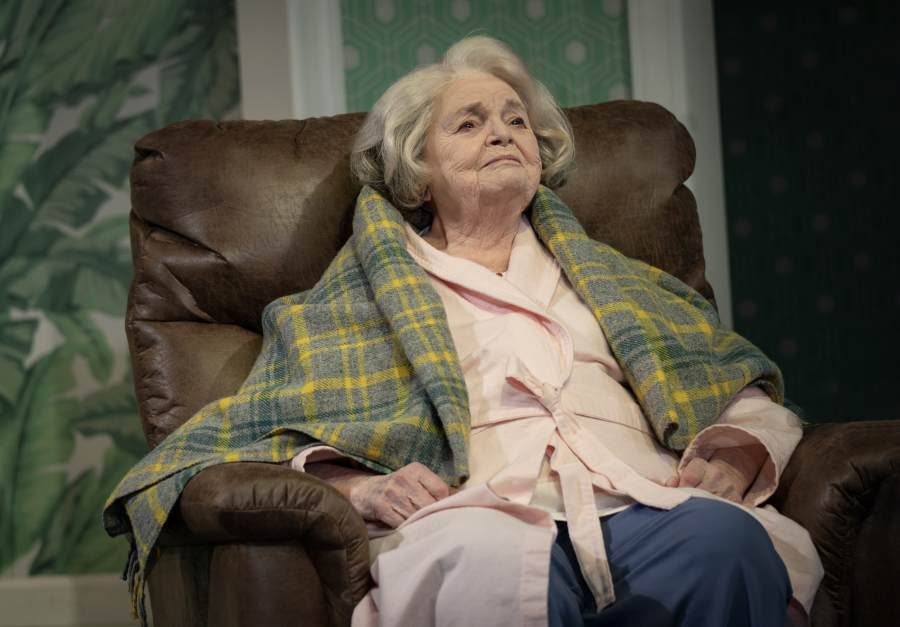
When you have trouble getting out of bed in the morning, just think about June Squibb, the 96 year old actress onstage each night performing 8 shows a week in Marjorie Prime at The Hayes Theater. As the title character, Squibb plays an 86-year old who is losing her memories. Although her husband is deceased, she is not alone since she has the companionship of Walter Prime, an AI robot modeled after her husband when he was 30. The play, by Jordan Harrison, is set in 2062 and given all the recent advances in AI, the notion of companion robots, Primes, doesn't seem farfetched.
When Marjorie says, "tell me about me," Walter (Christopher Lowell) tells her stories about the two of them. Marjorie is well aware that she’s losing her memory, yet she’s funny, making jokes and astute comments. What she doesn’t know is that some of the memories have been handpicked for her. Walter can only repeat what he’s been told and sometimes will remind her that he doesn’t have certain information.
Her son-in-law, the empathetic Jon (endearing Danny Burstein) told Walter that, in her youth, Marjorie had a suitor who was an 8th world ranked tennis player (not true) and that he even wrote to her after Walter’s death. Jon and Marjorie’s brittle daughter (Cynthia Nixon) have not yet told Walter about the suicide of Marjorie’s son. They have different attitudes about Walter Prime. Tess doesn't want to cherry pick the memories, while Jon wants to spare Marjorie pain.
Many in the audience came to see Squibb and they were not disappointed. In fact, it was hard to believe that she is 96 as she never falters in her recall of the dialogue. She’s witty, funny and with the use of a cane and a helping hand, moves about the stage gracefully. Her performance is sharp and precise. She’s a model of how to age gracefully and productively.
Burstein is warm and loving, and his character only sees the AI as a benefit. It’s a way to comfort and support his mother-in-law. As her daughter, Nixon is rigid, resenting her mother’s use of Walter. Her reactions are indicative of the contentious relationship the two had when her mother was younger. Later in the play, Tess becomes despondent about the nature of life and aging saying “There’s the half where you live and the half where you live through other people. / And your memory of when you were young.”
At first, Christopher’s Walter is a bit stiff but as the play progresses, he moves better, in keeping with AI’s ability to acclimate itself. He gets stronger as Marjorie loses more of her memories.
Interestingly, Marjorie wants Walter Prime to be a young man in his peak physically while she is in a state of decline. She is aware of what’s happening and begs of him, “I don’t have to get better. Just keep me from getting worse.” He is a substitute for the husband she lost and she knows that Tess isn’t happy about her growing dependence on him. When Marjorie recalls, she is extremely lucid. In fact, she tries to reprogram Walter herself by customizing their story. “What if we saw Casablanca instead?”
Directed by Anne Kauffman, the play offers much to discuss. For all the complaints about AI, Marjorie Prime provides a good use for it. The play which predicted the rise of the AI companion was a Pulitzer finalist in 2015. Harrison’s stage directions remind the director not to make the Primes robotic and creepy. The audience needs to believe in them and we only realize what they are when they remind us that they need more information.
As we age, do we want to be able to recall only the good memories of our past? It's an AI dilemma we will all have to face.
Hayes Theater
240 W 44th Street
New York, NY