



In Sophocles’ classic play, Oedipus tries to circumvent the fate the gods have ordained for him. He will kill his father and marry his mother. Tragically, he can’t because he has already fulfilled the predictions. The play, written in 429 BCE. is part of a trilogy of plays centered on Oedipus, the mythical king of Thebes. In its original form, it is unwieldy for a modern reader.
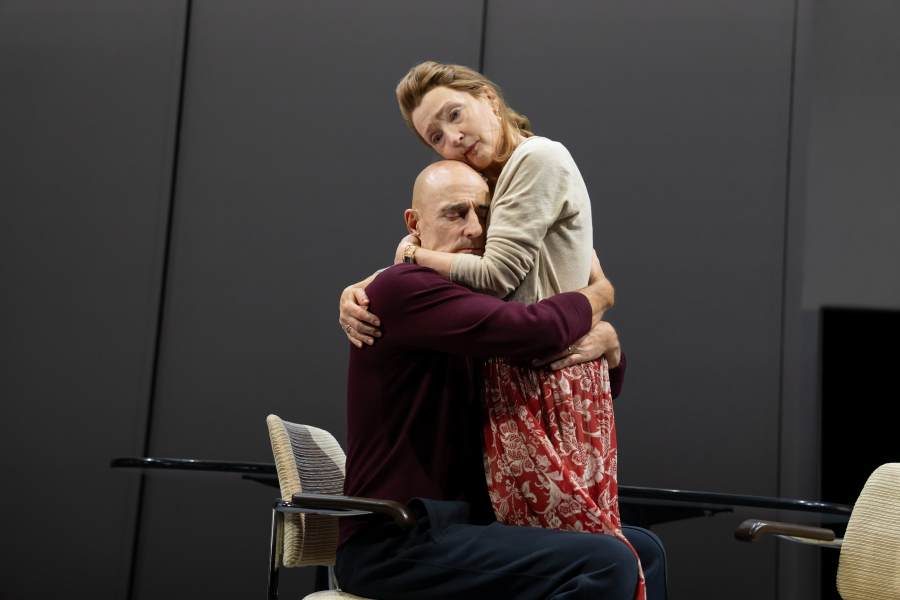
Using the prophecies as a framework, playwright-director Robert Icke has modernized the story, making it more relatable, totally gripping, but still frightful. The play is incredibly sensual and powerful, due to the two leads, Mark Strong as Oedipus and Lesley Manville as Jocasta, his wife /mother.
Oedipus is running for office. The polls are about to close.The onstage countdown clock builds tension as it lets everyone know how much time is left before the results are known. The office he seeks is the same as the one that Laius held ( Jocasta’s first husband.)
During the opening newsreel, Oedipus goes ‘off-script,’ telling the crowd that once elected, he will investigate the death of Laius, who held the office thirty years before. In addition, he will release his birth certificate to answer the concerns of people who want proof of his background. (Shades of Trump accusing Obama.)
Icke infuses the production with incredible eroticism and emotion. Jocasta and Oedipus are constantly caressing each other. This is one time that a play works much better if you know the plotline before you see it. There are several instances of dramatic irony, times when Jocasta refers to Oedipus as her fourth child or when she dares him to ‘sleep’ with his mother, not realizing that he already has.
The one set (Hildegard Bechtler- scenic design) is the campaign headquarters. The most significant item is the clock. The room will be stripped down during the course of the play as the campaign comes to an end. In an unnecessary flashback, Oedipus brings Jocasta to the same room as they plan for his foray into politics.
Strong is superb as Oedipus, arrogant and self-centered. When his adopted mother (Merope played by Anne Reid) announces that her husband has died, his first reaction is to ask if it was because of him. He’s easily angered, and when the blind sage Teiresias (a young tattooed man in a sleeveless t-shirt) delivers dire prophecies, he gets violent. He’s also nasty and suspicious, turning on Creon, Jocasta’s brother, who has been his loyal campaign manager. He viciously reviles Creon ( solid John Carroll Lynch), even accusing him of setting up the meeting with Teiresias.
Despite the awful fate in store for him and not at all one of his own making, it’s hard to feel much sympathy for him.
Oedipus and Jocasta have three children. The antagonistic relationship between Jocasta and her daughter Antigone is particularly nasty and never explained. There’s the gratuitous introduction of homosexuality into the plot. When their son Polynieces is ‘uncloseted,’ Oedipus is gentle and supportive, but the story line is not necessary.
Mark Strong is dynamic as Oedipus. Appealing, attractive, with obvious leadership qualities. Even better is Lesley Manville as Jocasta as his wife, especially when she describes in painful detail her awful relationship with her first husband. The obvious attraction of Oedipus and Jocasta is sensual and a bit creepy.The two are wonderful together and have great chemistry.
There’s also an example of “Chekhov’s Gun” when Oedipus’ son brandishes an ‘unloaded’ gun owned by a long-time servant. Writer Anton Chekhov said not to introduce a gun in Act I unless you plan to use it in Act II, so the audience is not surprised when there’s a gun shot later.
If you don’t know the story of Oedipus, you will probably be shocked by the ending. Those who know the outcome will appreciate the modern day soap opera written 2,500 hundred years ago.
Studio 54
254 W 54th St
New York, NY 10019