



Let's say you have all the money in the world. You've ruthlessly built a global corporate tech empire from nothing; it's taken you your whole life. Legions of employees do the hokey-pokey when you snap your fingers. Presidents are at your beck and call. But your knees hurt, you can't pull off low-rise jeans anymore, and you have to get up to pee several times at night. What kind of bullshit is that? Isn't there something we can do to fix that?
Spare Parts, at turns a broad comedy and a serious, probing drama from the playwright David J. Glass and director Michael Herwitz, now playing off-Broadway at Theater Row, interrogates a classic #BillionairePeopleProblem. Incredibly rich people can do anything, but they can't stop themselves from getting old and dying, and that's a huge, huge bummer for them. What they can do is use their colossal wealth, power and influence to come up with new, cutting-edge, and freaky-deaky ways to sometimes figuratively, and often literally, de-age themselves. If we agree that billionaires are a species who simply want because there is no end to wanting, then the last frontier of wanting things is more life – maybe another six months; maybe another 60 years.
Zeit Smith (a compelling Michael Genet) is one of the men who move the earth. He's the masculine, gruff head of a tech company that provides free internet to people around the world. Some early, subtle dialogue allows us to understand that he has connected the world's peoples by harvesting their data in exchange for internet access, thereby creating a global surveillance network that he runs. He's in the process of trying to get a couple of annoyingly reluctant stragglers to commit. At one point he tells his assistant to “call Malaysia back and get them on board,” with the same expectant irritation one might use to say, “Make sure to get the diet ginger ale this time.” But his actual job doesn't really matter to him, or us, at this point. He’s already won. The point is to give himself time to keep winning. He laments that he was born too early: what if, in another 50 years, we've solved the mystery of living another 50, 100, or 1,000 years? “I just want to make the cut,” he says.
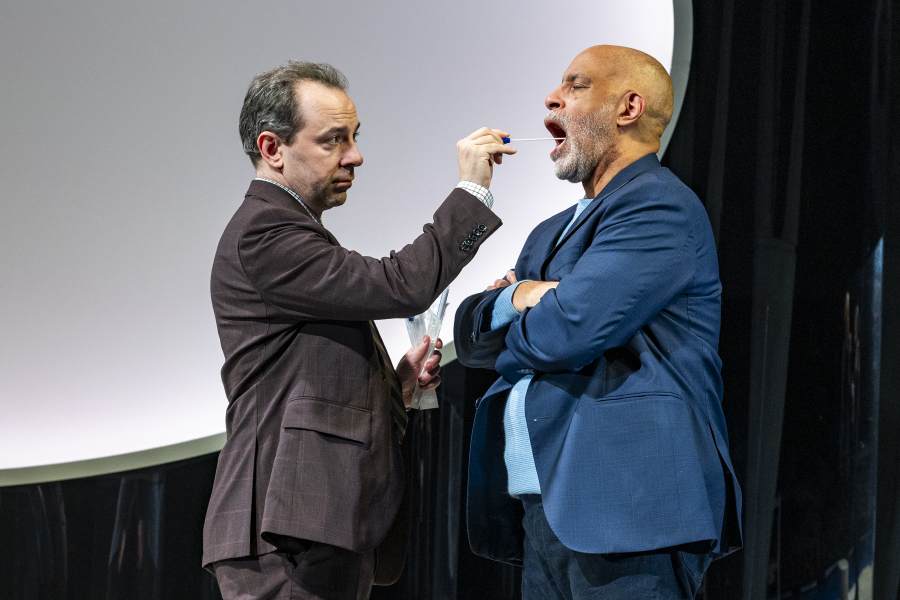
To do so, he and his assistant Ivan (a wonderful, sensitive Jonny-James Kajoba) have enlisted the help of two biologists specializing in gene studies, Professor Coffey and grad student Jeff (Rob McClure and Matt Walker). Their eventual plan is an almost-impossible, cutting edge procedure where the middle-aged Zeit will be connected to a younger person, with the hopes that their perky blood plasma will take the place of his, making Zeit physically into a younger man. McClure plays Coffey, a prickly, prideful, expert geneticist who agrees to help Zeit. Walker plays his assistant Jeffrey, a tousle-haired grad student whose aw-shucks affect sometimes seems sincere, and sometimes full of crap. It's a subtle performance: Jeffrey knows just how to ingratiate himself with the rich and powerful, but you can feel his own disdain for authority radiating off of him like white heat.
There's some broadly comic exchanges while the two enemy tribes of techies and academics circle each other warily. Genet impressively exudes the pissy impatience of a rich guy who can’t be impressed. His dialogue is dripped in the language and cliches of CEO-bro-dude podcasts – he demands that everyone justify their usefulness to him at all times, and reminds his assistant to “always exploit his enemies’ weaknesses,” like a fusion of Sun Tzu and Elon Musk. Coffey is his pained foil, a man who just wants to help everyone in the world – as long as he gets credit for it. A source of helpful energy and tension in Glass's script comes from the fact that Zeit and the professor, despite having been bred to hate each other's social caste, share a certain arrogance and a disregard for social convention.
Spare Parts soon shifts from a comedy about eggheads versus executives into its true dramatic theme: everyone has a bit of an urge to mess with the boundaries of the human body. How long can we hold our breath? How much Botox do we have to get before Andy Cohen knows our name? And, if we went from biplanes to space flight in under a century, how long do we really have to wait for eternal life? Coffey, initially cagey, reveals himself as a man with frustrated schemes of his own. In a carefully calibrated performance, Rob McClure slowly pushes his professor's mask of scientific rectitude to one side, letting us see naked ambition. This is the kind of guy who does things for the greater good – and we all know that can be used to justify, well, anything.
Glass's script cleverly plays with the tension between doing something we know is wrong and our natural desire to make things happen. After listening to a babbling, hype-filled scientific pitch from lab assistant Jeffrey (Matt Walker) about how Zeit can be made younger, Zeit's assistant Ivan says, “So what you're really saying is that this plan doesn't make any sense, and we should not do it.” Yet, of course, they do. The play wisely hints at a certain shared megalomania between billionaires and scientists, who theoretically would love to push the boundaries of human possibility.
As the extent of Zeit's life-sustaining schemes are revealed, the play builds to a final act, where the youthifying procedure must finally take place. Glass makes a smart structural decision to let that procedure be the play's capstone and not its midpoint. By building to a single event, a blood transfer is made to feel like a fight in a gladiatorial arena. And Michael Herwitz's direction feels sleek and restrained, without over-emphasizing too many robotic gadgets and scientific devices. This is a play about science and technology that is mostly interested in what we say and how we feel, and the shifts in lighting and musical cues harmonize with the characters’ struggles without telling us quite how to feel.
The dramatic twists of the play's conclusion do somewhat strain the nuanced drama set up by its first hour. People do things that we're not quite sure we believe they're capable of doing, and a few twists of shocking violence - physical and emotional - may not feel wholly organic. But the cast - with Jonny-James Kajoba as a confident and compelling standout - convincingly portray the greed, vanity, and human curiosity that drive the characters into the radioactive wilderness of bio-hacking. When something threatens to go terribly wrong, we share the characters’ moral anguish that they have gone too far, as well as their egotistical fear that the experiment might not work at all. Like Dr. Frankenstein, they’re thinking: I know it’s wrong to create a monster, but we put so much work into this!
Spare Parts is playing at Theater Row, 410 W 42nd Street, NY NY, March 26 – April 16, 2026.