



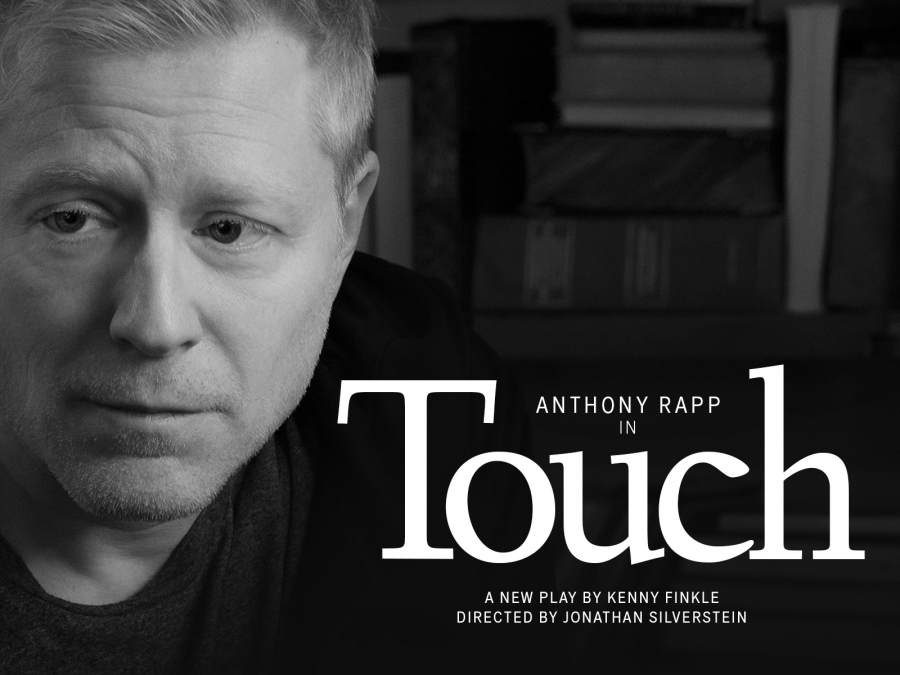
How can you trust a man who lies about doing yoga? In the intimate one-man-show Touch, directed by Jonathan Silverstein and written by playwright Kenny Finkle, the actor Anthony Rapp delivers the life story of an unreliable narrator.
Anthony Rapp, already well known from starring in Rent, made headlines in 2017 when he accused the actor Kevin Spacey of sexually molesting and attacking him when he was a 14 year old boy. There is an electric charge in Touch because we know that, and we know what Rapp went through. But his character in Touch is not just a victim, and the script is not a simple story about the trauma caused by an open-and-shut assault. Touch is not a fictionalization of what happened to Rapp: he takes on a character who himself has predatory impulses and instincts, who’s likable, funny and flawed.
“I love yoga,” states his character, a fifth grade drama teacher named Sydney Blatter. “It’s part of my morning ritual. I do ten minutes of yoga. When I can. I don’t do it every day….Actually, I haven’t done it in a little while.” Morning ritual, you say? As I have learned following a lifetime of plans to eventually go to the gym, here’s only a hair's breadth between “when I can” and “never.” Sydney Blatter, who we spend 100 minutes with in a confessional atmosphere during the events of Touch, is a man who is simultaneously opening up to us while lying to himself. Blatter, a failed, embittered writer, is a complicated character who draws on our sympathies while also provoking our outrage. Over the course of the play, we watch him try to sexually seduce and coerce a young person, and then fall victim to his own victim’s published version of the event. He victimizes, and is then made a victim.
Sydney Blatter wanted to be a successful playwright or a novelist, but, really, he wanted to be famous, sophisticated, and invited to everything. He has ended up unpublished, unsatisfied and a victim of panic attacks on the subway. In Touch, Sydney happens to come into contact with Joseph, one of his former students, now in his early 20’s, who looks up to Sydney, aspires to be a writer and asks him for advice. Sydney is attracted to Joseph and contemplates using his role as mentor to initiate sex. Joseph, meanwhile, in a roundelay of problematic come-ons, is in the orbit of a powerful literary agent, Jackson, with whom Sydney used to be close friends – and possibly more. Jackson has everything Sydney wants – fame, literary clout and a house in the Hamptons. Eventually, Joseph writes a story which contains an accusation – framed as fiction, but it obviously refers to Sydney – of a sexual, inappropriate touch from a teacher to a student. We hear multiple versions of the story. What did Sydney actually do? We feel he’s capable of predatory behavior, but we spend enough time with him that we know he’s not an evil man. We like him. He’s funny, he’s not un-self aware, and he’s obviously a smart guy. Who did what, and what counts as coercion, versus just connection? Touch navigates the thorny reality that victims of abuse are often perfectly capable of abusing others, while still holding a claim to our compassion.
In Sydney’s daily life, he rides the train back and forth to his teaching gig in the Bronx. The details of his current life are vague: we don’t learn his husband’s name, where he lives or what he does when he’s not teaching. What does shine through are his grudges, resentments, and unrealized ambitions. In the Ben Kingsley movie Elegy, where Ben Kingsley has a wildly inappropriate age-gap affair with his young student Penelope Cruz, Kingsley’s character says, “When you make love to a woman, you get revenge for all the things that defeated you in life.” (I always say that to people. Strangely, it hasn’t caught on.) For Sydney, sex is a way to get a win after a lifetime punctured by loss after loss. When Sydney talks about his daily life, he seems whiny and petulant; when he talks about sex, status and power, we catch a glimpse of the real person underneath.


The play opens with Sydney’s description of a panic attack that he had on the subway. “The train is getting hotter, more people are getting on, the sounds of the train feel like a trash heap, just piling on top of each other, one after another… I feel light-headed,” he says, “and I want to say to all the people on the train that I’m probably going to pass out, but when I look at all their faces, everyone is so tough. There’s no kindness anywhere for me to hold on to.” Eye roll: Sydney is a lifelong New Yorker; are his feelings really hurt that the denizens of the subway seem uninterested in his problems? They don’t care! They’re listening to the new Harry Styles album, which is excellent. I have watched people blithely munch Lays potato chips while I sobbed in front of them on the #1 train. Sobbed, and they didn’t even offer me a chip. But, to be clear, Sydney’s fraught descriptions are the well-written faults of the character, not the play: Kenny Finkle’s subtle script understands that Sydney’s over-developed sense of victimhood is really about his emotional wounds from the past.
The show, hosted at the East Village Basement, is very intimate; you’re seated a few feet away from Rapp. There’s no stage or set dressing, but Rapp’s chops as a storyteller and Finkle’s immersive script are enough to evoke scene and setting. One acting choice feels slightly odd: Joseph is a Hispanic kid from the Bronx, but when Sydney speaks in his voice, he gives him (to my ear) a stereotypical accent that we associate with elderly Jewish neighbor ladies. (It’s such an odd choice that there is a stage direction in the play’s script, explaining that Sydney is not doing impressions of the other people in his life when he relates what they said. Okay, but why does Joseph sound like my great-aunt Ruth?) Rapp otherwise does extremely subtle, impressive work in Touch: as an actor, there is a really strong urge to make yourself likeable and charming to an audience, and it’s a testament to Rapp’s respect for the material that he doesn’t make Sydney more charming than he should be.
Finkle’s script is dotted with Sydney’s evasions and deceptions. His struggle to do yoga comes up more than once. “It gets hard to get to the mat sometimes,” admits Sydney. It gets hard to get to the mat sometimes? It can’t be that hard. The mat is on the floor. The truth of the man lies in his resentments and recriminations. He’s still angry over the relationship-ending argument he had with Jackson years ago, over how much Jackson was paying him to write for his literary magazine. “I told him…we all knew his parents were supporting him and his little project, which was true, and he told me he knew my parents were supporting me as well, which was true, but only to a point, so I told him to fuck off and that everyone knew he was a fucking crack whore, which was sort of true.” That’s Sydney at his most honest, and therefore at his most likable. Or the moment when Sydney the seducer takes a break and Sydney the writer comes out to critique Joseph’s style: “He writes exclamatory bombastic prose with a bravado that I find distasteful but happens to be very in vogue in our culture.” Yes, honey! Scathe! If we didn’t like Sydney so much in those moments, the play wouldn’t work as well, and we wouldn’t be as conflicted when we realize that he might have been coercive in the past when Joseph was his student. (It all depends which version of the story you believe.)
Touch works as a commentary about success as well as about sex, and how it’s easy to pursue one because we think it leads to the other. There’s a very well-written scene where we get to actually watch the thought process of a predator in action, when Sydney and Joseph meet at a coffee shop. “I find myself thinking about how I can get him to come back to my apartment. I start to reason – it’s not very far and it’s so noisy in here, we can talk more at my place.” Finkle’s script gives us the chance to listen to the mental machinations of someone who is actively preparing to bullshit someone in order to sleep with them. Our sympathy for Sydney, and our complicity with him, elevate Touch beyond a morality play about victimhood.
Playing until March 30th, 2026 at the East Village Basement located at 321 E 9th St, New York, NY 10003.
Featuring Anthony Rapp
Written by Kenny Finkle
Directed by Jonathan Silverstein
Produced by Jack DePalma and Andrew Stein
Executive Produced by Mix and Match Productions
The creative team features Thomas Jenkeleit (Scenic and Props Design), Bart Fasbender (Sound Design), Jennifer Paar (Costume Design), Hayley Garcia Parnell (Lighting Design), and Shane Schnetzler (Stage Manager). The production team includes Jack DePalma and Andrew Stein as Producers. Mitch Marois, Maxwell Beer, and Lana Russell serve as General Managers and Executive Producers for Mix and Match Productions.