


Love transcends death. So do estates and trusts, intellectual property rights, and your grandmother’s ugly furniture. It’s just our actual bodies and consciousnesses that go kaput. (But don’t worry – Sam Altman is planning to disrupt death, as soon as he’s done disrupting life.) There’s a whole genre of love stories where beloved family members return as a ghost - from Cathy in Wuthering Heights to Emily in Our Town. Sometimes those who've left us have more to say.
Love Story – by the playwright Aurora Stewart de Peña and directed by Rose Burnett Bonczek – plays with a variation on that theme, to tell a poignant narrative about how our relationships connect the living and the dead. In the world of Love Story, people who have died are able to interact, briefly and ephemerally, with the living, by re-enacting scenes from their past lives. We’re introduced to a young woman, Maria (a wonderful Ally Callaghan), and a nameless older actress (Yassmin Alers). Maria is dead, and she and the actress have found an affordable studio space in the afterlife, where they’re conducting a kind of heavenly table read.
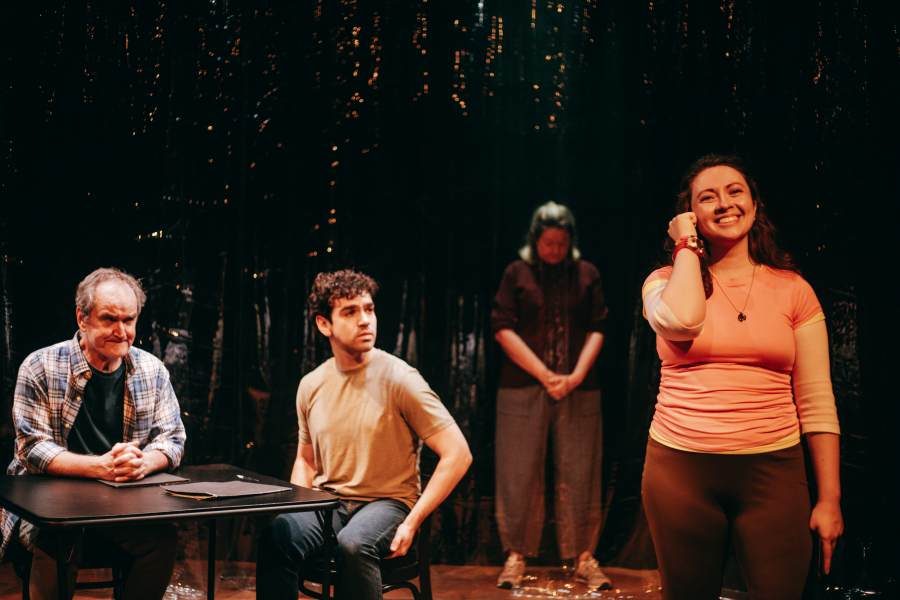
Whether all of this is really happening in some metaphysical ether is kept deliberately vague. In some moments, it feels like Maria’s relatives know that this is all an elaborate charade, or a group memory exercise, and are playing along, acting out the scenes from their lives. In other scenes, it feels like Maria’s family has no idea that she’s actually dead. And sometimes, the scenes from the past just feel like flashbacks.
So, sometimes the scenes are fake; sometimes they’re real. Maria is dead, and Maria is alive. That ambiguity throughout Love Story feels appropriate to the emotional un-reality of grief: your loved ones are alive in your mind and your heart, even when they’re dead. It’s confusing, because grief is confusing. The concept isn’t really explained, the way it would be in a work of science fiction or metaphysics, but it makes sense for the story. It’s like an emotional watercolor – memory, connection, imagination, fantasy are all smudged together.
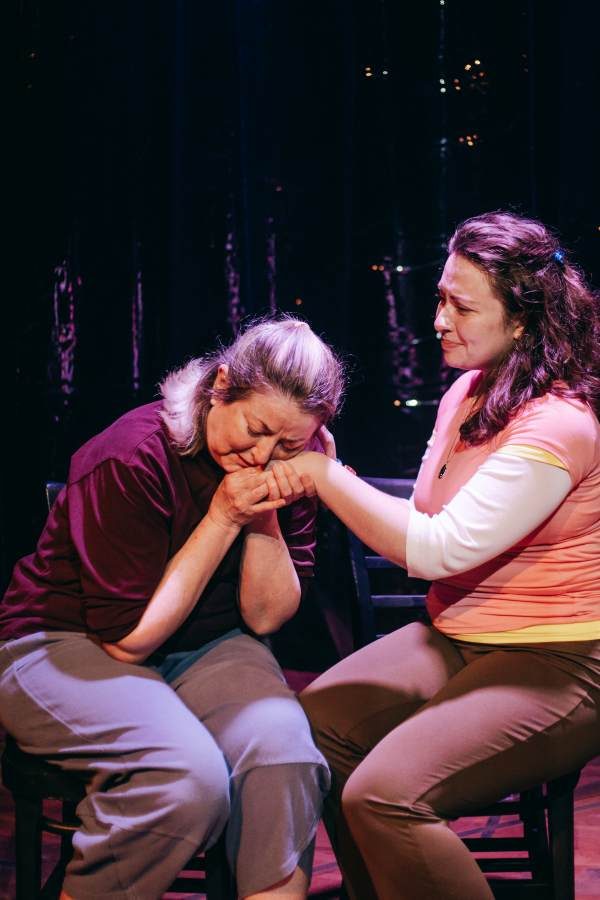
Maria and her mother, Noelle, have a very loving and also very combative relationship, i.e., a mother-daughter relationship. Maria had wanted to be a makeup tutorial artist on YouTube, and mom Noelle (Ramona Floyd) thinks that’s a pretty dumb thing to do when you grow up. The two lock horns in one of the fundamental contemporary forms of human conflict: Millennial versus Boomer. Their verbal swordplay is sharp and cutting. (Maria: “I’m going to start making make-up instructional videos and uploading them to the Internet!” Noelle: “Where people can see you?”) The disagreement between Maria and her mom, and how both of them feel about each other before and after Maria dies, is the emotional core of the play. Ramona Floyd is very effective and believable as a complicated, deeply loving mother – tough on her daughter in life, grief-stricken after she dies. We watch Noelle slowly realize that even something as seemingly frivolous as makeup art has its own spectrum of skill and artistry. Later, after Maria’s gone, her mom describes and defends her daughter’s signature makeup look – an eyeshadow style that’s meant to look like a sunrise. “It looks exactly like a sunrise,” she says, with a mother’s fierce pride. “That look took her forever to perfect.”
Maria is a vibrant person: bubbly, bright, optimistic, and sometimes sassy. She wears her feelings on her sleeve. Little things are special to her – she gushes over lip liner; Caboodle makeup kits (“All my Urban Decay shadows are in here!”), and Spice Girls CDs. Maria is a millennial, and Love Story is very attentive to the music, language, and the cultural objects of the late 90s to the early 2000s. If you remember the feeling of putting your thighs into the punishing denim cylinders we used to call “skinny jeans,” you will feel warmly rewarded by the play’s many references to the early aughts. One stage direction states, “Maria is reading Face Forward, the 2001 book by the iconic makeup artist, and Kate Moss’s best friend, Kevyn Aucoin.” The very specific way that Maria loves all of these little things makes us love her back.
Aurora Stewart de Peña’s sensitive script – and the table-read conceit, where the dead Maria interacts, somehow, with her family – underline the ways in which those we have lost are always with us. And, more than that, they change us – hopefully, for the better. In life and in death, Maria is working away at Noelle’s snobbishness and contempt for the arts, and convincing her mother that there’s meaning in picking something you love and following it. In a poignant scene, Noelle (who seems, at that moment, to understand she’s speaking to her dead daughter), admits she was wrong: “I think smart looks a certain way. But what do I know?...The best thing I can do is get out of your way.” Letting yourself be affected profoundly by another person – so much that you change the way you act because of them – means a connection that lives past death. We don’t get the chance to have rehearsals for our lives, but perhaps we can take some comfort in knowing there’s no such thing as a final curtain call. Maria fought through the doldrums of high school and the pain of growing up; she held onto her passion, and as a result, her loved ones will never forget it.
Love Story is produced by The Tank and Voyage Theater Company, running between April 23rd and May 17th, 2026
Written by Aurora Stewart de Peña
Directed by Rose Burnett Bonczek
With: Yassmin Alers, Ally Callaghan, Ramona Floyd, Julio Cesar Gutierrez, Mickey Ryan
The Tank is at 312 West 36th Street, 1st FL, New York, NY 10018 / www.thetanknyc.org