



Playwright-actress Marin Ireland channeled her own experiences with domestic abuse to create the 75 minute play Pre-Existing Condition. The title refers to how certain US states, as late as 2010, classified domestic violence as a way for insurance companies to deny victims coverage.
Domestic abuse is more than physical and mental trauma. It’s the aftermath. How does it influence a victim’s relationships, her moods and her social interactions?
I was leery about seeing the show because I feared that there would be violence on stage. Yet there is no physical violence-only indifference and misunderstanding. Marin never even gives a description of what happened. When asked what happened, “A” simply says “he hit me.”
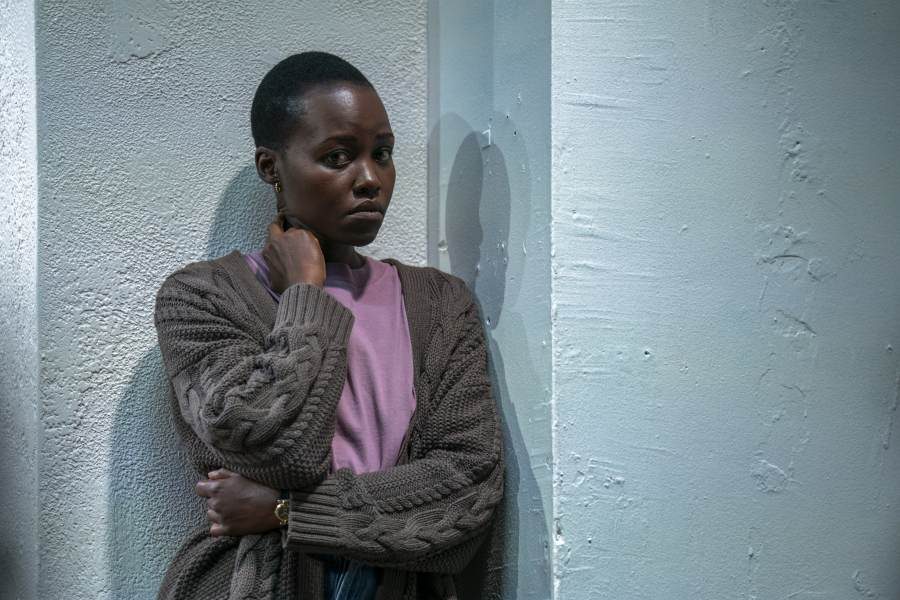
As the first performer of an alternating cast, Lupita Nyong’o (Helen of Troy in “The Odyssey”) plays “A.” The actress works hard and expresses many conflicted feelings and gives a fine performance as she alternates between a sense of numbness and calm. Repressing anger and shame, she seems tightly wound yet never blows.
There’s enough to make her lash out in anger. “A” is told that there’s nothing that she can do. Even worse is when a friend tries to get her to forgive the contrite boyfriend who hit her, she is actually trying to make her feel guilty.
When “A” seeks help from friends and family (played by an ensemble “B,” “C,” “D” who play multiple roles) she gets little assistance or understanding. When asked how her last relationship ended and she says he hit her, one ‘friend’ responds asking, “what did you do?” It’s a reminder that often the victim is blamed. There was an audible gasp from the audience.
The intimacy of the Greenwich theater reminds us to concentrate on the story in front of us. There's a nearly bare stage with several chairs that the actors move around. The performers wear nondiscriminate street clothes and never change even when they become different characters.
“A” should get support from her family and friends but she realizes she will get no help from them. So she doesn’t even confide in them. (Her self-absorbed mother is played by Greg Keller, the one male in the cast. His portrayal of the character provides comic relief.)
What resources are available for “A”? Her lawyer suggests that there's little she can do and the therapist says the same. “A” admits she doesn’t even know what she wants.
The help she gets is from her therapist and the two leaders of the weekly support group she attends. (Sarah Steel and Dael Orlandersmith.) The message of the show and the wealth of free literature in the theater lobby promote support groups and therapy.
Steele plays a therapist, a counselor and a friend. She’s an energetic performer and sometimes is able to shift characters. Orlandersmith is a powerful actress and I wonder what dimension she could have brought to the role of the mother.
The subject is heavy and the information important, yet I didn't feel enough emotionally. I was distracted by Keller as the comic mother and later the gratuitous introduction of him as her father who had no role in her life. Perhaps adding extra performers as her family and friends would have given greater depth to the play.
Shouldn't we have felt anger about what happened to “A” and how her whole life had changed? Domestic abuse is all too prevalent and many cases still go unreported as women stay with their abusive mates often because of the kids.Maybe powerful plays like Pre-Existing Condition will work to help victims and provide support and understanding.
Greenwich House Theater
27 Barrow Street,
New York, NY 10014