



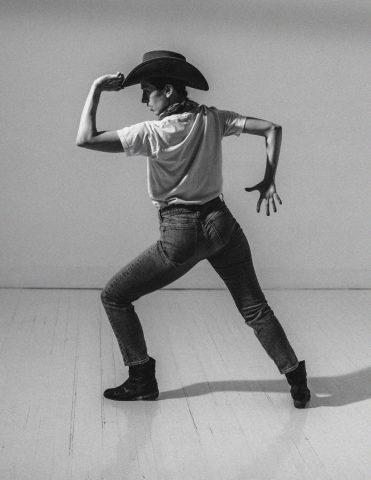
“The Cowboy is a lonesome figure, out riding his horse for days on end in the hot sun. He is strong and brave and admirable but also has outlaws and other shadowy figures after him.”
Such is the apt description given by interdisciplinary artist and dancer Kendal Hartse (Summer: The Donna Summer Musical, Rodgers + Hammerstein’s Cinderella), who’s preparing to premiere her self-devised piece, Cowboy, named for this brooding rowdy wrangler, at the Royal Family Performing Arts Space for three nights later this month.
Co-created and directed by Austin Regan (Broadway’s upcoming Galileo), and presented as part of the eclectic new theatre group, Harlow Radical, the work is described as an amalgamation of the dance theater of Pina Bausch, Western movies, Hartse’s family history, and, of course, her own history as a Broadway dancer, the physical and mental toll it took on her, and the terrifying accident that almost ended her career.
An examination of “the loneliness, the legacy of injury and chronic pain from a vocation that also brings you deep joy, and the glory of doing what you were really meant to do despite what it costs,” according to Hartse, she further declares: “This piece is going to be a unique theatrical experience…. a deeply emotional study of what it means to love something you cannot sustain, which I think a lot of people can relate to.”
Read on as Hartse further discusses healing, hardships, and hope, as well as launching a theatre company, what dance really means to her, and why there’s a little “Cowboy” in all of us.
Can you speak a little bit about your background and your history as a Broadway dancer and performer? What led you to this point and made you who you are today?
I started my career as a dancer. When I was in high school, there was a professional summer stock company nearby and I started working there [during] the summer I turned 16. I worked in summer stock all through college as well, mostly as a dancer, and then my early Broadway credits were as a dancer in the ensemble.
As an artist, I always considered myself an actor first, but dance has been the foundation of my career. There is such value in dancing in an ensemble and being the backbone of a show. I learned so much about discipline and focus and how to bring my entire body to my work, which is, of course, invaluable in performance.
Can you speak a bit about the origins of this piece? What specifically inspired the idea of a dance piece? And what’s the impetus behind the use of all these elements?

Forging a path in the arts as a multidisciplinary artist can be confusing and lonely at times. You don’t always feel like you fit in everywhere, especially in the commercial theater space. Additionally, I have dealt with serious injuries throughout my career leading to chronic pain, and that experience has been similarly isolating.
A running theme for me at times of intense pain has been that I’m like an old cowboy, out on the lonesome prairie, whose been riding too long. When I started to put all of these ideas together [for the piece], I started to envision a dance piece about a cowboy, who is out there doing his own thing, like I was, lonesome and hurting.
Also, The Cowboy as a stoic and silent icon translates well to dance and the strong visuals of Westerns are inherently theatrical. And my relatives were literal cowboys on a ranch in Montana, who took part in cattle drives. There’s something to this deep sense of vocation that connects dance and cowboy work. I began to connect my experiences as a dancer to the experience of the physical labor and toll of being a cowboy which helped shape this piece.
How has your time in the Broadway sphere influenced this piece? What, if anything, have you used specifically in crafting this piece?
A big part of it is my journey as a dancer, informing the story of physical effort and pushing ahead through the struggle, just as the cowboy does. But in a practical way: I know how to treat my body like an elite athlete to execute eight massively physically demanding shows a week. I understand my limitations and pushing to the edge of them and through them.
And with Cowboy having just a handful of performances, there are things I can do that I wouldn’t be able to do in a Broadway schedule. I can push my body to different extremes, which is exciting to experiment with.
Similarly, what’s one thing about Broadway dancer life that surprised you? What’s one thing that you think other people would be surprised to know?
The physical toll it takes on you. Broadway dancers repeat the same movements over and over with no off-season, which leads to repetitive stress injuries and muscle imbalances. In shocking ways, it’s like being a factory worker. Your body is doing physical labor. Sure, it’s also fun and artistically fulfilling, but your body is still going through it in a very intense way.
Why was it important to you to present this story in this way? How does presenting it as theatre piece elevate it, or make it more accessible or digestible, in a way that it wouldn’t be if it were presented in another medium? What does it accomplish?
To me, Cowboy was always a dance piece. I was greatly inspired by the work of Pina Bausch, as I say, and I wanted to make a piece that was not only a a story through dance, but was also a piece [comprised of] pedestrian movement and also physical theater elements. I’m creating a world and a character that is an accessible metaphor for passion, pain, and where they intersect. Theatrically-infused dance is the most physically compelling way to share this character and journey.
Can you speak about your relationship and collaboration with Austin? How has his influence informed your work as a performer, and the piece as a whole? How do you feel you’ve helped each other in contributing to and forming this piece?
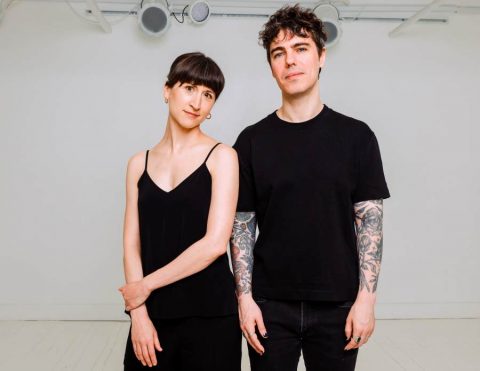
Austin and I have been partners for over 20 years and have a beautiful shared vocabulary when it comes to art. We have so much in common in terms of taste and influence, and we have a clear idea of the kind of work we want to create and put out into the world. A lot of this process has been me alone in a studio choreographing, then showing Austin my work, where he will make suggestions and offer ideas for me to take it back and refine. Working with him is so wonderful, as he always encourages my risks, pushes me to take things further, and respects the vision I have. He knows when to offer suggestions and when to step back and let me do my thing. (Laughs).
Can you speak about launching a theatre company, and what inspired that move? What does having your own launching pad allow you to do that you perhaps couldn’t do elsewhere? How about the challenges and hardships?
This endeavor has been illuminating and hugely rewarding. So often as actors we find ourselves waiting. As a person with many different ideas and mediums that I like to work in (writing, singing, dancing, choreographing, making music, etc.), I have often, as I’ve said, felt limited in the commercial theater space. Austin and I wanted to make opportunities for ourselves and also we are at a time in our artistic careers where we are generating a lot of ideas and need an outlet for them. It is financially and logistically challenging to be a two-person operation, but very worth it!
What have you learned from your previous outing, UH OH! at the Gym at Judson, that you’re using to fuel the creation of this production?
The response to UH OH! was so fabulous, and I still have [people today] who consistently tell me they saw it and loved it.
It’s deeply satisfying to make something from the ground up. Part of our mission with Harlow Radical is to create work that might not necessarily feel like it fits into an obvious genre category, and seeing that people loved UH OH! even though it was not a typical musical or cabaret fare was hugely encouraging. Even before UH OH!, I had begun working on Cowboy.... and when UH OH! went well, that’s when I knew that we had to keep going!
As you and Austin have said, Harlow Radical aims to create “electric, ambitious, intimate, avant-grade work” that evokes an “edgy and radical downtown aesthetic” and challenges the mind, but is also entertaining. Why do you find this type of work exciting? what about it appeals to you and draws you in? And why do you feel it’s important for audiences to explore this form and other different types of theater like this?
I think that making this kind of work is thrilling because it challenges both artist and audience. I am often drawn to less conventional modalities of entertainment and the excitement of not just consuming this kind of art but making it cannot be understated. While big shows with big budgets can be artistic and fulfilling to audiences, I think there is a hunger with audiences for intimacy, weirdness, and radical honesty.
Why was important for you to tell this story? And why is now the right time for it?
For me, this story and this show is happening at an exciting time in my life. When I was 21, I fractured my spine on the national tour of Cats. I didn’t know if I would ever dance again. I healed as much as I could, danced on Broadway again and then on tour again, and then thought I was done dancing around age 35. But every dancer knows, even if you stop dancing professionally, that you never really stop being a dancer. And I realized I wasn’t done dancing... but I was done sacrificing my body to other people’s choreography. In other words, I was ready to dance again, but on my own terms.
Going back to Pina Bausch for a moment, I have seen performances from her company with dancers in their 40s and 50s, who, despite the absolutely electric talent of the younger dancers, end up being the most compelling performers on the stage. I also remember seeing Baryshnikov do a fabulous Robert Wilson piece called “Letter to a Man” and seeing his graceful, beautiful, and simple movement as a man in his 60s was an absolute life-changing event for me.
So, as I reached 40, I wanted to make a piece that encompasses what it is to dance in an older body, and the beauty that there is in spite of (or maybe, because of) physical limitations that a more youthful, uninjured body doesn’t [have], and [explore] how inspiring that can be.
What does dance do for you? How does it speak to you? Why do you dance?
Like most dancers, I dance because I have to. When I was a kid, I had a lot of energy and my parents put me in a combination tumbling and dance class at age four. I fell head over heels for ballet and the idea of how one can use their body to tell a story. I think there is something incredibly sacred about movement, and I think that dance is a powerful expression of the human spirit.
What’s one thing you’ve learned about yourself through creating this piece?
I am learning how my body likes to move… how to tend to it and care for it, how to push it and when to back off.
My high tolerance to pain meant that when I broke my back onstage in 2008, I finished the performance before realizing how hurt I was. For years, I pushed through the pain and repercussions of that and other injuries until my body said “enough.” The decision to create the most physically demanding [piece] I have ever performed — at age 40, when I have had 20+ years of chronic pain building up — feels like a glorious return to tough resiliency.
I always considered myself to be pretty tough. But it’s been nice to be reminded: I’ve still got it.
Similarly, in the spirit of the piece, what advice do you have for anyone regarding moving forward despite setbacks? Why should someone keep going?
I think it’s important to learn how to get back up again, but also to learn how to rest.
Speaking for myself, I had to learn to rest before I could heal, and heal before I could recover, and recover before I could keep going.
My advice is that [life’s] a marathon, not a sprint. Setbacks are inevitable, but they’re often just a cue to slow down, not to stop. I find that if I can get to a place of tenderness and kindness with myself and my limitations, I can slowly move forward, and then past, any setback!
What are your hopes for the future of this piece? Where would you like to see it go next?
My current goal is just to get through it! (Laughs). Though I confess I have a fantasy to see the Cowboy again as time passes. Who is the Cowboy at 45? At 50? At 60? I hope I have made a piece with longevity in mind.
What do you hope to instill in audiences as they come away from this piece?
I think The Cowboy as a piece of theatre is both tragic and inspirational. I know it’ll appeal to fans of modern dance, but I also hope that a more traditional theater audience will resonate with it. I would love for audiences to have a sense of both hope and inspiration, but also a sensibility of resilience and chutzpah. Essentially, I hope everyone sees a little of themselves in the Cowboy.
Cowboy, conceived and choreographed by Hartse, and co-created and directed by Regan, plays the Royal Family Performing Arts Space (Upstairs at 145 West 46th St.) from August 22-24, at 7pm. For tickets and/or more information, click here.