


“Follow your dreams. / Let your imagination run wild. / Follow your dreams. / You're gonna make it, / Some way somehow.”
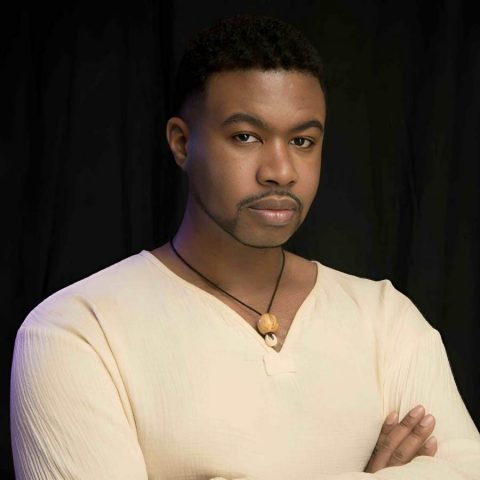
Such is the recurrent mantra of multi-hyphenate artist and producer Germono Toussaint. A fervent composer and playwright since birth, his plays have been prominently featured in the Not for Broadway Theater Festival, Horse Trade Theater Group, the All Out Arts Play Festival, and the National Black Theater’s Keep Soul Alive reading series, to name a few.
His 20 years of experience creating, arranging, and producing music have allowed him to cross paths with such eclectic artists as James Earl Hardy, Stanley Bennett Clay, J Keys, and Katori Hall, in addition to releasing his own album, Brown Liquor & Blessed Oil, and developing a forthcoming original musical, The Last Gatekeeper, self-described as “an immersive Black, queer Afro-futurist theater experience.”
Finally, he is a founding member of the Obie-winning The Fire This Time Festival, and serves as Artistic Director of A Mile in My Shoes, Inc., and owner of Brown Liquor Music, LLC — all while holding fast to the heart of those indelible words.
Now, he’s woven these words into his new, semi-autobiographical Songs I Wrote, a soul-stirring exploration of identity, survival and spiritual rebirth through song, to be presented in concert at Midtown hotspot 54 Below on February 8th, as part of the venue’s new Verses and Voices concert series saluting burgeoning new artists and engaging diverse audiences.
Ahead of the big event, we talked to Toussaint about his projects, his process, and why patrons should support independent artists and their work, with additional commentary from 54 Below’s Assistant Programming Director Alexa Spiegel, who elaborates on the origin of Verses and Voices series, and why we need it now more than ever.
Can you talk a bit about your background? What about your history as a person and a producer/creator led you from who you were then to who and where you are now?
I’m a composer, playwright, and producer from Milwaukee, Wisconsin, and I’ve been living and creating new work in New York City for the past 20 years.
I was raised in a deeply musical family, so music was never something I discovered later in life. It was always a part of my world. For a long time, I thought I was the only one in my family who pursued music professionally, but over time I learned that my uncle Sonny, who inspired my play, Sonny’s Song, worked in the music industry. Additionally, my cousin Donald Daniels wrote for Motown, and my cousin Wanda Smith wrote lyrics for Marvin Gaye. That lineage wasn’t something I grew up knowing, but it helped me to understand that this path wasn’t accidental. It is part of my heritage.
Similarly, how did you become involved with Verses and Voices?
I went to see my friend and longtime collaborator Dionne McClain-Freeney perform at 54 Below. After the show [54 Below’s Deputy Programming Director] Mia Porter approached me and asked if I had ever thought about doing something there myself. I said I would think about it.
A few months later, I received an email about the Verses and Voices series. It felt like an invitation that also came with a deadline, and honestly, I needed that push (laughs).
Can you speak about the origin of this series?
Spiegel: Verses and Voices came about because we were lucky to receive a grant from the Live Music Society to create a program that we’ve always wanted to do. The basis was our New Writers at 54! series, which we’ve been doing for a few years. We chose this [Verses and Voices series] in particular because 54 Below has always been [vocal] about the duality you can see on our stage. At the club, you can see a famous Broadway name at 7pm and an up-and-coming writer at 9:30pm. As costs continue to rise, we wanted to ensure that [audiences] would still always be able to see that new up-and-coming writer for a lower price.
54 Below states that this program “will bolster the cabaret and musical theater landscape by providing space for new voices, supporting the development of original music, and engaging diverse audiences.” Why is that important at this time in our world, perhaps especially for young artists and audiences?
Sometimes you need to see what’s possible in order to imagine yourself doing it.
When I was eight years old, I saw Dreamgirls and knew exactly what I wanted to do with my life. Later, in my twenties, seeing James Scruggs’ The 5th Man at 3-Legged Dog shifted my trajectory again and sparked my exploration into immersive multi-sensory theater experiences.
Everything we now consider a classic was once untested. There is room for revamping classics, but there should also be room for something new.
What was your inspiration or impetus behind writing and presenting Songs I Wrote specifically?
Too many people in my circle still don’t know what I do. And even though I’ve put some music and material out, the majority of it has never been presented in a live setting.

Also, honestly, a lot of my music was just sitting on my hard drive. I realized if something happened to me tomorrow, no one would ever hear [it]. So, this show is my way of saying, “This is what I’ve been building.”
Can you talk briefly about your process in assembling and working with this cast and group of performers and musicians? Did you write specifically with any of these voices in mind?
I invited artists I trust and have collaborated with over many years…. transformative performers who are at the top of their game, each with their own voice, following, and artistic vision.
And yes, some of the work was written with a specific artist in mind. I wrote “Out Loud” for Crystal Monee Hall. I created the EP Project 1:11 with Harriet D. Foy. For the band, I asked myself who the best musicians were that I’ve worked with over the years. There is history and, more importantly, trust, within this group, and that matters to me.
According to press notes, the piece takes audiences on a journey “from Milwaukee to NYC, from the church to the club, and from silence to truth.” Can you speak to those musical influences and why it was important to showcase your musical diversity in this piece?
My musical influences come directly from my upbringing and my family: gospel, soul, musical theater, funk, house [music], etc. I heard and retained everything.
For a long time, I struggled with the idea of “branding”… that pressure to be “one thing.” But I’m an eclectic, layered, multi-hyphenate artist. This show is me embracing that. In many ways, this is me expanding and claiming my space.
Can you speak to the mentorship and support offered through this series, and why that matters?
I studied music composition and trained formally [in my youth], but my real education happened in real time. When I moved to New York, friends who were already established threw me into rehearsal rooms with theater legends, Broadway artists, and extraordinary creatives. It was truly sink or swim.
Over the years, I’ve been fortunate to have mentors like Dr. John-Martin Green, Dr. Pei Desrosiers, James Scruggs, [and] Ron Simons, who have helped me navigate the industry. And I’m extremely grateful to have access to Joe Iconis through this series, who has been so open and generous. All these mentors have helped me own and acknowledge my gifts more fully, and they’ve [helped to] open doors to new opportunities for me to share those gifts. They have made me more aware of my blind spots, helped me avoid pitfalls, and given me firm reminders of my own potential. Collectively, that kind of access, advice and guidance has been invaluable.

You’ve spoken at length about your work as a space for healing and reconciliation. What advice would you give to artists navigating trauma through their work in similar ways?
Artists tend to go into very scary places within themselves, exploring their truth and sharing it through their art. When done responsibly, that exploration can help heal some broken pieces for the artist and the audience. That is a beautiful thing, but I also believe in therapy. Therapy helped me unlock trauma I had ignored, which I was then able to explore, through my work, in a healthy way.
Why should audiences support rising independent artists like yourself?
It takes a team to grow a career, and many independent artists don’t have one. Often, it’s just us and a few friends. Support, whether it’s showing up, sharing the work, or buying a ticket, makes a real difference. I’ve seen incredibly talented artists walk away from this industry simply because the load became too heavy. Supporting independent artists is a way of sustaining culture.
The series offers a pay-what-you-wish model with waived food and beverage minimums. Why is that significant, and why should it be supported?
Spiegel: One of the main things that we hear [is] a barrier to audiences is price. With our support from the Live Music Society, we have been able to remove those barriers, and hopefully get folks in the door who wouldn't be able to otherwise. Our mission statement says we’re committed to growing opportunities for diverse communities of emerging and established artists and to expanding their audiences, and this is a great way to do that.
Toussaint: When I first moved to New York, venues with covers or minimums weren’t even an option for me financially. Access changes audiences. It changes who gets to be in the room. That matters.
What do you hope audiences take away from this evening?
Toussaint: Easy. Follow your dreams.
Spiegel: In a general sense, I hope that audiences are able to expand what they think musical theatre can be and who they think can do it. The goal here is to showcase folks working within the art form beyond the names we already know, and to hear what these writers have to say through the musical medium. And hopefully one day those who were in the audience [for these evenings] have the bragging rights to say they saw them when.
Finally, how does this work inform your other projects, and how will you use it to move forward?
My work continues to evolve because I’m following what genuinely moves me. My other projects build on the same questions around identity, legacy, and belonging. Each one pushes a different part of my practice forward, whether it’s music, theater, or film. All of them are rooted in lived experience.
I’m hoping my concert at 54 Below opens doors to other opportunities for me to present my work. I’m putting that possibility out into the universe as I’m now ready to walk through those doors myself. As I write in the piece, you’re gonna make it, some way somehow.
Germono Toussaint’s Songs I Wrote will be presented at 54 Below (254 W. 54th Street) as part of the venue’s Verses & Voices series on February 8th. For tickets and more information, click here. For more on Toussaint, click here.