



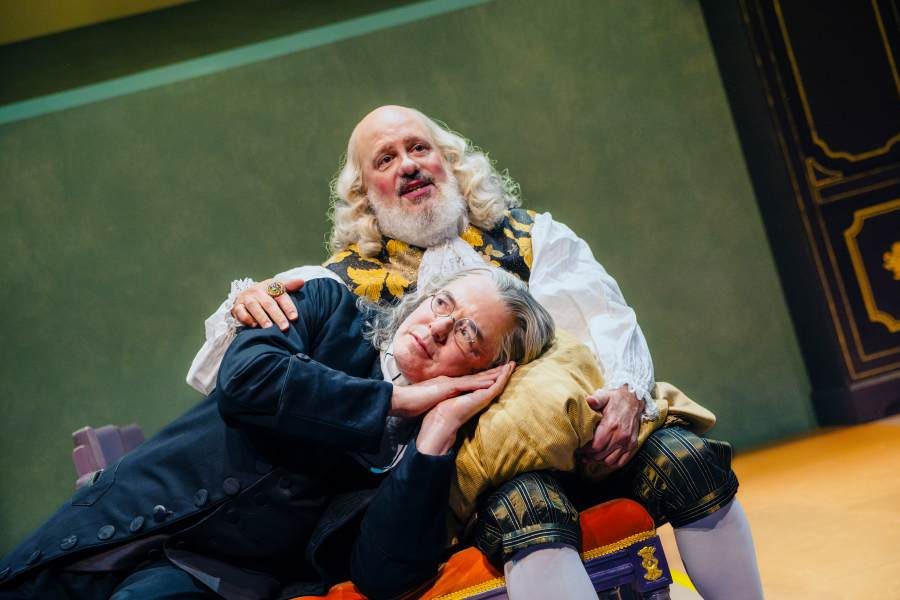
Tartuffe, the womanizing fraud in the eponymous comedy by Molire, is like the man who came to dinner. It’s next to impossible to get him to leave. In Moliere’s play, Orgon, a wealthy man, is having an emotional, religious crisis when he meets Tartuffe who he feels has saved him. Grateful, Orgon welcomes Tartuffe into his home.
Tartuffe (here played by bland Matthew Broderick) is a swindler, but Orgon (an ineffective David Cross) won’t acknowledge it. Even when his family creates a scenario where Tartuffe reveals his true self, Orgon refuses to admit it. Instead, he turns on his son Damis (Ryan J.Haddad) accusing him of lying, kicking him out and finally, in a show of ‘love’ for Tartuffe, disinheriting his son. Going even farther, Orgon signs his house over to the con artist.
The characters are introduced initially by Orgon’s mother Madame Pernelle (formidable Blanca Del Rio from “RuPaul’s Drag Race”.) Like her son, she’s been duped by Tartuffe. She is leaving but before she goes describes each of the characters and what she finds wrong with them, setting up the story for the audience.
Sarah Benson directs a diverse, sparkling cast that delivers a revised version of the play by Lucas Hnath. Hnath’s script is true to Moliere’s original storyline but modernizes the language. The original play was written in 12- syllable lines and Hnath’s script uses poetry as well but with more modern language and a liberal sprinkling of four-letter words.
The wise omniscient maid Dorine (capable no-nonsense Lisa Kron) calls Orgon, her boss, a ‘dipshit.’ Later she comments on a plan to get rid of Tartuffe, noting that it is “a fucking stupid plan.”
Raja Feather Kelly’s choreography is used to delineate scenes. Characters move across the stage, coming from one end of the stage to the other and so scenes change, sometimes with characters swinging tennis rackets. There are tennis balls in several scenes but no game is played. So what’s the purpose?
The characters are pleasantly silly and even, in distress, are likable. One of the cutest ‘bits’ is when Ikechukwu Ufomadu changes clothes many times in the space of a few minutes, becoming several different characters.The other characters, Orgon’s daughter Marianne (Emily Davis ), his brother-in-law Cleante (Francis Jue) and second wife Elmire (Amber Gray) join in the spirit of Hnath’s script.
First performed in 1664, Tartuffe satirizes religious hypocrisy through its main character who pretends to be pious and truthful. In reality, he is dishonest and lecherous, leering after Elmire, Orgon’s second wife (lovely Amber Gray.) Moliere added a happy ending, which, though not a realistic one, seems to satisfy the audience.
“Tartuffe” is pleasantly entertaining. The disappointing element is Broderick. As always, he is vacuous, playing the same character he always plays with an almost monotonous innocent tone. Despite the insipid performance, the play was fun to watch.
New York Theatre Workshop
79 E 4th Street
New York, NY 10003