


Remember when people went on psychedelic mushroom trips as part of a spiritual journey to discover themselves? I don’t. In my zillennial world, people take mushrooms to confront their annoying roommates. That’s the premise of Lanmaoa Asiatica, the lead-off one-act in Quantum EntangleBrunch – a group show featuring five new one-act plays from the Ensemble Studio Theater’s Youngblood Collective, with some fresh funny insights to offer about how science and technology have invaded every aspect of our lives.
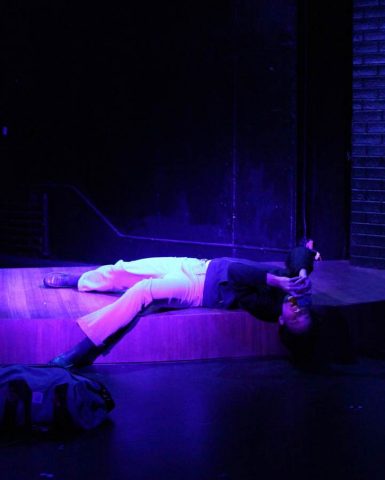
In Lanmaoa Asiatica, directed by Mikhaela Mahony, playwright Avery Deutsch tackles the medicalization of everyday experience. In a funny opening scene, shroom-seeking Wren (Smith Alfieri) is probed by their overbearing roommate Kai (Will Bruno) for details about her mushroom quest. Wren plans to get the mushrooms from her psychedelic therapist Marigold (a brilliantly odd Sharina Martin, who speaks with perfect diction and has an eerily calm vibe). With Marigold, Deutsch has captured a new type of weird, unsettling person: someone who goes to a medical specialist to teach them how to do normal human actions like sit, stand, lean, etc. Such activities have taken Marigold years to master, but she has arrived at a serene place of self-knowledge. (Marigold tells Wren, “I spent a lot of time with a foot reflexologist, and now I enjoy sitting.”) Besides being delightful, she makes Deutsch’s point, which seems to be that we – or maybe just Gen Z – are all living in an anxiously pathologized reality. Deutsch’s world is funny, off-kilter, and ultimately humane. There’s a longer play in this one’s DNA about relationships, medication, and conflict; I hope to see it (while sitting mindfully, wearing my Oura ring).
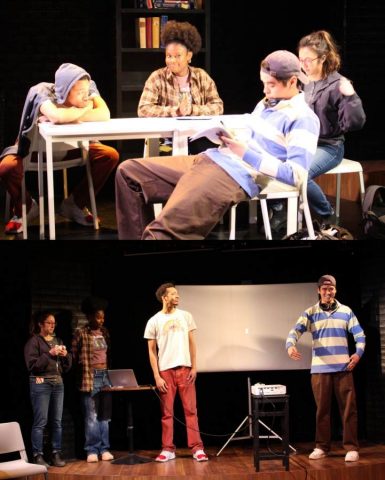
In Morgan Barnes-Whitehead’s Biology II, directed by Ann Noling, we are taken back to a classic science-ey situation that many of us endured in our formative years: doing a group project with complete morons. Sasha (Sasha Diamond) is a shrinking violet but a natural scientist; Marnie (Sydney Lolita Cusic) is her more assertive and socially confident lab partner. The two conscientious girls have to work on a high school biology class presentation of a scientific experiment with two jocks, Ray (Jordan Bellow) and Luke (Sky Smith). Ray is hostile; Luke is merely empty-headed; neither of them knows anything about scientific procedure. Marnie helps Sasha gain the confidence she needs to argue against the jocks. It’s a very appealing story - the core of the play is the slowly blossoming friendship between Sasha and Marnie. The play has an undercurrent of satire about the oafish jocks and cutthroat swooning girls of the classic American high school. It's not clear how much we’re meant to root for our science girl versus how much we’re meant to be winking at the teeny-bopper-ness of it all.. Sasha Diamond and Sydney Lolita Cusic are standouts; Diamond, in particular, perfectly captures the endearing cringe of a person attempting to speak publicly, while utterly terrified.
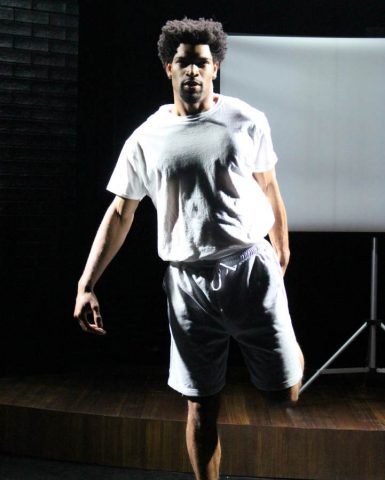
Ife Olujobi’s Hellfire explores how our many forms of technology allow us to ignore the cost of war. It starts in darkness. With no one on stage, a screen shows a montage of online comments about military drone strikes, presumably written in the comments section of a video, or sent between people on an internet chat. The comments are repellent: the commenters are cheering death and destruction and making racist jibes about the mutilation of the victims, as if discussing knock-out punches in a boxing match - like, whoa, dude, did you see that, that was crazy! We then see video footage of drone or missile strikes, while audio plays of news anchors talking about wars in the Middle East and Gaza, emphasizing the toll on casualties, especially the innocent. After what felt like a long time, a young, athletic man (Garrett Allen) does warm-ups to prepare for some kind of required military test while we. We hear the exhaustively detailed instructions for how to take the test. (I can’t say I was on the edge of my seat for that part.) He runs back and forth, faster and faster, and we hear more audio about military strikes, and their victims, all building up to a dramatic crescendo and collapse.
Hellfire makes undeniable, uncomfortable points about war, brutality, white imperialism and genocide. The play’s lighting, staging and the drama of the A/V effects successfully create a totally forbidding atmosphere of darkness and intensity; everyone completely sobered up and the audience was absolutely quiet. We watch missiles destroy people again, and again, and again. The repetition is the point - if you’re sitting there thinking, “Okay, I get it,” you’re minimizing the carnage and destruction that war creates. It’s a ridiculous, cretinous impulse to look at people’s lives ending and wonder when intermission is. Having said that, I am admitting to being a ridiculous cretin, because I was sitting there thinking “Okay, I get it,” and wondering when intermission was.
Hellfire is one of those pieces that is deliberately tough to watch, because it’s meant to shake up and point a finger at the audience, and at the casual genocide perpetuated in the name of our country that many of us hate but don’t actively fight. I struggle to criticize it, because it did remind me of things I didn’t feel like thinking about. But I’m not sure I appreciate Hellfire as a play, especially without characters for me to look at and dialogue for me to listen to. If the point was to point a middle finger at me, then the point is well-taken: the play worked. I will say that my view is a minority one - the audience seemed to be completely captured and shocked, from the first moment of darkness to when the lights came back up again.
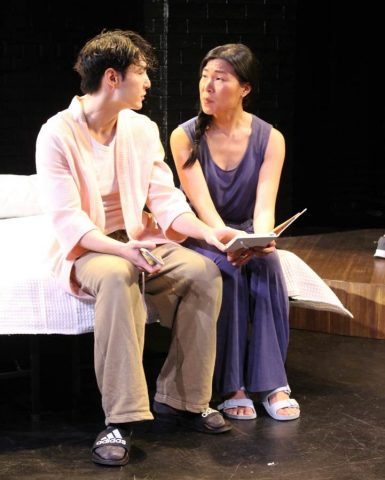
The difference between the hothouse absurdity of the internet and the humdrum pain of real life is the subject of Xiàoyán Kāng’s The Cut, a poignant two-hander. Wu and Lan have been flown out to a luxe, sterile hotel room where they’re prepping for a medical procedure. Wu (Eric Yang) has issues – the couple are trying unsuccessfully to get pregnant and he’s looking for work. Like many men, myself included, he doesn’t know how to solve any of the major problems in his life, and instead wants to just scroll on Instagram. “Come watch Reels with me,” he says to his exasperated wife Lan (Rachel Lin). Rachel Lin is very believable as Lan, the wife who genuinely loves her husband, but is fed up with his pessimism and indolence. Online, Wu watches weird stories about science, medicine, and the power of corporations over laboratories. Kang invents a very silly, very funny conceit to illustrate Wu’s obsession; as Wu relays stories about corporate conflicts, two other characters (Helen Coxe & Fang Du) wearing raincoats, stand off to the side, wielding umbrellas as weapons with clownlike flair while narrating the stories in greater detail. (“In 1991, G.E. tried to initiate a hostile takeover of Nabisco. Have at you!”)
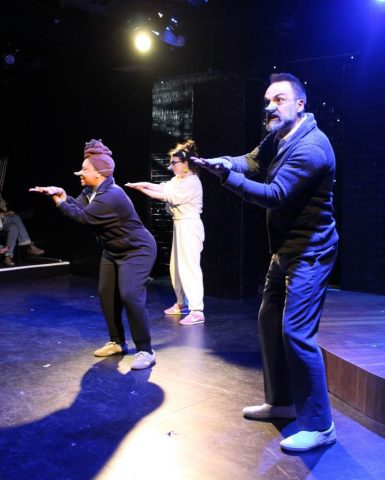
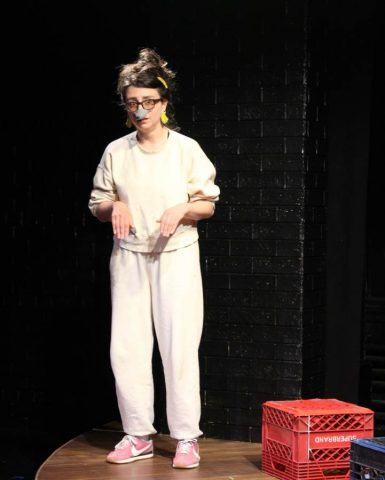
Davis Alianiello’s Hero Rat poses a question you don’t hear much: Who’s happier, a rat with a banana, or a human being with a paycheck? We have to spend our paychecks on things like phone bills and health insurance. Rats get the banana with no strings attached. Hero Rat creates a world of sentient, collegial rats who work as a team of land-mine sniffers. This is a real thing: for decades, nonprofit organizations have trained rats to detect landmines in war-torn places like Cambodia, because rats can smell the scent of TNT in landmines, and are light enough to avoid triggering explosions. Some research (okay, a Wikipedia article) reveals that one celebrity rat named Magawa found 71 landmines in Cambodia due to his exceptional sense of smell, eventually retiring in 2021, and spending “a number of weeks mentoring 20 newly recruited rats before ultimately retiring to a life of snacking on bananas and peanuts.” This raises some more questions than it answers. How does a rat mentor another rat? Can rats be disappointed in each other? (I also like the concept of a retired rat.) In any case, Magawa has clearly accomplished far more than me or anyone I went to high school with, and I salute him, or would have if he hadn’t died peacefully of old age, surrounded by his mentees and bananas. Alianiello sees the humor in the hard working rats: they’re rats, but they’re treated like people. Or, they’re at least treated like employees, who, in the real world, are treated somewhere between rats and people.
The three rats (named Rasputin, Cleopatra and Emily Dickinson – played by Sean McIntyre, Jehan O. Young, and Chet Siegel, wearing little rat snouts and rat ears) are friendly in the way colleagues are, but also are aware of their coworkers’ foibles. Their job is to walk around sniffing until they “smell the smell,” and then scratch at the ground to indicate they’ve found a land mine. If they have, an unseen handler throws them a banana from the wings of the stage. It’s a pretty simple job. And yet, life creeps in. Rasputin has a problem with scratching and biting his handlers. (Who hasn’t had that impulse?) Emily Dickinson is a good bomb-sniffer, but is randomly seized by the urge to recite her own impromptu poetry. “It comes to me!” she declares. Cleopatra is the only rat who has fully accepted the bargain of gainful employment: you sniff a bomb; you get a banana. Sean McIntyre brings laughs as a boisterous Rasputin, and Chet Siegel is very funny as Emily Dickinson. I mean this as nothing but praise: she has really mastered the art of skittering and sniffling like a rodent on stage. Jehan O. Young brings complexity to Cleopatra: she spends the play ruefully trying to convince Rasputin and Emily Dickinson that there’s value in just doing your job well, and that they should try to accept a life that has clearly delineated boundaries and rewards. Hero Rat also features a live score, composed and performed by Emre Tetik on the keyboard; Tetik’s score is musical, melodic and playful, and helps create Alianiello’s world of sentient rodents.
There’s mutual love, and understanding, between the rats although they have different values. Cleopatra sees nothing wrong with working a pointless 9-5 rat job that gives her the rat version of health insurance. Emily Dickinson wants to do the rat equivalent of exploring her bisexuality and becoming a DJ. “I just don’t understand why you can’t scratch when you smell the smell,” asks Cleopatra. “I don’t know!” says Emily Dickinson. That exchange basically sums up centuries of angsty soul searching: all we are trying to do in this life is figure out why we can’t just scratch when we smell the smell.
Quantum EntangleBrunch is a production from the Ensemble Studio Theater's Youngblood collective.
Youngblood readings are hosted every Monday, Wednesday & Friday through June 2026.
Ensemble Studio Theater Program Directors: Estefania Fadul & Graeme Gillis
Youngblood Collective Program Director: RJ Tolan
Lighting Design: Liam Corley Sound Design: Bailey Trierweiler Stage Manager: Traci Bergen
Playwrights (in this production): Avery Deutsch; Ife Olujobi, Morgan Barnes-Whitehead; Xiaoyan Kang; Davis Alianiello
Directors (in this production): Mikhaela Mahony; Ann Noling; Ife Olujobi; Hannah Yurfest