



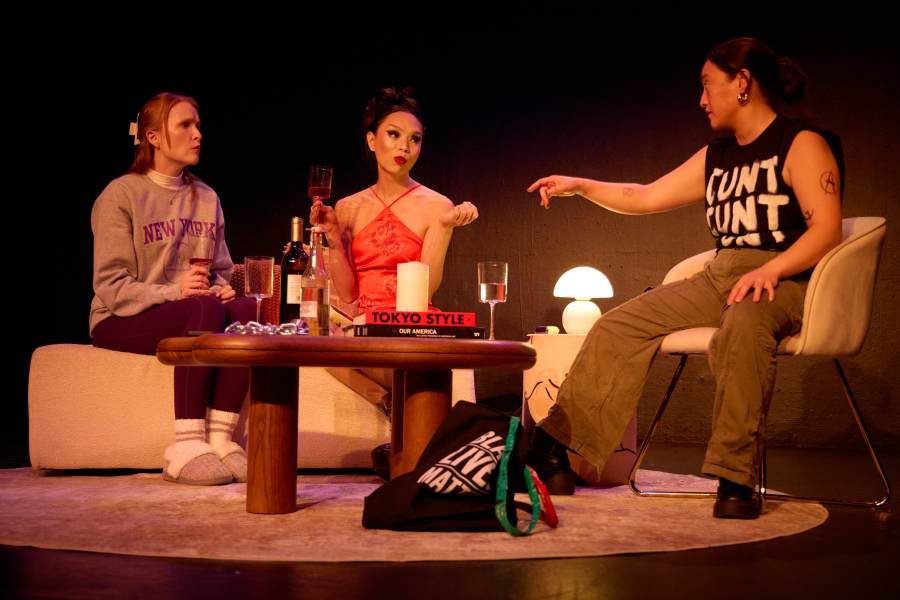
Before I review this play, I just want to say that the Democratic Socialists of America are totally valid, I really hear what they’re saying, I appreciate their perspective, and the work they do in our community is so, so important. I don’t usually start a review with a political declaration, but I just saw Chapter Meeting, and its dead-on parody of paranoid politically correct language has taken over my brain. In Chapter Meeting, now finishing its run at the Wild Project theater in the East Village, writer-director Taylor Jon Gonzalez has created a shrewd satire about the Democratic Socialists of America, Brooklynite progressive politics, and the uncomfortable truth that even our most noble intentions are infinitely less compelling than the deeply human desire to trash our friends.
Chapter Meeting is set at an all-night DSA meeting (“Sub-Chapter Brooklyn, Sub-Sub Chapter Williamsburg”), where the chapter members who are (supposedly) friends with each other are snowed in at a member’s apartment. Over the course of a long night, they trade barbs, criticize each other’s lifestyles and do their best to diminish each other’s cred as progressives. Writer Taylor Jon Gonzalez has clearly spent some time in this world, and has created characters that feel like painfully accurate composites of archetypes from the universe of woke, youthful left-wing activism. Throughout the evening, the group’s initial, lofty ambitions to transform society become subordinate to each member’s pressing need to prove their friends and comrades are unworthy jerks.
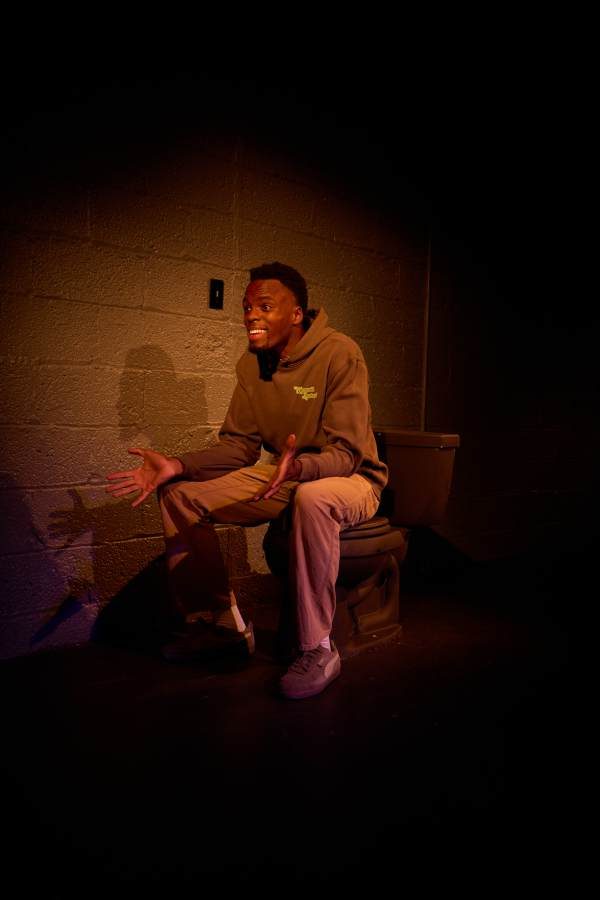
The incident in Chapter Meeting that changes everything in the group occurs when one member announces he has finally gotten a job. This conceit is already funny: for a group of perpetually underemployed, side-gigging, trust-funded or influencer-adjacent young people, getting a job – any job – is a betrayal of the highest order. The job is IT for Goldman Sachs: for the chapter, that’s like saying you’re quitting the Rebel Alliance to be a bathroom attendant for Darth Vader. The newly and disgracefully employed member is Andrew (a very funny Ihea Inyama) who knows that his announcement will mean the end of his friendships with the others. He’s right. The ensuing argument is dotted with hilarious outbursts about the world of the Brooklynite gig economy. Andrew yells, “You think I wanted this? I wish I could make a living teaching kids how to skateboard, but the market in Brooklyn is too saturated!” One of the best jokes in Chapter Meeting is in the framing of Andrew’s confession, which feels like a kid coming out to his homophobic parents. Andrew, by admitting that he will be receiving health insurance, has turned woke Brooklynites into a version of sobbing fundamentalist parents who tell their queer son, “Your father and I just don’t understand how you could do this!”

The person angriest at Andrew is Mar, a grunge lesbian who loves to physically fight cops. We first meet Mar – played by Michelle Chan Bennett, in a performance that’s both villainous and sympathetic – when she stomps into the apartment wearing a full black balaclava, camo-style cargo pants, and a tube top that has the word “C**T” three times on it. You know who she is – and who she thinks she is – just from that walk into the room; Taylor Jon Gonzalez’s is terrific at at portraying character through his actors’ clothing and body language.
The other Sub-Sub Chapter members are Esther (Kelly Whitley), an anxious, perky white girl and NYU student who reads abstruse theory about Latin American revolutions, and Dee (Kiko Soirée) a statuesque, glamorous Instagram influencer with a side gig as a quasi-sugar baby. Some of Dee’s followers are men who pay for her trips, her clothing, and her rent. “Sometimes, yes, I do have intercourse with them or perform intercourse-adjacent activities with them,” says Dee, “so in that sense there is some sex work involved, but I am not a sex worker.”

Dee is the soul of the play. Gonzalez takes an easily-mocked contemporary stock character – the superficial, vocal-fry-speaking Instagram influencer who lives for followers, likes and engagement – and turns them into a wounded, empathetic figure who makes you laugh and then breaks your heart. The high note of Kiko Soiree’s performance comes in an extended solo scene where, sitting on the toilet, she calls a friend/follower/sugar daddy/client (the lines are blurred, these days) and has fake-enthusiastic phone sex with him. Her challenge is to pick just the right moment to ask him to pay her rent. “Take me someplace warm,” she purrs. “The Maldives? Mmm, I love that. Baby, that reminds me. It’s the first of the month coming up soon… I cannot go back to living with roommates. They make me wash the dishes as soon as I use a dish!” The toilet scene is a feat of acting and comedy that becomes its own one-woman show, a tour de force that the audience applauded. I wanted to spend more time with Dee. Heck, I wanted to follow her. I would watch an entirely separate play about her.
One of the pleasures of the play is its take on progressive language. There’s a brilliantly observed scene in the first act where Mar, who is hostile, martial and gruff, confronts Dee who swims in the waters of social acceptance and self-presentation about her constant posting of DSA activities on Facebook, which Mar thinks is dangerous. A clash between Dee and Mar is really a clash between existential, ancient opposites; like Harry Potter and Voldemort, Scott Pelley and Bari Weiss, or the Zoroastrian entities of light and dark, Ahriman and Ormuzd, the Instagram baddie and the grunge lesbian are destined to chase each other’s tails in a spiral until the end of time. But because they’re both members of a community whose chief principles are to respect the identity and agency and feelings of the other person, their argument sounds like a cross between Robert’s Rules of Order and a Tumblr post. Explaining why she wants Dee to stop posting, Mar says: "I'm not telling anyone what to do and I don’t want to police anyone’s voice, especially marginalized voices, of course…” The result is a very shrewd parody of the self-conscious, liability-proof language that characterizes many progressive circles.
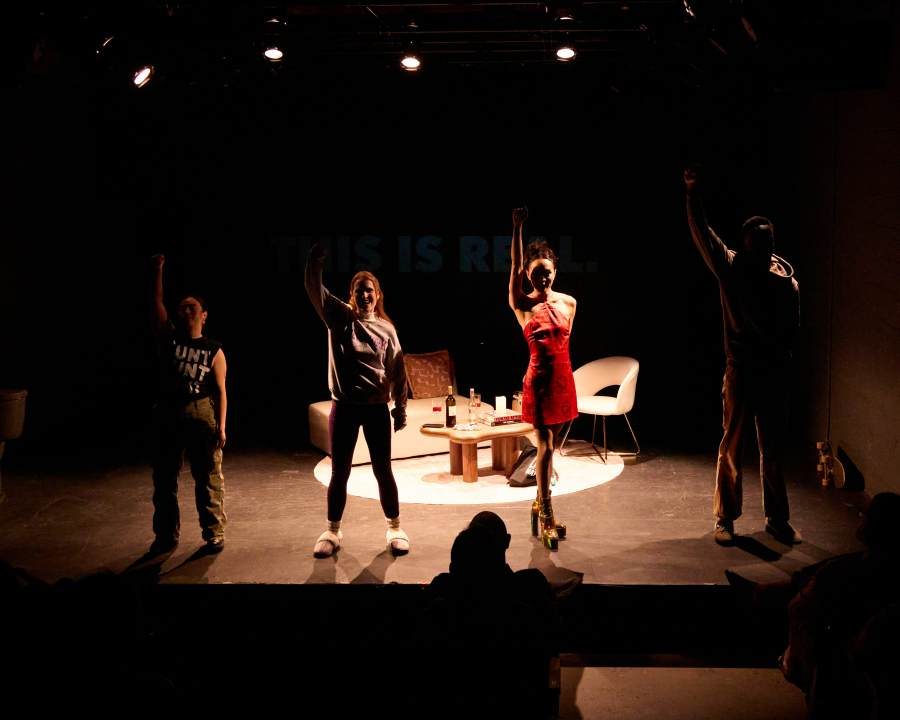
Over the course of the night – catalyzed by Andrew’s confession – things break down, and any pretense of “doing the work” is abandoned in favor of back-biting recitations of every questionable thing every member of the group has ever done. Much like Stalin’s Presidium, the Sub-Sub Williamsburg Chapter of the DSA are all carrying around lists of each other’s failures to be weaponized if they themselves are ever attacked. It’s like the struggle sessions in Maoist China during the Cultural Revolution, where people accused of being class enemies were publicly humiliated and forced to confess, often by their closest friends, to ideological crimes. It’s like that, except if the Maoist torturers were sipping IPAs and carrying a Black Lives Matter tote bag. Mar is attacked for taking photos of the bystanders around George Floyd’s death and endangering them. Esther is attacked for her privilege (her parents pay her rent). Dee is attacked for having a stalker who terrorized the rest of the group: “I'm sorry that a man was so deeply in love with me that he wanted to kill himself but instead decided to live another day and doxx you guys. I can't help that!” The entire room goes silent when Andrew, in response to a misdeed, says the scariest words in the progressive left canon: “Isn’t that a little…problematic?”
Every individual scene is funny – but the second act does lack some narrative propulsion and a few characters are given emotional monologues that feel a little bit like deliberate star-turn moments that take away from the hilariously observant realism of the group dynamics. Chapter Meeting works a little better as a comedy than a drama. But Gonzalez’s script is razor-sharp, and his point is well-taken: that, in certain sub-sub-(sub?) chapters of progressive political institutions, gossip, performative judgment and accumulated resentments are far more thrilling and sexy to young socialists than material, political change. Nobody in the play comes alive until they get to talk about that one time where that one person embarrassed themselves on Facebook in 2010.
With Michelle Chan Bennett, Kelly Whitley, Ihea Inyama, and Kiko Soirée
Written & Directed by Taylor Jon Gonzalez
Asst. Director & Stage Manager Abigail Landesman
Lighting design by Z Cameron