



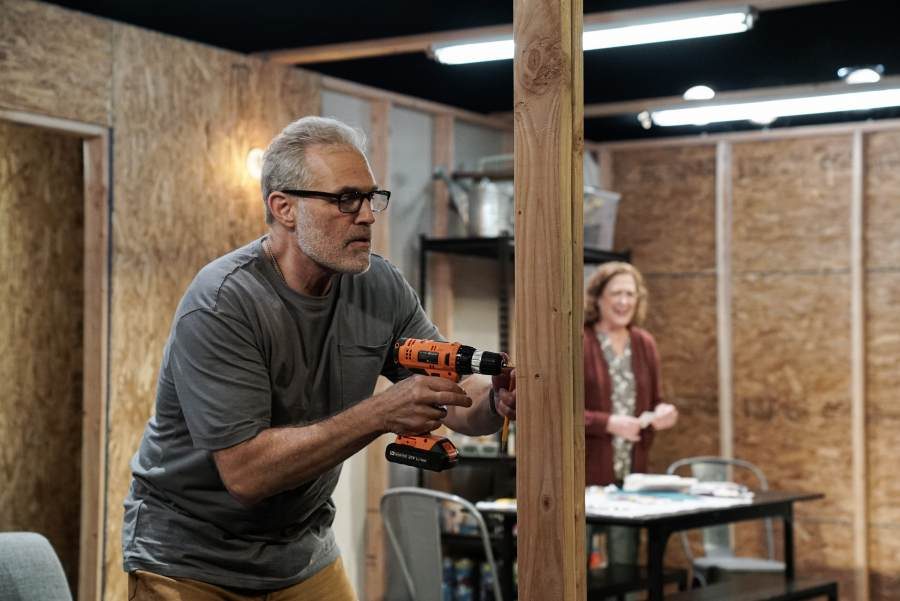
All happy families are alike; each unhappy family is unhappy in its own way. And when families become very unhappy, they imprison each other inside manmade bomb shelters. Or so Tolstoy would have elaborated, had he seen this play. In Safe House, an affecting and intense play written by L.B. Browne and directed by Benjamin Viertel, familial tensions that have been as solid as physical structures finally take physical form when a crisis occurs. Safe House is billed as a play about a man who is so susceptible to reactionary, polemical politics that he feels the need to construct a shelter in his own home to protect his family from what he sees as a potentially over-reaching government. It is, therefore, a play for our time. We know that millions of American men have used contemporary political realities as an excuse to play out their worst tendencies of dominance, prejudice, and control. (Also, some people make really dumb AI images and post them on Facebook.) And Safe House works well as a drama about the excesses of reactionary politics. But L.B. Browne’s play also functions on a deeper, more nuanced, invisible realm: that of the unspoken, decades-long grievances, compromises and resentments that undergird nuclear families, and how, when those long-held feelings erupt into physical violence, they can seem both incredibly shocking and completely inevitable. No one can hurt you like your loved ones, and that’s true whether you’re living eight feet underground or not.
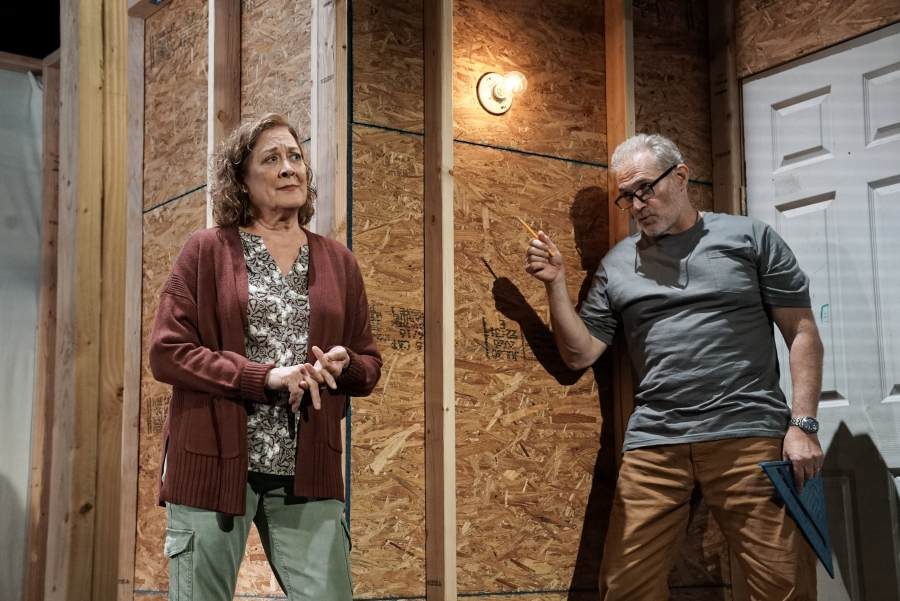
Marc Kudisch plays Rock, a former Department of Defense employee who grew up as a military brat and spent his career designing and constructing bases and barracks. Now retired, he’s spending all of his time building a safe room in the basement of his house for him and his family, ostensibly so that there will be a refuge for them if an up-and-coming election ends up being decided in favor of a liberal candidate that Rock hates and fears. Marc Kudisch has had a long and storied theater career, and has a talent for portraying comically and delusionally masculine characters: I personally knew and loved him best from a role the Showtime TV show Billions, where he played a comical, hyper-masculine performance coach named Dr. Gus, who would try to motivate day traders by yelling things at them like, “GET IT HARD, KEEP IT HARD, USE IT!” (Okay, Dr. Gus. I’ll try my best.) At the start of Safe House, Rock is pretty jovial, puttering around the bomb shelter with a drill and ranting affably about how fluoride doesn’t work and how the family needs to stock up on canned goods in response to the inevitable commie takeover. As the play progresses, he starts to become more unreasonable, and his fun little side project – constructing a bomb shelter – takes on the character of a neurotic obsession. We learn that Rock was abandoned and emotionally abused by his absent, constantly-reassigned military father, which usually helps people live healthy and well-adjusted adult lives. There are a few suggestions that, for all of his years of service to the DOD, he was basically treated like the help by actual military personnel, and therefore has an inferiority complex to add to his childhood abandonment complex, which stack up to a full Pringles can’s worth of chips on his shoulder.
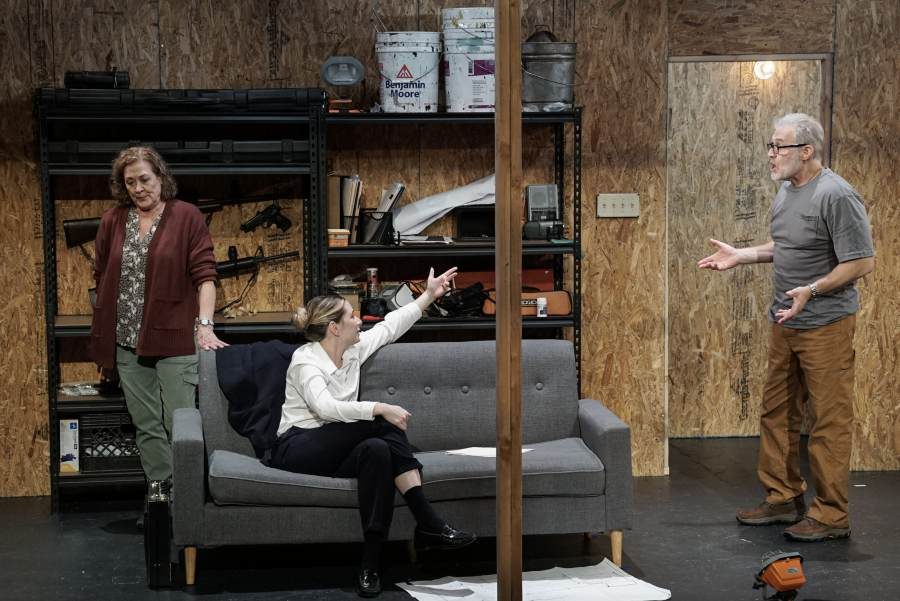
Rock’s wife and two daughters have spent their entire lives trying to conform to his idiosyncrasies, suspicions, edicts and rages. They work a hell of a lot harder than he does: his biggest effort is in trying to figure out whether the planks he’s installed in the basement are level, whereas they’ve spent decades minutely following and mapping all of his emotional triggers so that they can physically and figuratively tiptoe around his neuroses. His wife, Slipper (a sensitive, heartbreaking Karen Ziemba), scurries around him, always trying to vaguely smooth over his rage-filled outbursts like an ineffective curling brush. Her character is best expressed by the sentence, “Oh, you know how your father is…!” Yes, his daughters know how their father is. Their older daughter is Ashley (Anna Roman), a 27-year old lawyer whose body language immediately reads as a posture of extreme stress and emotional repression. Anna Roman gives us a lot of information about Ashley with her body language and vocal tone – she’s hunched over; she speaks in clipped sentences; she’s usually making gestures that seem to be trying to tamp down whatever emotionally upsetting or disruptive thing Rock is doing. There is no joy in Ashley’s life, and we get the sense that most of her 20s have disappeared in a choking haze of tedious work, the primary purpose of which is to distract Ashley from whatever she might be feeling. Rock and Slipper’s younger daughter is Claire (Grace Church), who is both Rock’s favorite child and the bane of his existence. She’s the black sheep of the family: a leftist, free-love-practicing radical and hippie who spurns rules, restrictions, jobs, and savings accounts. But although her suite of beliefs is diametrically opposed to Rock’s, she has his same stubborn spirit. The combustible power of her relationship with Rock is one of the main themes of Safe House: for some reason, people on opposite sides of the American political spectrum are attracted to each other, and, like celestial bodies on a collision course, are forced to violently ignite.
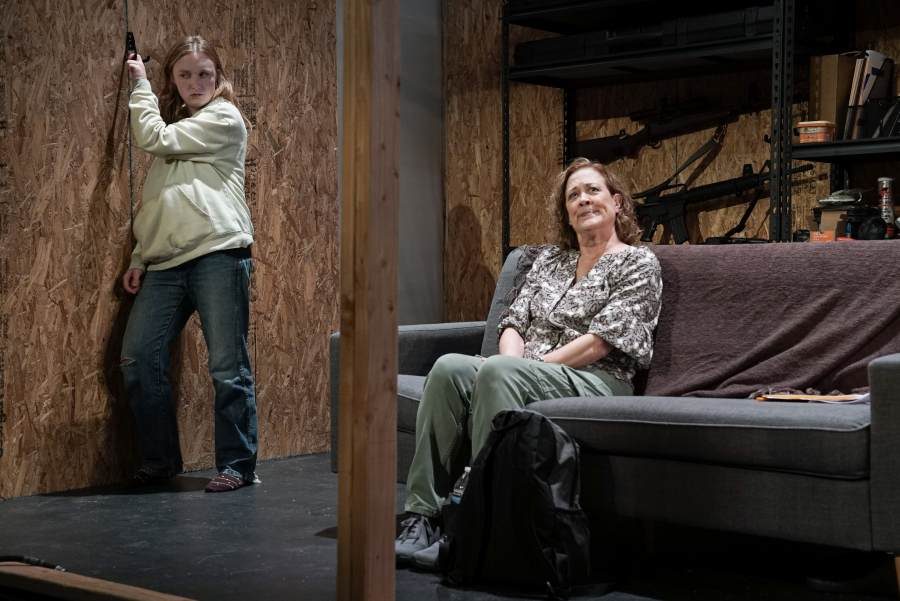
Claire kicks Safe House’s plot into high gear by announcing that she’s alive. A year before the events of the play, she ran away from home at sixteen without telling Rock, Slipper, or Ashley why, leaving them to wonder whether she was alive or dead. Now she’s coming home, and her return lays bare the wounds left by that year of terror and uncertainty. The fact that Claire is still alive – in all of her fiery defiance – somehow makes the possibility that she could have died feel newly real and horrifying. Poor Ashley, who has essentially appointed herself the family’s chief mitigator and make-everything-okay-er, doesn’t give herself much time to think about how she feels about Claire’s return. Instead, she immediately gets to work making sure both of her parents are okay with it. Rock, meanwhile, having almost lost his daughter once, becomes even more militaristic and draconian in his efforts to keep her home. Slipper and Ashley are forced to confront the depths of their instinct to defend Rock, which is Safe House confronting a painful reality about the parent-child and husband-wife dynamic: it is really, really hard to just let your parent or partner be an asshole, and not try to somehow talk them down, or indicate to the world that you know it’s not okay.
The narrative revelations in the second half of Safe House are explosive and effective. But I was more interested in the tense, heavy family dynamic that is set up in the beginning, before Claire even comes home. Anna Roman, in particular, does tremendous work as an actress to convey a life that has been spent in surveillance, constantly sweeping the perimeter of her parents’ emotional states and getting ready to react, mitigate, and contain. There’s a scene later on in the play when, after a couple of plot developments, she has, literally and figuratively, let her hair down, and the change in Roman’s posture and bearing is remarkable; you truly realize when she relaxes, how tense she has been for her entire time on stage. One of the impressive feats of Safe House is that things only seem bad in the second half of the play, when Claire comes home and Rock blows up. But they were bad before. It’s bad that Ashley has effectively lost a good chunk of her young life to her parents’ dysfunction, and it’s bad that Slipper is too afraid of her husband’s reactions to ever really tell him the truth about how nuts he is. Safe House deals with political violence, and people who have been irretrievably radicalized by political propaganda. It’s making the point that, for people like Rock, who are carrying around a suite of neuroses and triggers, that propaganda can act as a fuse.There’s a more sophisticated point underneath that one, though: it doesn’t really matter whether the bomb ever goes off, or whether the commies ever invade. The mere fact that the shelter was built at all is evidence of profound damage. The damage has already been done
With Karen Ziemba, Marc Kudisch, Anna Roman, Grace Church, Justin Lee Miller, Glenn Seven Allen, Julianna Layne split/decision+1
Play by L.B. Browne
Directed by Benjamin Viertel
Set Designer: Forest Entsminger
Lighting Designer: Mary Ellen Stebbins
Costume Designer: Kyle Artone
Sound Designer: Liam Bellman-Sharpe
Props Designer: Samantha Tutasi
Production Manager: Megan Gillis
Production Stage Manager: Skylar Back
Producer: split/decision, with L.B. Browne and Glenn Seven Allen
Press: Emily Owens
Theatre Row Address: 410 W 42nd St, New York, NY 10036