



What if there were no men in the world? Feminist authors have been exploring that concept for over a century, from Charlotte Perkins Gilman's Herland in 1915 to Joanna Russ's 1975 speculative fantasy The Female Man. (My ex-girlfriend also used to pose that question a lot. I'm sure it had nothing to do with me.) But in Hungry Women, currently playing at the SoHo Playhouse, playwright Melissa Maney runs with that premise. The result is a very funny play that can be enjoyed by both the oppressors and the oppressed; a work that argues that even if bellicosity, violence, and the patriarchy were eliminated, humans would find other ways of mistreating each other.
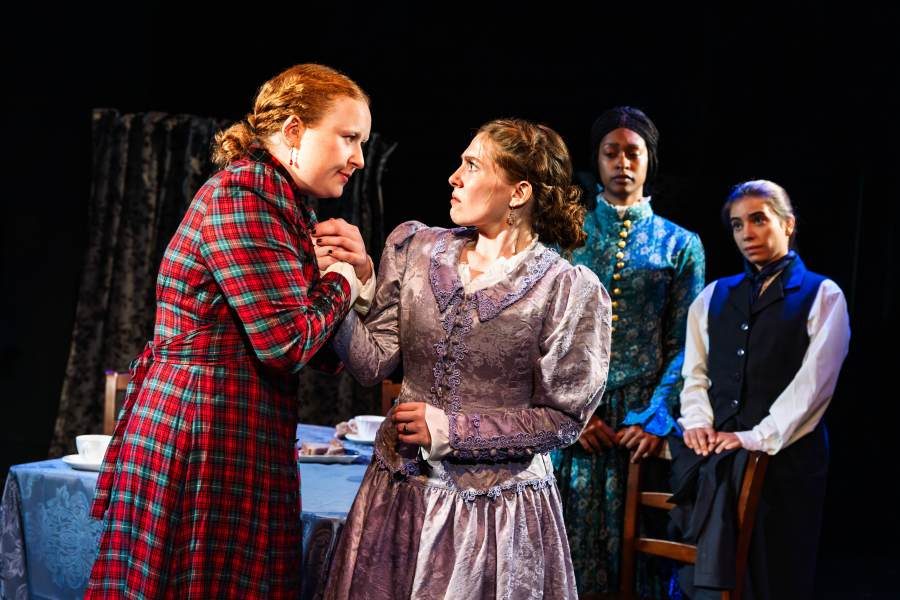
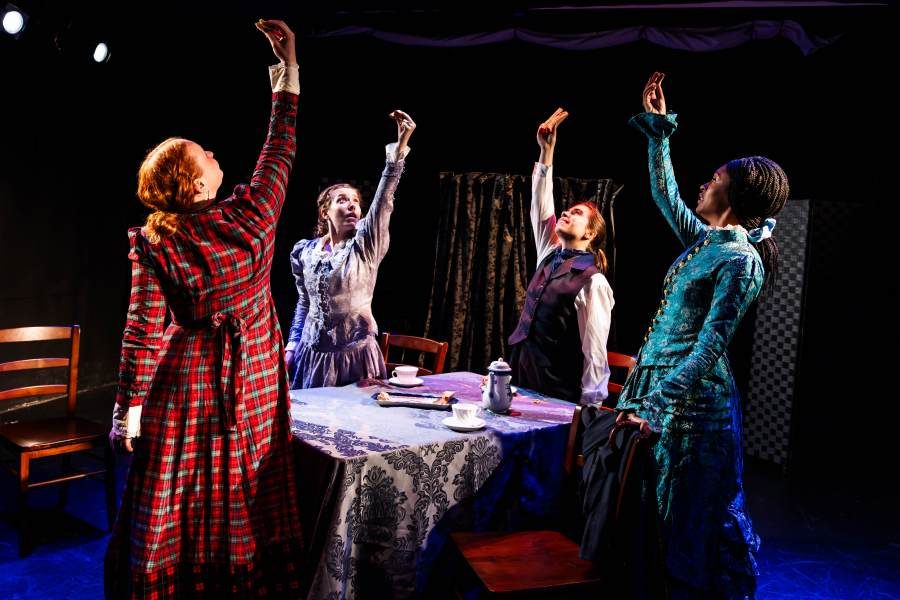
The play is set in three different time periods, with four actresses playing four different women each time. It opens in 1891 in Concord, Massachusetts, where the four well-frocked women with their dresses buttoned up all the way are having a post-traumatization tea party. Their husbands – along with all of the other men in the world – have simultaneously and mysteriously dropped dead, and the wives, who have known nothing but child-rearing and housework, are attempting to keep calm and carry on. That is, until one of them – Victoria (Sophie Zmorrod), who plays a plucky, revolutionary woman in all three acts – comes up with a modest proposal. We’ve got all of these dead men’s corpses lying around. Why don’t we eat them? (The others are initially disgusted, then intrigued; the act ends with the rabble-rousing Victoria convincing them that eating their dead husband’s bodies – sautéed in a nice little white wine sauce – is a revolutionary act.)
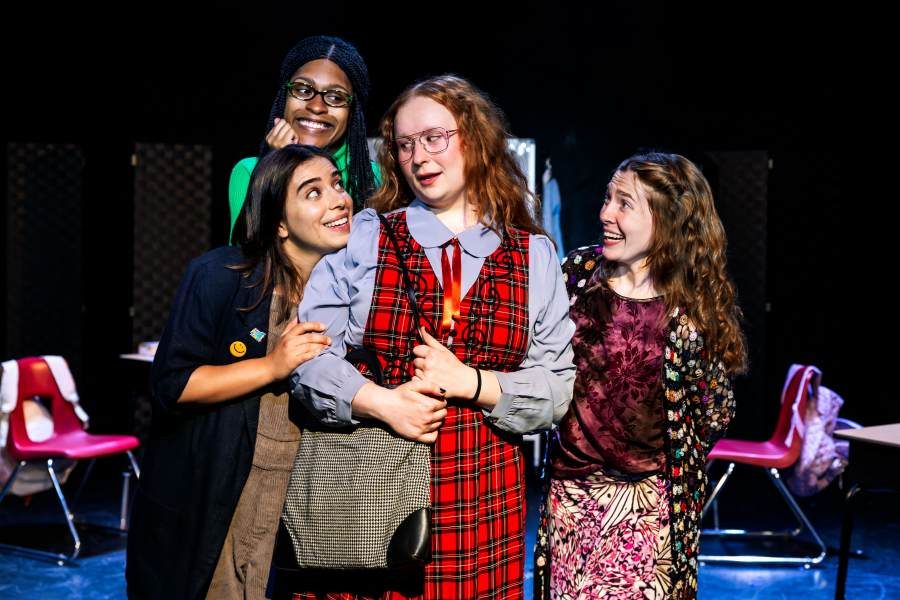
The second act winds the clock forward a century, where women have mostly adapted to the Earth’s dearth of men and made reproduction possible with two eggs. Propaganda-filled “AP Herstory” is taught in high-school classrooms, which means that the women who run the world have wiped away the history of everything before the Manpocalypse in 1891 and replaced it with vague, woke myth, which the girls recite like the Pledge of Allegiance: the death of men “allowed us [...] to create a world free of war, a land without borders, and a society that sees us as humans, not our gender. “ But the 1991 schoolgirls are inquisitive; they want to know the real, messy history of America, so they summon the spirits of a couple of dead guys for a seance. Once summoned, the spirits of the men from the past demonstrate why nobody has missed them for a century. Their appearance culminates in a startlingly intense and visually striking sequence in which the male spirits attack the women onstage in what amounts to a kind of psychic sexual assault – a moment the play treats with complete seriousness. (Apparently, men don’t even need bodies to inflict bodily harm.)
The third act takes place far in the technologically advanced future of 2091, where a couple of women rule like president-queens. The president-queens have built a dystopian regime where women are selected for mandatory childbearing, and kept under control through a global surveillance network; basically, they have come up with methods of paternalistic dominance so advanced that even men never thought of them. (We just didn’t have enough time. We would have gotten there!)
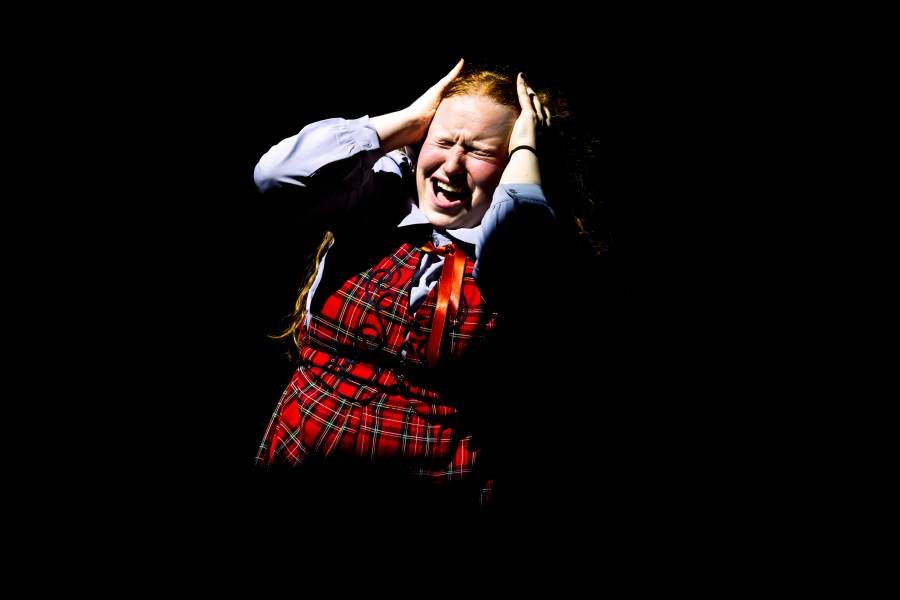
All the performances are strong, particularly Julia Lester, who plays the alpha-bitch character in all three time periods – the conservative housewife who refuses to consume human flesh; the substitute teacher who allows her students to convince her to hold a seance; and the chief president-queen of Earth, who has figured out how to keep not only everyone in the world, but also the other three president-queens under her autocratic rule. Another standout is Zoe Dean, who plays the most innocent member of each group with natural comic timing. It’s fun watching her accelerate from guileless confusion to frantic hysteria in every scene.
The set is minimal but appropriately suggestive. The most inventive bit of staging is what happens between the acts. During each act break, the four performers change their costumes on stage to become the characters in the next act, stripping down in front of the audience while music – sexy, fun girl-power anthems – plays. The interstitial costume changes are staged like a concert by director Daniella Caggiano: the women dance and pose a little for the audience. It’s a clever idea: instead of taking you out of the play’s world, the costume changes bring you further into it. In a world without men, there is no male gaze to hide from.
Hungry Women does two things at the same time: it imagines a future where women make brave, autonomous decisions in a world without men and it also has its eyes open to the fact that everyone, even women, are capable of dominance and aggression, and that the will to power is not just the birthright of men. The hungry women here aren’t hungry for revenge, they’re hungry for freedom. At the end of the play, there is hope that the president-queens will undo their tyranny. Maney appreciates the way people will keep pushing against the limits imposed on them, driven by a stubborn desire to know the truth and live their lives as freely as they can. I think even Joe Rogan could get down with that.
With Julia Lester, Mariyea, Sophie Zmorrod and Zoe Dean
Directed by Daniella Caggiano
Written by Melissa Maney
Scenic & Production Design by Qingan Zhang
Costume Design by Olivia Hern
Lighting Design by Annie Garrett-Larsen
Sound Design by Chris Verde