


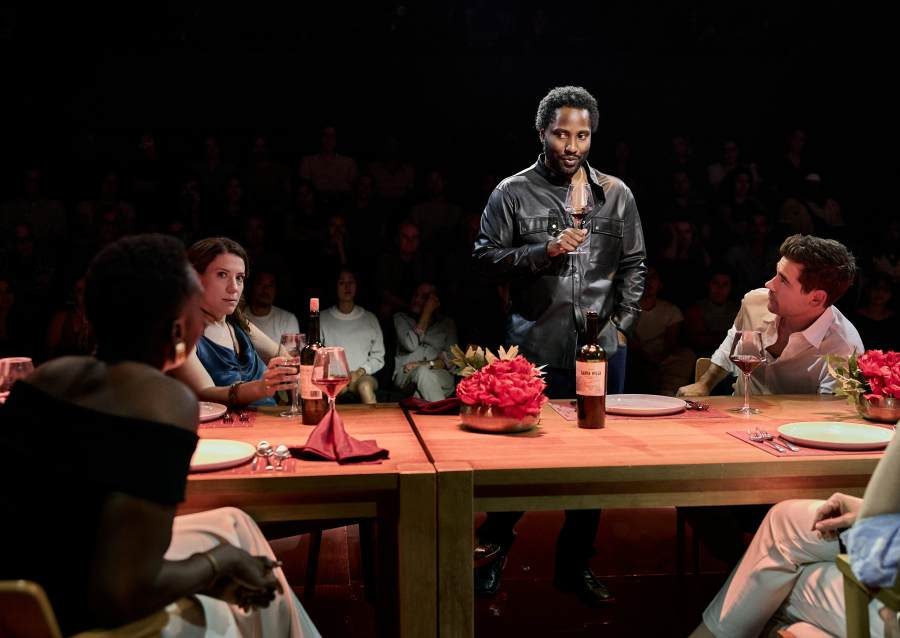
What’s more destructive to the human race – the threat of AI, or the reality of marriage? On the one hand, artificial intelligence seems fairly close to replacing the charmingly antiquated notion of “thinking for ourselves.” But marriage has been inimical to human happiness since the first Canaanite got married in a small, intimate ceremony, which nevertheless required guests to take two days off work. In Disruption, an entertaining new play by Andrew Stein at the Signature Center, John David Washington stars as Nick, a tech entrepreneur, who tries to rope his closest married friends into investing in an artificial intelligence program that can tell them how to decide on the most pressing questions of human existence, like when to buy property in Brooklyn. Disruption’s warnings about the creeping paternalism of artificial intelligence are certainly true and well said, if a little obvious, but Disruption has far more interesting things to say about how married couples interact, and how they fight and struggle and claw for power within their sacred unions.
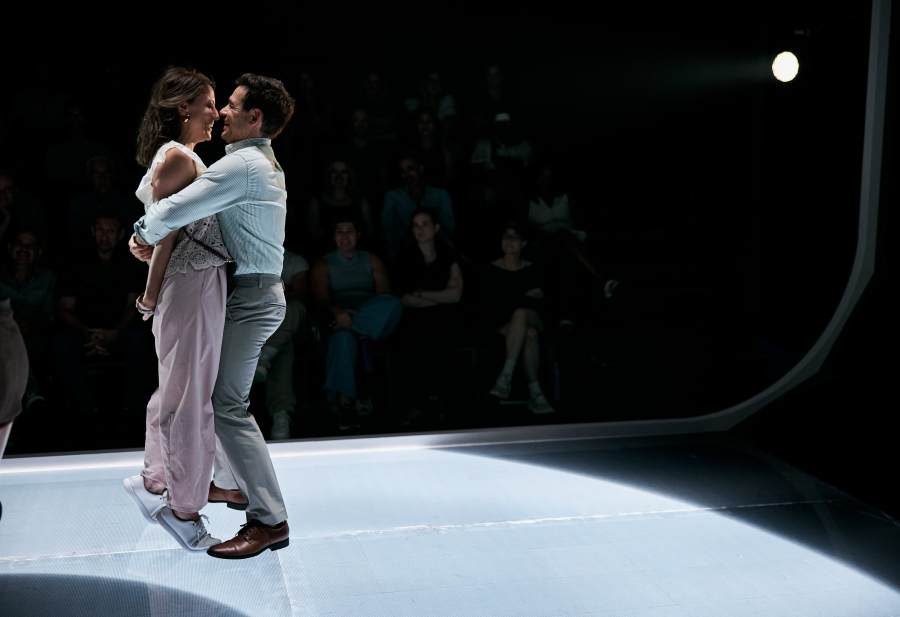
Disruption is at its most disarming and original in its playful dissection of modern marriage. Its sharply observed dialogue – the parries and lunges between long-married partners and couples whose relationships are on the rocks – shows playwright Andrew Stein’s granular understanding of the counterintuitive reality that the person you trust enough to spend your life with and the person standing in the way of all your ambitions, are, unfortunately, sometimes the same person. The texture and humor of Disruption, directed deftly by Hersh Ellis, come from the tensions between three married couples, who have all been friends with each other – and with Nick – since college. Ben (Conrad Ricamora) and Suzie (Shaunette Renée Wilson) are well-educated (he’s a Columbia professor; she’s a psychiatrist); Ben is affable and meek, whereas Suzie is intense and razor-sharp. Their problem is that Ben wants a baby and Suzie doesn’t. Then there’s the even more fraught relationship between Jill (Elizabeth Stanley) and Paul (Joe Tippett) who I recognized from his memorable performance in Mare of Easttown, where he played Julianne Nicholson’s disappointing husband, who at first seemed quite sexy but then turned out to have covered up the fact that his tween child committed murder. (Men.) Paul just wants to chill, have fun, and possibly sleep with other women. Jill wants to get through the day, keep her bread-winning corporate lawyer job and get her kid into Fieldston. Barry (Jason Ralph) and Mia (Irene Sofia Lucio), have the healthiest marriage, a push-and-pull relationship with the natural rhythms of real life. Lucio is endearing as she drapes herself around Ralph; she’s always touching him, throwing her arms around his neck, or playfully pushing him around. Barry and Mia’s problem isn’t each other; it’s that Mia wants a Brooklyn brownstone they can’t afford. All the couples, in other words, are simultaneously comfortable and miserable, i.e., happily married.
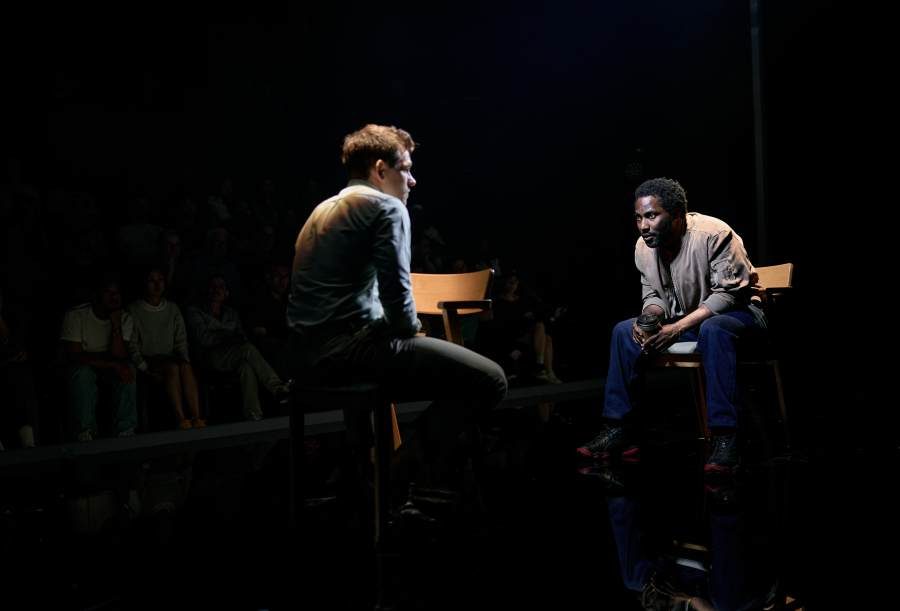
Into this simmering pot of unresolved tension, plops Nick (John David Washington) and his younger girlfriend Raven (Emma Kikue). Nick is a boundary-busting, boisterous backslapper; his presence is like a shot of tequila that warms up the couples and gets everyone thinking about money, sex and success. Nick organizes a fancy dinner for his old friends, and offers them all a suspiciously vague investment opportunity: for half a million dollars each, they can get in at the ground floor of an algorithm that uses artificial intelligence to “help people navigate their lives,” as Nick says. It’s basically an AI life coach, but one that knows things even we don’t know about ourselves. The couples are ambivalent: should they risk their reasonably happy, unhappy status? Why isn’t what they have enough? What would be enough? Nick, like a Mephistophelian tempter, tries to convince them not only to invest in the algorithm but to use it on themselves, to live their own lives according to its advice. But the initially clear-cut choice between relying on AI versus making your own decisions gets muddied in the second half of the play, when Nick’s girlfriend Raven reveals that she has tweaked the algorithm so that it not only tells you what you should do, but actively - and secretly - manipulates events so that you do it. Raven and the algorithm can control anything that gets texted, emailed, or pops up on your Amazon Recommended Products list. It has access to all the data out there about you. But the algorithm’s main tactic is to dispatch Nick to execute its schemes. Nick is torn between friendship and profit, but egged on by Raven, who is like an AI Lady Macbeth, he reluctantly carries out the algorithm’s agenda.
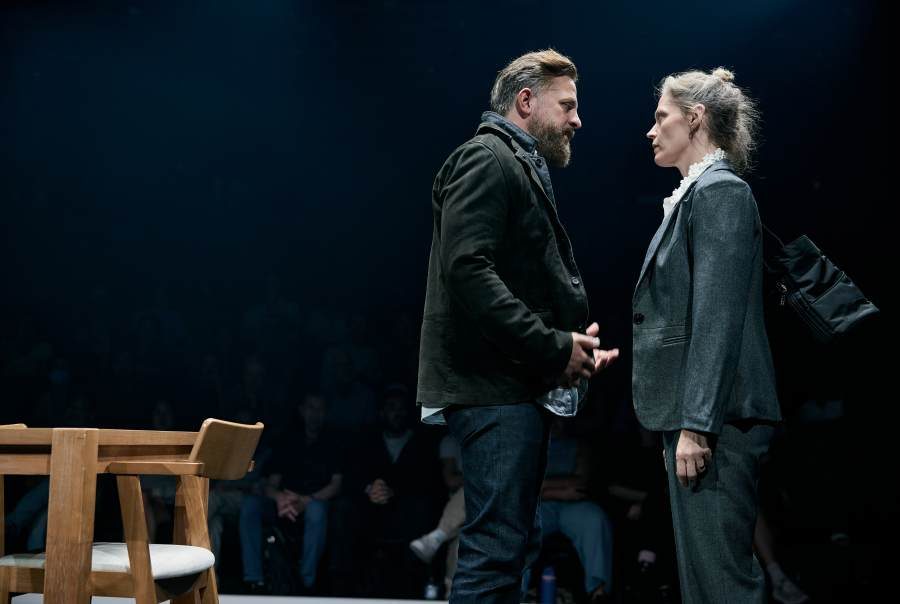
From there, we watch everyone’s lives start to change the way that the computer thinks will make them the happiest – which, as you might imagine, doesn’t always work out. As the saying goes: Man plans, Claude laughs. Some pieces of the AI plot thread, especially in the second act, feel a little reminiscent of AI-doom narratives in recent years, like Black Mirror. We all – well, except for Sam Altman, Dario Amodei, and HAL 9000 – agree that computers taking over our lives is bad, even though I did have to ask ChatGPT how to get to the Signature Center. The AI-domination plot is creepy, compelling, and effective, although it’s also a little funny, that the world’s smartest algorithm is using all of its gigabytes to try to figure out how some upper middle class people in Brooklyn can best capitalize on the housing market. Could we please cure cancer first?
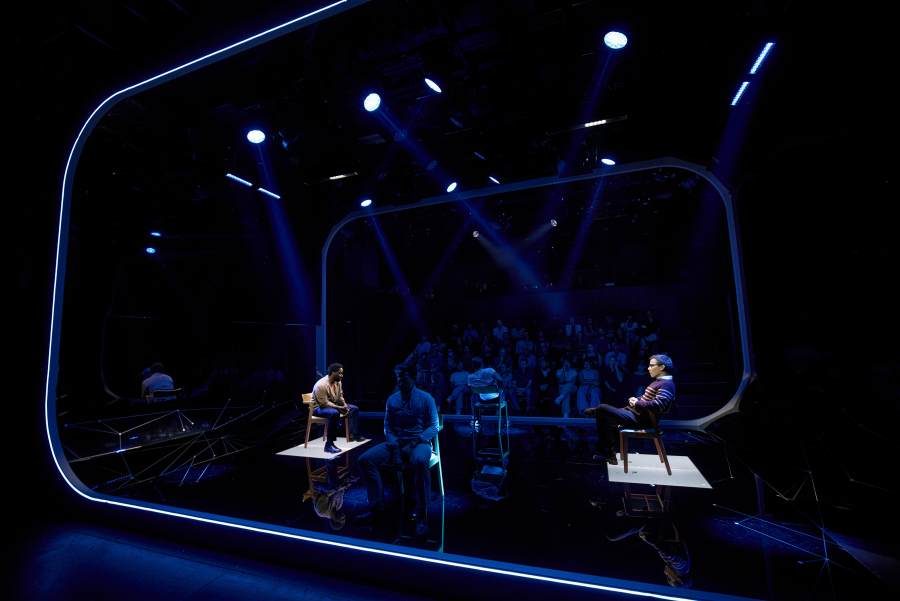
The cast is excellent, but if you go to Disruption expecting the incredibly handsome and well-groomed John David Washington of Christopher Nolan’s Tenet, you’re in for a surprise – Washington’s character dresses with the studied carelessness of someone so rich, he looks poor. His costumes struck me as a few notches schlubbier than even the pared-down billionaire aesthetic that the production was presumably aiming for. Still, Washington delivers an affecting performance as a man with one foot in the future and one in the human world. In an assured, creepy performance, as Nick’s young, hot, confident girlfriend – qualities that seem to often characterize real life female AI evangelists – Emma Kikue subverts expectations as Raven, who initially seems like arm candy but turns out to be the cynical mastermind of the entire play. “People are f***ked unless they embrace technology,” she cheerfully tells the couples.
The fact that the human side of Disruption is consistently funny, engaging, and genuinely laugh-provoking, while the AI plot functions primarily as a dramatic conceit, reinforces the play's central argument: that in the great war between silicon and flesh, human consciousness and human relationships still hold the edge. Disruption ultimately argues that every disruptive choice – even one planned down to the last line of binary code – produces consequences no one, not even AI, can predict. Claude plans; mankind laughs. As the play’s denouement, where we discover everyone’s fate, shows, it may be that humanity’s greatest accomplishment is that we’ve created such a screwed-up way to live our lives – i.e., with a spouse – that even the most intelligent computers could never possibly understand it.
Written by Andrew Stein
Directed by Hersh Ellis
With John David Washington, Joe Tippett, Conrad Ricamora, Irene Sofia Lucio, Elizabeth Stanley, Shaunette Renée Wilson, Jason Ralph, Emma Kikue
Scenic & Costume Designer: Zoë Hurwitz
Lighting Designer: Reza Behjat
Sound Designer: Caroline Eng
Video Designer: Yana Biryükova
Property Designer: Samantha Shoffner
Movement Director / Coordinator: Ryan VanDenBoom
Intimacy Director: Claire Warden
Disruption is playing at The Romulus Linney Courtyard Theatre at the Pershing Square Signature Center, located at 480 W 42nd St, New York, NY 10036.