



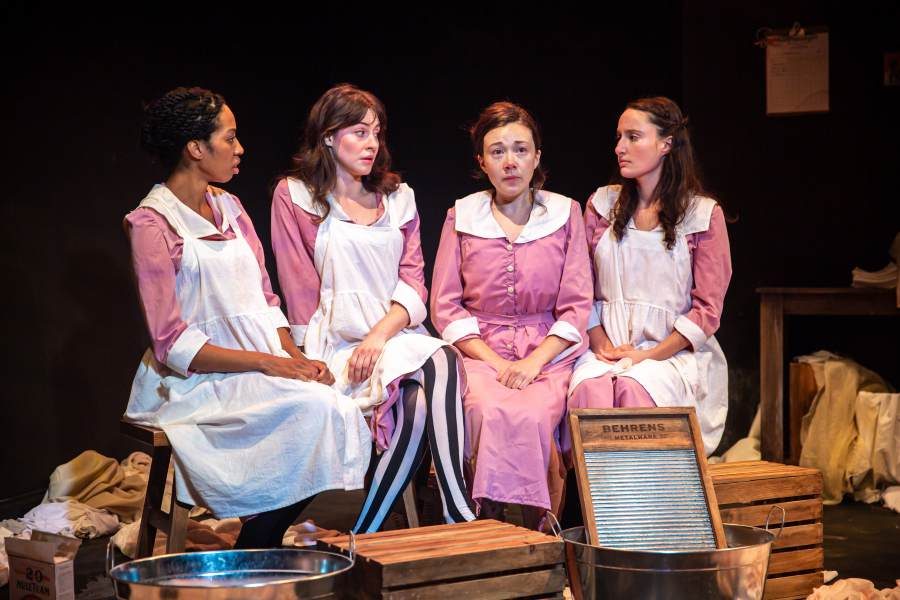
In Sophie McIntosh's compelling new play Benevolent, playing through September 12th at the IATI theater, there are a lot of ways women can get in trouble: poverty, prostitution, pregnancy and premarital sex, to name a few. The four young women in Benevolent, which is set in 1917, have each violated the rules governing female behavior and for that, have been sent to a reformatory, the Inwood Benevolent Home. (For my fellow millennials, reformatories were a kind of privately run juvie; women were sent there who had violated the moral code of those bygone days when women’s bodies were a source of shame and women were expected to behave more purely than men. Luckily, we don’t do that anymore.)
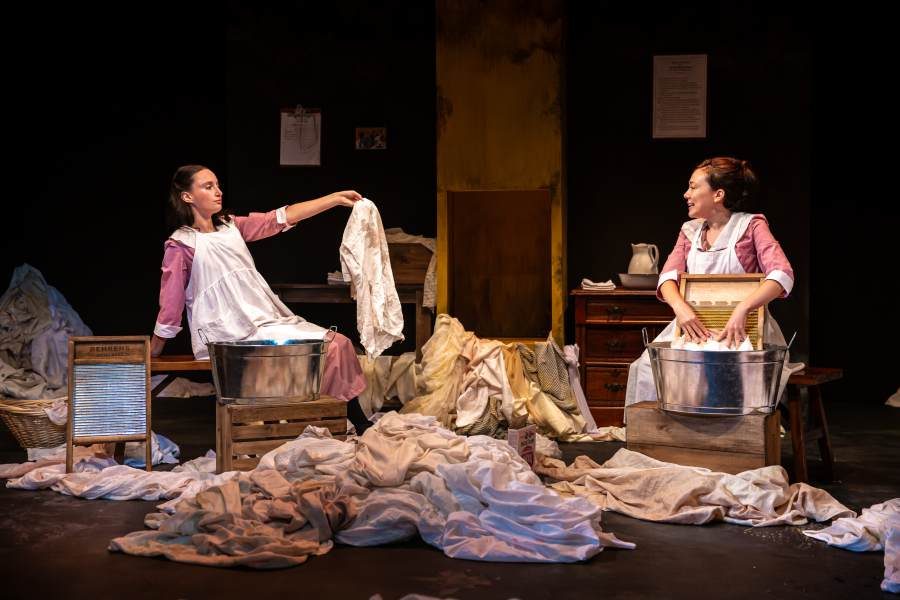
The four women in Benevolent – Emma, Sarah, Margaret and Abby – have been assigned to the “soiled shift” of the laundry room, which means that they sit in a room festooned with sodden sheets and underclothes, miserably scraping dirty laundry against a metal washboard. Today, this position would require three rounds of interviews. Sarah (Rachel Ravel), is a friendly, entrepreneurial aspiring singer who was arrested for panhandling. Margaret (Chani Reese) is a prostitute with an I’ve-seen-it-all, working-girl attitude, which guards deep wounds and covers for her ambition to live a better life. Emma, played with great subtlety by Mia Fowler, is like an R.A. in a college dorm: she’s a prostitute too, but she has the power to narc the other women out to Miss Antonia, the unseen matron of the home who rules over them. As a Black woman, Emma is at the bottom of the economic ladder; she’s hoping that her loyal service to the home will eventually turn into a job with room and board. The entire play takes place in this one laundry room, and the actresses actually wash clothing during the performance. Giant, sodden clumps of laundry are strewn across the stage, encircling the characters and creating a filthy, makeshift barrier around them. You can hear the water sloshing against the metal tubs.
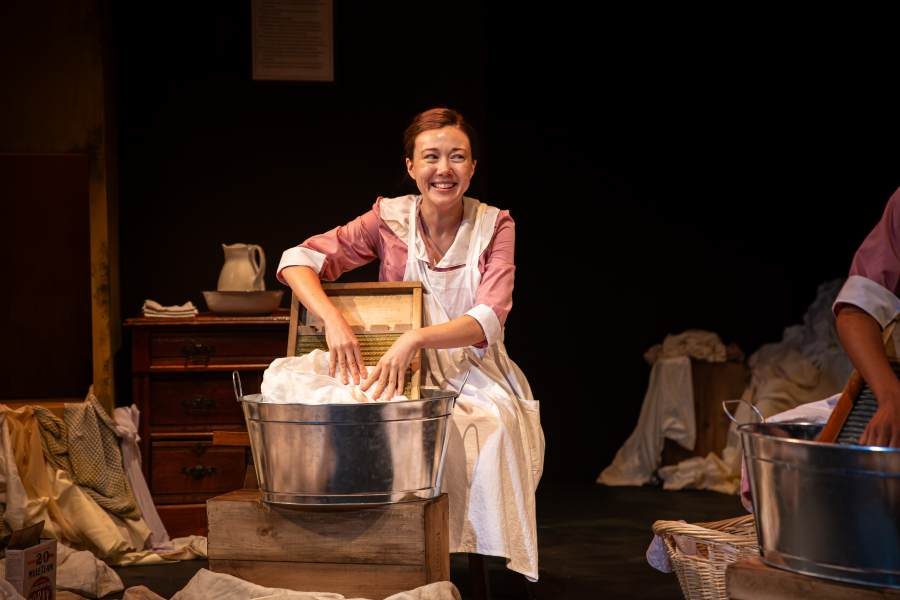
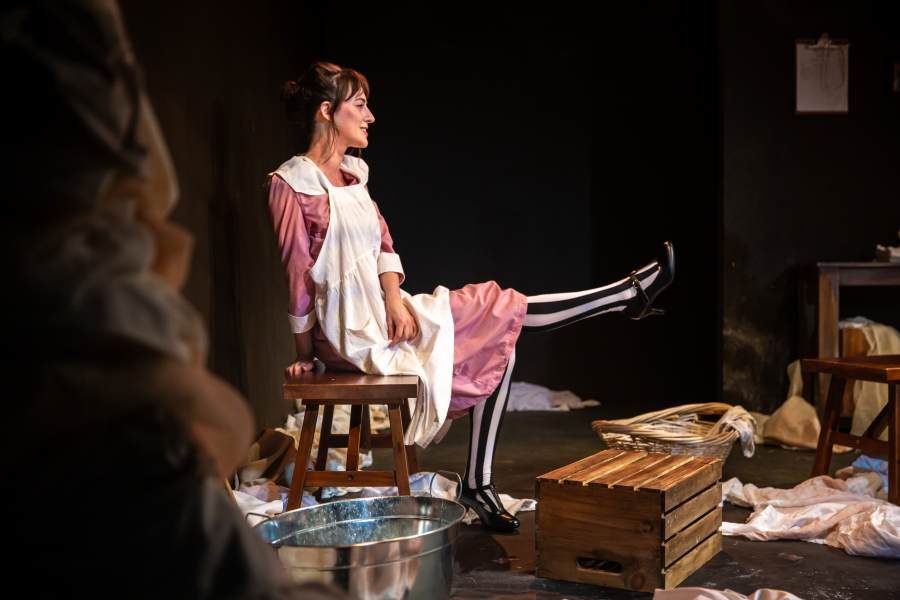
Into this group of jaded, yearning women tumbles Abby, who has the personality and physicality of an excitable cartoon rabbit. Millennials would call her a “cinnamon roll,” exuberant, small and sweet. Abby, played by Livvy Marcus, is the only one of the four who has any money: her rich father has sent her to the reformatory as punishment for allowing her beau, a young man from the Astor family, to visit her without a chaperone. 17-year-old Abby (the other women are in their 20’s) has decided to treat her stint like Margaret Mead, using it to see how the other half lives. Abby is one of the world’s true innocents; she wants everyone to be friends in every situation. In a few especially funny moments, Abby wears a huge smile as someone describes the horrors of Manhattan’s underbelly of prostitution; her smile never fades, even as her eyes betray utter confusion.That this strange, delightful, almost screwball performance fits so seamlessly into the four-person ensemble is a testament to Nina Goodheart’s direction and Sophie McIntosh’s script. Abby’s problems eventually become the engine of Benevolent’s main plot. And Marcus’s comic performance gradually gives way to something far more painful and affecting, making Abby not just the funniest character in the room but Benevolent’s emotional center.
Much like coworkers at any crappy job, the four girls feel both disdain and intimacy for one another; they know each other’s secrets, keep tabs on each other’s misdeeds, and guard their dreams and ambitions from one another. And like co-workers in a dead-end office, they unite against workers from other departments. In the laundry room, there’s a giant chute where soiled clothing is dropped from somewhere upstairs into an unceremonious mound that our heroines must sort through. The four girls have a hostile relationship with the chute-throwers, who sometimes throw particularly disgusting things downstairs, which gives the actresses opportunities for some truly fantastic yelling (“Next time throw yourself down too, YOU BITCH!”) Their dynamic is a well-observed example of how people within oppressive systems will find ways to wield the tiny pieces of power that they do have against each other. It’s as if Santa’s elves had beef with the reindeer - we work all day, and all they do is jingle their bells and drive the sled. Assholes.
A central point of Benevolent is that the shame and stigma around women’s bodies is a tool designed to oppress them. The reformatory itself is a place where women like Margaret and Emma, who are used sexually by men, go through the daily task of “purifying” themselves through physical labor, only to get out and do it all again. The laundry is covered with bodily fluids, blood, and other “unclean” things that young women in 1917 aren’t supposed to know about. All of these points are illustrated through the events of the play; none of them feel overly didactic or woke, because they happen through characters that are thoroughly developed and feel authentic.
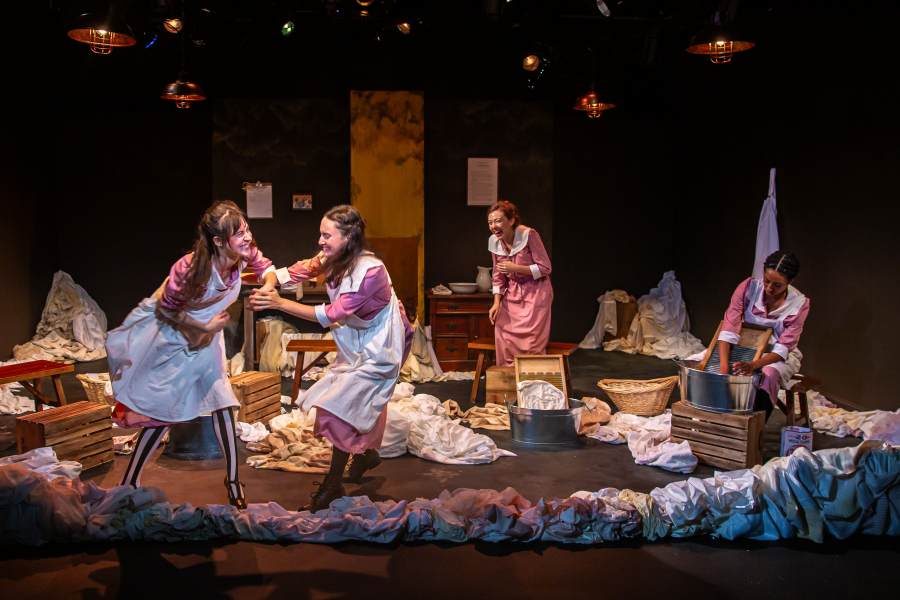
Women’s bodies are at the center of the play; the narrative is driven by the physical want, need, and pain of the characters. We see the women use their bodies for economic survival and as sources of pleasure and emotional intimacy. There’s a moving subplot about Sarah and Margaret’s early sexual experimentation that, in another play, could easily serve as the narrative centerpiece. The daily grind of washing dirty laundry is soon interrupted by a physical crisis Abby has, which jolts the four girls out of their contemptuous familiarity and emboldens them to draw on all of their life experience to help her. From there, the four girls form an alliance to take care of their smallest, weakest, and seemingly most powerless member. This leads to the play’s most powerful and harrowing scene, where Emma has to help Abby through a medical procedure. It’s a showcase for Mia Fowler and Livvy Marcus, who both deliver heart-wrenching performances and give the scene the grisly reality it deserves.
Emma, Sarah, Margaret and Abby are trapped, to different extents, in the reformatory, but the boundaries of Benevolent are expansive. Director Nina Goodheart brings scenes to life rarely if ever seen onstage. There are scenes of sexual and romantic intimacy coupled with scenes of surprising physical violence. The taboos so commonly felt about women’s anatomy are deliberately transgressed, but in a way that is fully real, and without luridness, irreverence or nihilism. There are moments where you ask yourself if it’s okay to watch such a frank account of women’s bodies, and then you realize that it’s not only okay, it’s reality, and that you might be part of the problem (or would have been, in 1917) by thinking what you’re seeing is taboo or wrong. This may not be the right term for this particular production, but Benevolent has huge balls.
https://www.goodapplescollective.com/benevolent
With Mia Fowler, Livvy Marcus, Rachel Ravel and Chani Reeves
Written by Sophie McIntosh
Directed by Nina Goodheart
Costume Designer: Saawan Tiwari
Scenic Designer: Junran "Charlotte" Shi
Intimacy Director: Willow Funkhouser
Sound Designer: Max Van
Lighting Designer: Paige Seber