


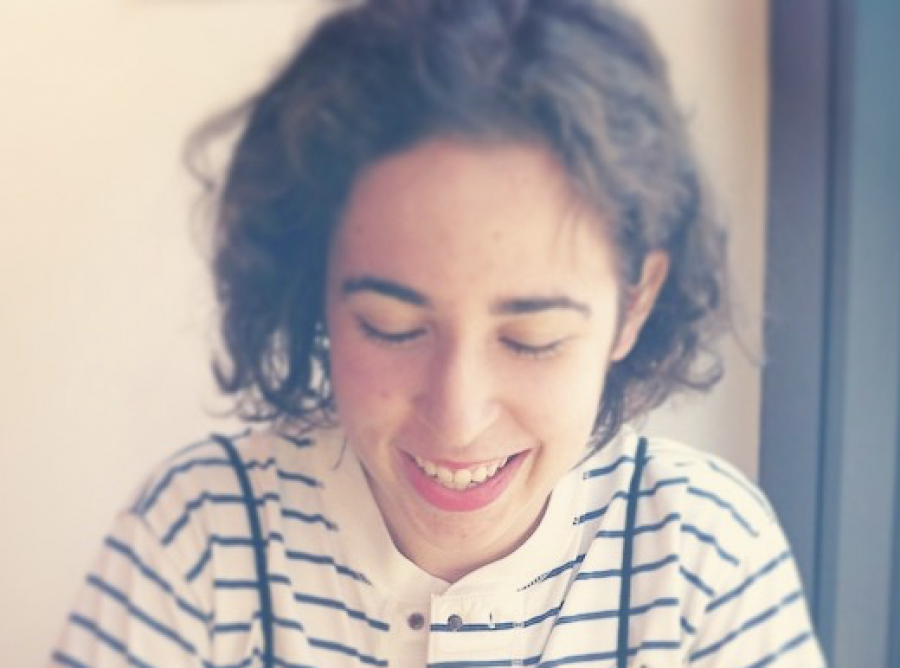
In playwright Catherine Weingarten’s I Wanttt a Unicorn Frappé!!!, a young woman’s craving for a limited-edition and highly caloric Starbucks beverage becomes a sharp and satirical exploration of wedding culture, romantic delirium, and the fantasies we build around love. Weingarten combines playful, inventive language with painfully real insights about how people behave when lackluster relationships collide with our idealized notions of romance. I spoke with Weingarten to discuss Unicorn Frappé’s origins, her take on the “wedding-industrial circus,” and the strange allure of the perfect romance.
Here's our review of I Wanttt a Unicorn Frappé!!!
This interview has been lightly edited and condensed for length and clarity
Q: So, congratulations on the play premiering at The Tank! What inspired you to write this very frothy satire of weddings, love & relationships?
Catherine Weingarten: So, the piece was originally inspired by the Unicorn Frappé, which came out in 2017. I went to Ohio University for graduate school, and they didn't have any real Starbucks; they only had Starbucks affiliated with the university. So they didn't have the Unicorn Frappé. And I got really upset and I was like, “Oh my God, I have to try this drink.” And I started doing a lot of posts on Facebook about it. And a friend of mine who's a playwright is like, “You have so many thoughts about this drink, maybe you should try writing about it!” So that's where the drink came in. And I guess I would say in general, a lot of my plays have that rom-com element; I was just interested in the fantasy of wanting to be with someone.
Q: The play draws from the structure of a romantic comedy, but it’s so subversive, and in some ways, it’s so dark about love and relationships. Were you playing with the structure and the arc of a romantic comedy?
Catherine Weingarten: Yeah, I would say in general, in my work, I'm always drawn to this idea of fantasy versus reality. And growing up on rom-coms, you have this idea of like this perfect guy and everything he says. In the Hallmark movies, he's usually a gingerbread maker, or a lumberjack, or something romantic. And I think there's like an innate humor in that fantasy version versus some of my own dating experiences, where the guy ghosts you, or isn’t that nice. And at the time when I was working on the play, I remember being like, "Ooh, what would it be like to be able to talk to someone out of one of those movies and interact with him?"
And, you know, I've been seeing the play over and over again and sort of reanalyzing it and seeing what I was up to. And I do think there is a lot of satire about the romantic comedy structure and how they work. And it's funny because as a playwright, I would say I'm very dialogue-driven and character-driven, and plot sometimes can stress me out a little bit. So I think there's a little bit of a wink, nudge vibe when it comes to like, this is the arc of the play, versus this is the character. I did so many of these writers groups where people would say, “What is the arc? And what does this character want?” And I guess I did some of that out of spite.
Q: The narrative really seemed, to me, to be that Jenny, played brilliantly by Rachel Lin, was going through this process of realizing what she wanted, or figuring out what love really meant to her. And the character of the prince that Jenny falls in love with (Fernando Gonzalez) is magical, and he’s special, and he has a cute horse. But he’s also kind of a douche. He’s a little grabby, he’s a little handsy and touchy. Were you trying to show the dark underside of the perfect guy with his character?
Catherine Weingarten: Yeah, definitely. And I think Jenny can't fully see all that, that there is sort of something ominous there, something off there. I guess it's hard to have that perfect fantasy, and it sort of comes back, I guess, to the [Unicorn Frappé] which is so fun, and then suddenly you're like, “I have a headache and I sort of want to throw up.”
Q: Does Jenny love the concept of love, or does she love Sebastian, or is it both? And what does it mean to be in love with just the concept of love and romance?
Catherine Weingarten: I think she definitely loves Sebastian, but I think what's sort of funny is the idea that, just because you love someone, it doesn't mean your relationship is going that well. And I think it took me a really long time to learn that. I was just like, “Well, I have a boyfriend! That's amazing! Like, this guy wants to be with me!” And it's like, no, that's not the end of the journey. Things evolve and you have to both be interested, and both be into it, and both put in effort. And clearly, in the play, he is not putting in as much effort, and she almost doesn't want to process that, or is in denial about that. But I do think she loves love in general and has a rom-com-aholic kind of vibe as a character.
Q: Can you tell me a little bit about the specific way you wanted your characters to talk?
Catherine Weingarten: Yeah, for me, language has just always been very important to my work. And I feel like I find a lot of the comedy in the play within rhythm. It goes back to e. e. cummings; it goes back to Shakespeare, how he would just sort of make his own words.
And I remember, being a little actor kid, I was obsessed with the First Folio. And I was like, “Oh, that word is in the middle of a sentence, but it's capitalized. How does that affect how you say it?” I liked all of those little clues within the text; they made it even more fun for me as an actor.
So I like giving that to actors now. And I see it as an invitation with to the performer – of, like, “Okay, there's like 20 ‘e’s in this sentence, I wanna hear how you say that." Each of the actors I work with can make it their own. There's something about the distortion of everyday speech that’s exciting to me, and fun.
In this play, you can really hear that the actors honor the text. And if there's a line that says like, "Ma hairrrrrr," they're not gonna just correct it. And that's where a lot of the humor comes in the piece.
Q: What are some of the influences or works or like that you feel like you're playing with when you're writing?
Catherine Weingarten: I'm a very big Christopher Durang fan. Just because his stuff is so heightened and funny, but then also very raw and very confessional. And as a playwright, I'm always trying to reveal something of myself, share some kind of truth, and then hopefully make people laugh. So I definitely was inspired by his work and how he's not afraid of the darkness. Hallmark movies are like a big obsession of mine. I am Jewish, but I am very into Christmas culture, even though people are like, “You're Jewish, why are you watching this Hallmark movie about finding love on Christmas?” And I’ll say, “No, they have to find love on Christmas. You know, that's the only day!”
Q: I’m curious about what you think about the wedding industry in general, and about the craziness of wedding ceremonies. What elements of wedding culture did you want to make fun of?
Catherine Weingarten: I love that question. I do think some parts of wedding culture are sort of ridiculous. I do think it's sort of a hustle, and I feel like they will try to just sell you anything. Like, “Oh, that? That’s not a glove. That is a glove that the bride must wear on her day. It is made out of diamonds, and it is $10,000.” And I'm married now, but when I originally wrote the play, I was just in a relationship, and I had never been part of the actual wedding industrial circus. And now I have been a part of it, and I have been freaked out and been super, super overwhelmed by it. I also think it's funny that you have to make so many decisions, you know, it's like complete decision fatigue. And some of it is so dumb. Like, okay, are you gonna have light pink or dark pink flowers?
Q: The Sebastian character is so funny, and I love the way that his excuses just get more and more ridiculous. What have you observed with contemporary men that is contributing to that character? Is this a species of Homo Boyfriendicus that you’re playing off of?
Catherine Weingarten: I'm interested in hetero guys, and how they can have a deadbeat vibe, and a lack of effort, or lack of interest. Drawing on some of my own relationship history, you're putting in like, 90%, and the guy is barely scraping by. This guy [Sebastian] is sort of lost in his own life, and I think that is contributing to the imbalance of the relationship. He has his own angst, but they don’t ever talk about that as a couple.
I’ve noticed that sometimes guys will just sit in a relationship. Like they’ll all sort of loiter in the relationship. But is this moving forward? Like, where are you trying to go? And people put a lot of pressure on the woman to be like – “Oh, well, you have this boyfriend, how are you going to get him to propose?” And you have to be dropping hints, and you have to blackmail him, or entice him, and do all this stuff. And I think it’s kind of depressing. Why is it all on the woman to make sure it happens?
Q: Love is represented, sometimes, in a really dark way in the show. These guys [Sebastian and the Prince] are not worth loving – but, also, Jenny’s love of love is really fun for her, and makes her into this larger-than-life person. Where do you end up on this? Is love worth it, even if it’s for the wrong person? That’s a big question.
Catherine Weingarten: No, I love that question. I think it’s valuable, even if it's kind of painful. But I guess the hope is, when it is the right person, it's just easier, and Jenny can just sort of relax into it. And it's like, she's just hitting against the wall, and it is sort of fun to watch, but there is a lot of pain.
Q: You don't have to answer this one, but what would you say that the Unicorn Frappé like represents? Is it love? Is it self-actualization? It would be valid if you told me to figure it out myself.
Catherine Weingarten: To me, it's the hope of a perfect life, or a perfect romance, but with dark edges. It’s like those labels they put on bottles of alcohol – “consume with caution.” You don’t want to have 20 of them. Be careful, even if it’s very tempting.
Q: Some of the language from the play felt influenced from some of my favorite TV comedies about girlhood – some of the dialogue reminded me so much of Ilana Glazer and Abbi [Jacobson] on Broad City.
Catherine Weingarten: I’m a very big fan of Broad City, so I definitely think that's in the DNA of the work. That's like a big influence on me, all those big female-led comedies. I looked up to Lena Dunham and Gilmore Girls and anything that's woman-led and trashy. I even dressed up as Ilana [Glazer] for Halloween one time.
Q: Did you have the outfit where she’s wearing the belt and gets stuck to the truck?
Catherine Weingarten: No, that would have been good. It was very specific. It was this one outfit she wore when her and Abbi [Jacobson] were in Bed Bath & Beyond, and she had this unhinged outfit. It was like black lipstick and a white jersey, and her hair was back.
Q: There's a really cool thing with some of the language in the show where people use adjectives that don't go with the right nouns to communicate a feeling which is hard to communicate. Like, you know, “I wish my dog was more mythical.” Tell me about those kinds of language constructions that you work with.
Catherine Weingarten: That’s definitely something I play with in my work. It’s like this weird comedic poetry that I just let myself free associate with. I love when things feel mundane, like it's like a normal conversation, but then someone says something weird and sort of distorts the everyday rhythm.
Q: I read somewhere that you were developing a work about motherhood next. What else is in store for you as a writer?
Catherine Weingarten: I have a few pieces in development. I have this piece, which is inspired by [Charlotte Perkins Gilman’s] The Yellow Wallpaper. It started off as a short play called “1900s Women Bonding.” And it's about these two best friends, and they both get diagnosed with hysteria in the 1900s. And one of them gets sent to sea. It’s a very trashy period piece. And then I have another piece about a woman dealing with her mental health, a crazy therapist, and trying to connect to her grandmother who's in a mythical retirement home.
Q: Thank you for making time to talk – good luck with the remainder of the run! We can’t wait to watch whatever you come up with next!
Catherine Weingarten: Thank you!
Catherine Weingarten is the author of I Wanttt a Unicorn Frappé!!!, playing at The Tank through June 21st.
The venue is at 312 W 36th St, New York, NY, 10018.