



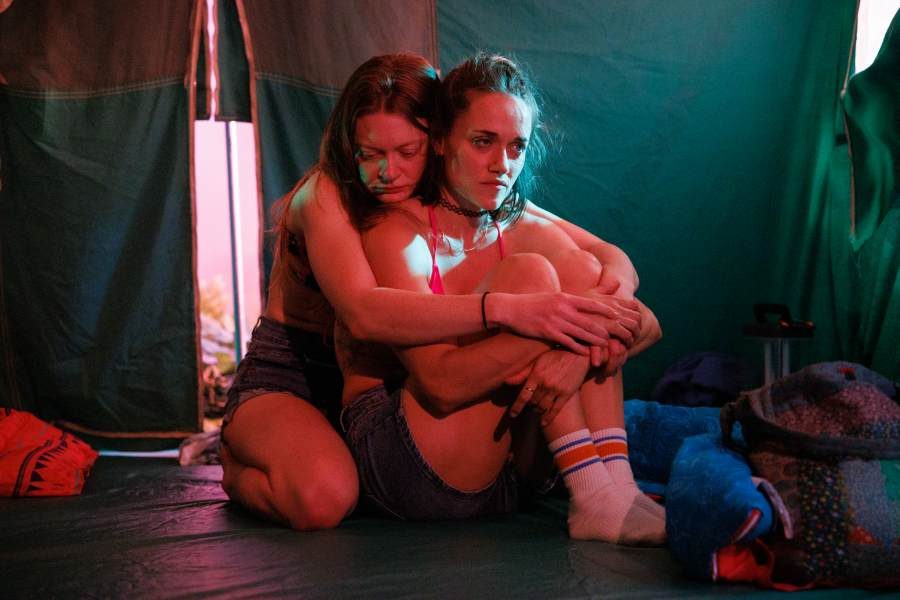
Camping is the most I’ve ever cried during a play that’s set outdoors. Based on the title, I thought the show might have something to do with nature - you know, the wonderment of seeing the stars in the firmament, all that hippie-dippie, woods-are-lovely-dark-and-deep stuff. Instead, it turned out to be about two queer women who’ve spent their entire lives in a desperate war with their own hearts, struggling to admit their anguished, mutual, all-consuming love. Thank god. I hate nature.
The anguished women are Ari and Brit, the two (and only) characters in Victoria Lynne Barclay’s Camping, directed by Adrienne Campbell-Holt and playing through July 11th at the HERE Arts Center. Each scene of Camping shows us a different event in their lives, traveling forward through time – first as middle schoolers, then in college, then in their twenties, then as adult women with families. In the first scene, they’re in 9th grade, and best friends – they share secrets, jokes, and occupy the same tier of social status at school (near the bottom, but not all the way on the floor). Ari has borrowed her brother’s tent, and they’ve invited two 9th-grade guys to come and have sex with both of them. The plan doesn’t work because, hilariously, only one of the two guys actually shows up. “We should have rescheduled!” cries Ari (Colby Minifie).
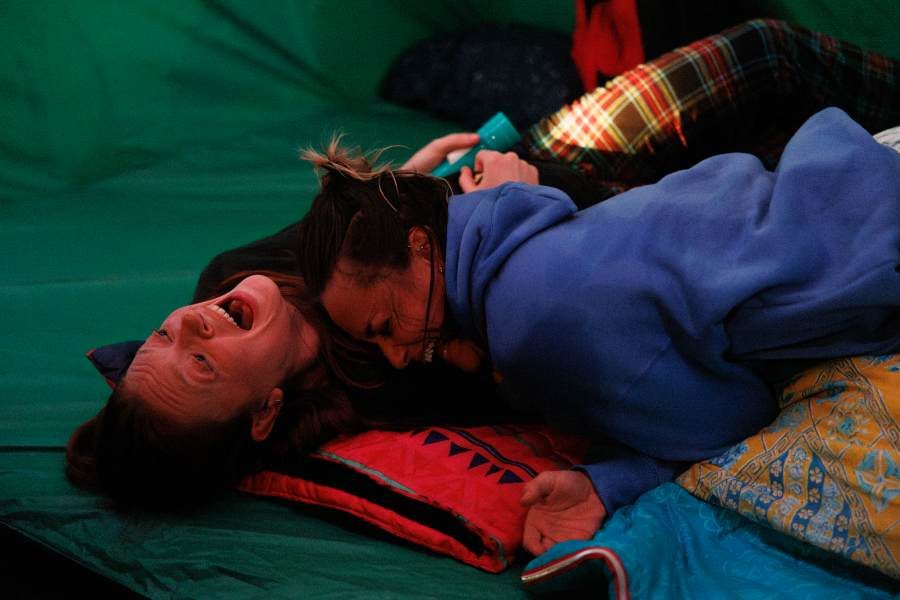
In some ways, the two are a case of opposites attracting. Brit (Alice Kremelberg) is effortlessly composed; beautiful and athletic, she could just as easily be a jock as a prom queen. She’s comfortable in her own skin, but also a little remote. Ari (Colby Minifie), by contrast, is like a cartoon character brought to life: huge blue eyes, a twitchy, almost manic affect, and an expressive, open face on which every feeling and anxiety can be plainly read. Neither of them are particularly concerned about boys. They just want to sleep with these guys because it’s a 9th grade milestone in their school. Ari and Brit are gay, and they’re in love, but it takes them years to realize it, years to accept it, and years longer to even wrestle their souls into a shape where each woman can admit she’s in love with the other one. Over the course of the play, we watch these girls grow up, spending their lives performing the roles they think they’re supposed to inhabit while reserving their truest selves for each other.
The premise is a bit like a gender-swapped version of Brokeback Mountain, except that Ari and Brit are two expressive young women, as opposed to two inarticulate, emotionally constipated cowboys. Like those poor guys, who can only express their emotions when they’re on Brokeback Mountain, in Camping, Brit and Ari only confront their feelings inside the tent. (I understand that the point of Brokeback Mountain is that the men express their love through gestures, silences, and meaningful shirt-button fondling, but I have always subscribed to the theory that more is more, not less.) In contrast, Victoria Lynne Barclay’s script gives the audience a Mamet-ful cornucopia of dialogue as Ari and Brit navigate years of confessions, negotiations and heart-wrenching declarations of long-lost love. “Loving you is like… you grip me by the back of my neck and shove me up against the window of everything that’s impossible,” Ari tells Brit. Both women express the ways in which heterosexual relationships and, eventually, motherhood, alienate them from their own bodies. “I have a son walking around in clothes that he picks out, and I’m watching him, and I’m just still fifteen, aren’t I?” asks Brit. “Trying to catch up to him, running behind him in this body that I don’t really know. Men have seen it, but I haven’t.”

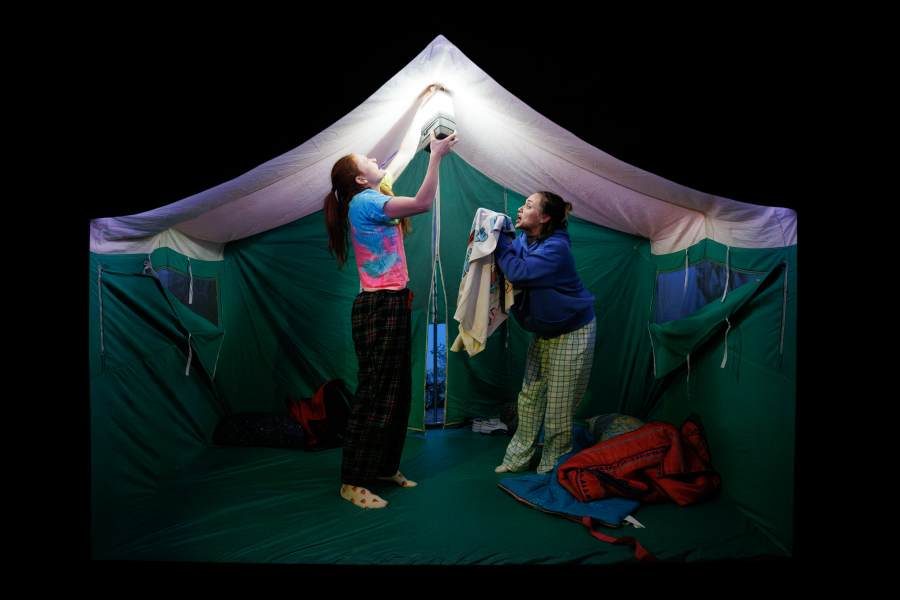
The conceit of Camping is that Ari and Brit use the same tent whenever they reunite: first for that ill-advised ninth-grade backyard exploratory sexual experiment, then as their drug-festooned headquarters at a Coachella-style music festival, and later during a family camping trip. The tent is tiny, but it completely immerses us in the world of the play. Another production would have placed a tent in the middle of an otherwise empty stage. In Camping, the tent is the stage. A large black wall has been constructed flush against the tent’s exterior, blocking out everything else so thoroughly that the audience literally cannot see anything else.
This achieves a few things: it mirrors the way that, when one is camping in real life, one really does feel like the tent is your entire world. (I’m assuming here. I don’t go outside.) And, more crucially, the enclosed set makes the intimacy between the two women palpable and immediate. There’s nowhere for them to hide. If one girl stretches out her arm to touch the other one, her arm has traversed the length of the observable world of the play. The scenic design is by Krit Robinson; lighting and sound design are by Vittoria Orlando and Salvador Zamora. Camping cycles through every combination of light and weather: we see arid heat, a cool night, a thunderstorm that batters the walls of the tent with torrential rain, and a shy, dewy morning where beams of light peek through the slivers created by the tent’s slightly-open flaps. It all feels real; your mind fills in the world beyond the tent.
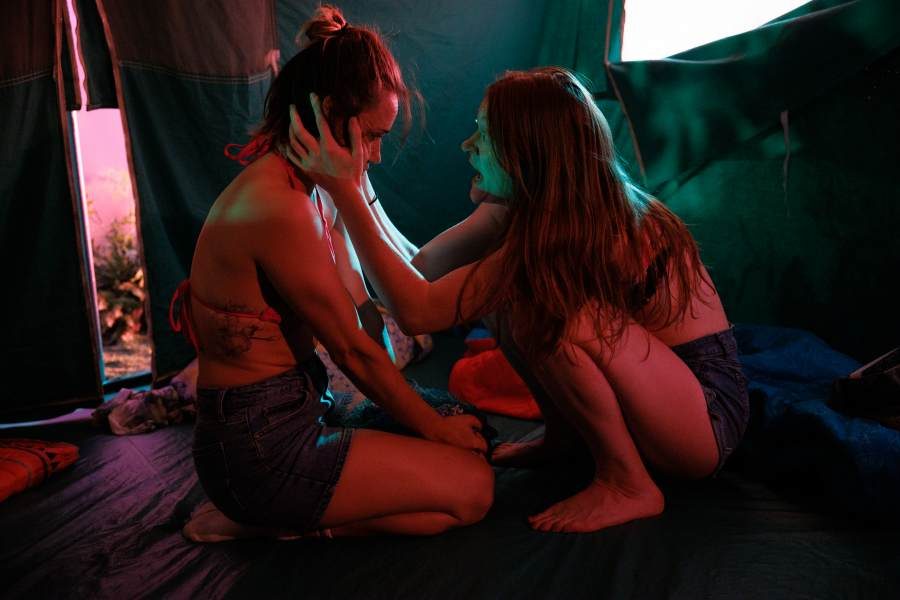
Ari and Brit should be together – but what keeps them apart isn’t just circumstance or the weight of bigotry and heterosexual expectation; it’s also their own distinct natures. We see most of the relationship through Ari’s eyes, who spends much of her life trying to find a way into her friend’s tightly locked heart. Ari realizes that she’s gay – and that she and Brit are in love with each other – long before Brit does. Throughout the relationship, she draws on all her self-knowledge, empathy, and verbal abilities to get through to Brit. It's as if she's an earthling launching every missile and torpedo in her arsenal against an alien planet. It's a bravura performance from Colby Minifie as Ari, who is both totally hilarious and genuinely heart-wrenching. Brit, in Alice Kremelberg’s funny, intense, and affecting performance, is very complicated; she’s icy, taciturn and stubborn, yet also wounded and broken. At first, Brit seems completely comfortable in her own skin. But over time, Kremelberg reveals a woman whose apparent ease actually stems from barely having a sense of self at all. It’s as though the world rushed in and filled her up before she had a chance to breathe.The dialogue is intricate and well-observed, but some of the most powerful moments happen when the two women make rare, desperate physical contact. It’s magic watching them touch. And if we didn’t care so much, then it wouldn’t hurt us when they suffer, too. It does.
There are a few moments where Camping gets a little bit soupy. There’s a Colby Minifie monologue at the end that’s well-written and well-delivered, but goes on so long, and is so relentlessly grim, that it made me wish we hadn’t pursued the Ari and Brit romance all the way down the road of despair, and perhaps turned off at the gas station of hopelessness a few miles back. A small weakness of the script is also that neither woman, once they reach motherhood, seems to think or talk that much about their kids. Even if you had children because you were trapped in a loveless marriage because you’re suffering under the yoke of patriarchal and compulsorily heterosexual society, you’re still going to care where they go to summer camp. But these are minor complaints. Camping is a beautiful, heart-wrenching play that made me think deeply about the gap between what my brain knows and what my heart has yet to communicate upstairs.
By Victoria Lynne Barclay
Directed by Adrienne Campbell-Holt
Starring Alice Kremelberg and Colby Minifie
Scenic Design by Krit Robinson
Costume Design by Sarita P. Fellows
Lighting Design by Vittoria Orlando
Sound Design by Salvador Zamora
Props Design by Thomas Jenkeleit