



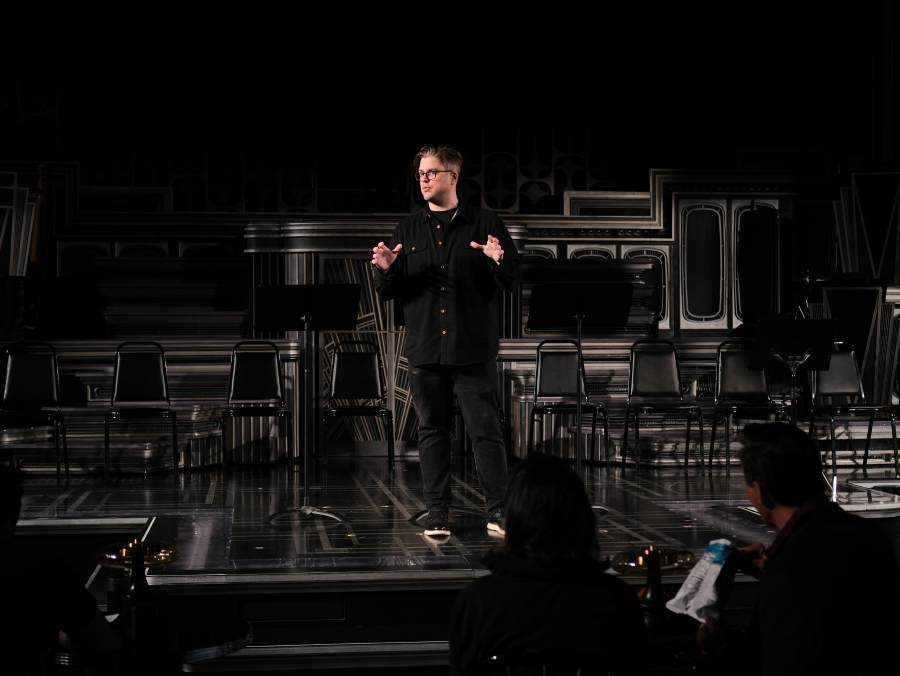
On Monday, June 22nd, an audience of people showed up at 11:00am at the Circle in the Square Theater at 50th St. They, and I, were planning to sit there for twelve hours until past 11:00 at night in order to watch five plays by the actor and playwright Tracy Letts, in one marathon reading. You may ask: what kind of people think it’s a good idea to sit through a twelve-hour play reading on a Monday? Looking around at my fellow audience members, the answer, at first, felt obvious: crazy people.
However, the experience, far from feeling like an ordeal, felt like a pleasure, albeit a very dark one. What you get from an undiluted high dose of Tracy Letts is how grim, funny and unflinching his world is. The plays are alive with the tension between the natural human urge to grope for connection versus the equally natural urge to abuse the ones we love.The festival’s sheer length was audacious, but necessary: I am now persuaded that 12 hours is the right amount of time to watch theater.
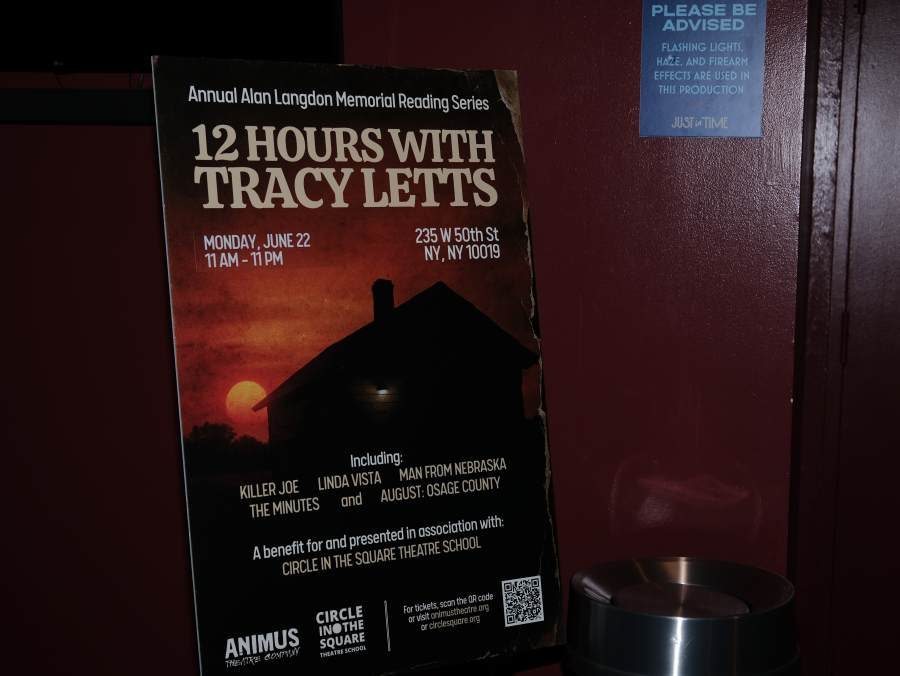
12 Hours With Tracy Letts is the brainchild of Jonathan Judge-Russo, the artistic director of the Animus Theatre Company, a production group made up of former members of Circle in the Square Theater School. 12 Hours With is part of a series called the Alan Langdon Festival, so named in honor of Alan Langdon, a beloved teacher and mentor at the school; ticket sales went to support the Circle in the Square Theater School. For 12 Hours With Tracy Letts, Jonathan Judge-Russo has staged readings of five of Letts’s plays: his best known, August: Osage County, The Minutes, Linda Vista, Killer Joe, and Man from Nebraska. The subjects range from a takedown of small town life set at a city council meeting where an innocent, progressive newcomer gets eviscerated by veteran parochial infighters; to a man who is the epitome of midwestern stability realizing that he doesn’t believe in God or want to be with his family; to a Texas trailer park family who hire a charming psychopathic killer to murder their estranged mother for the life insurance money. In a Tracy Letts play you always hurt the one you love – or try to kill them.
Letts' work is funny, sharp, and well-observed, especially when it comes to people in relationships who know each other well enough to have perfected the art of emotional violence. If one theme emerges, it’s that marriage sucks. In Linda Vista, a bitter, divorced middle aged guy (played brilliantly by Thomas Sadoski) seeks his married buddy’s advice on relationships; his friend tells him that he doesn’t regret getting married, and he’s basically happy with his life, but, "on the whole, [marriage] is maybe not worth it.” Then his friend says, “Don’t tell my wife we have had this conversation.” In August: Osage County, the sprawling family melodrama that won a Pulitzer, a seemingly passive husband tells his sharp-tongued wife that although he loves her and wouldn’t trade any of their 38 years together, he will leave her if she doesn’t stop ragging on their adult son, a sweet-tempered, disappointing goober. Marriage is a flimsy tissue we use to cover the abyss of loneliness and even a decades-old marriage can be blown away in an instant. But, hey, don’t tell my girlfriend I said that. There are other themes that emerge from the 12 hours – the idiocy of men in relation to women, the extremes people will go in pursuit of their desires, the fragility of our belief systems. But that’s the point of the marathon: after 12 hours, you emerge with a sore butt and a curiosity about what this particular playwright is trying to say – and all the different ways he tries to say it.

Jonathan Judge-Russo, artistic director of Animus Theatre Company, both produced and performed in 12 Hours with Tracy Letts, appearing as Mr. Assalone in The Minutes. Our interview has been lightly edited and condensed for length and clarity.
Q: How are you feeling, now that this giant labor of love is complete?
Jonathan Judge-Russo: I feel good. I think to pull off a day like yesterday, you need an army of extraordinary humans. And I feel like, if we did what we set out to do, which was bring some awareness to Circle in the Square Theatre School, maybe raise a few bucks, and get people talking about what's going on there, then I feel great about it. So I'm great.
Q: Why Tracy Letts?
Jonathan Judge-Russo: I was unfamiliar with Tracy until I saw August: Osage County on Broadway. And it had a profound impact on me as an actor and a human being. I think I saw it three times. I brought my dad to see it. I told everybody in the world to see it. I just thought, This is our contemporary Eugene O'Neill. This is our Long Day’s Journey Into Night, but funnier. And then I bonded with Alan, and we just continued our bond over that play. Alan loved Tracy Letts. So that was the inspiration to go out and try to convince Tracy Letts to do this; that connection.
Q: What is the Animus Theatre Company? And how did you guys get involved with Circle in the Square?
Jonathan Judge-Russo: We founded Animus, officially, back in 2011. It was originally conceived by four of us who graduated from Circle in the Square Theater in 2008. We all were mentored by Alan Langdon, after whom the festival is now named. We just got it in our heads that we wanted to start our own work. Our first production was Where's My Money? by John Patrick Shanley. And I think that kicked us into an arena of lesser known plays by well-known playwrights. That became our niche. And later in our development, we started nurturing new plays. And then we brought this 12-hour festival into the world. The pandemic set us back a little bit, but prior to the pandemic, I think we put 55 or 60 productions out there in the world. And so now this is our sort of first step back into getting the ball rolling again.
Q: You confessed in front of the audience that this 12-hour festival was your crazy idea. Tell me how that idea came about.
Jonathan Judge-Russo: If I'm being totally honest about it, I feel like I stole the idea a little bit from LAByrinth. And they did a festival a number of years back that honored Tennessee Williams. It was called TENN 99. And I think it ran for 72 hours, if I remember correctly. And for 72 straight hours, all they did was read Tennessee Williams. And it was one of the most invigorating experiences of my artistic life, because I was still fairly fresh out of school. I was hungry for everything. But you could walk up to the Bank Street Theatre at 3:00 in the morning and walk into a reading of some play that you'd never heard of and see incredible people reading in the middle of the night.
And you're like, "What's going on here?" So I left that feeling so alive. And I think that tradition for them has sort of passed its prime, or they're not really doing that anymore. But for us, it was, let's get in direct contact with a living playwright and let's try to, in 12 hours, read as much as we can on a Broadway stage. So that's where the idea of the marathon came from.
Q: I didn’t know that was a thing, the Tennessee Williams marathon reading. I love the idea of someone walking in at 4:00 in the morning and someone on stage is going on and on about jonquils. “The vases for the jonquils!”
Jonathan Judge-Russo: I’m trying to remember which play I saw there - I think it was Tiger Tail. It was the middle of the night and I walked out of there like, "This is an extraordinary piece of theatre and I just saw it at 3:00 in the morning with maybe six other people."
Q: Some of the productions seemed so amazingly fleshed out, given that they had only rehearsed one time. I was really struck by Linda Vista and Thomas Sadoski, who played Wheeler. He must have had to learn 1,000 lines of dialogue; he was on stage almost every minute of a two-and-a-half hour play. And he just blew the doors off the theater. Did you feel like some of the productions could be fully staged with a little more time?
Jonathan Judge-Russo: I actually felt that way about all of them. I think if you put the right people together, and you try to be mindful about where they are and what the roles are, and you get the right directors, I think you really do set yourself up for being able to do that. There's an incredible vibe in all of the rooms, all of the rehearsals, all of the casts. And that's what translates on stage, and that's what you watch and you say to yourself, "Oh, my God. They only had one rehearsal. This feels like you could mount this within a week."
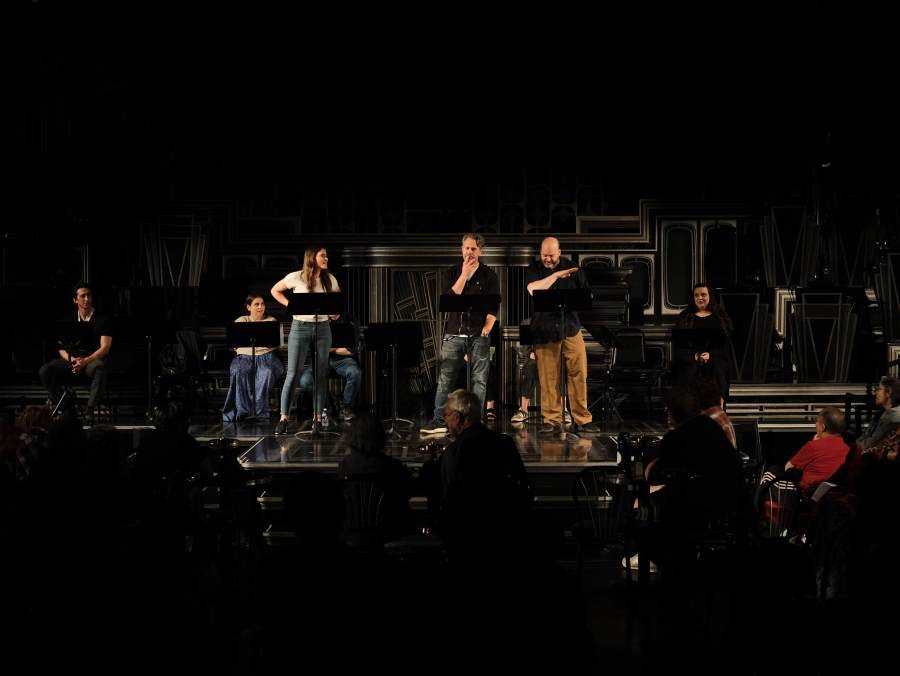
Q: How do you explain these actors’ commitment to doing this, which takes a lot of time and energy and effort?
Jonathan Judge-Russo: At the end of the day – and I’m putting my actor hat on at the moment - this is why we do it. We love getting together with a group of people and reading a play. Period. Full stop. It doesn't matter where you are in your career trajectory, or what level of fame you've reached, or whatever. I think if you find the right kind of artist who's committed to making good work, and really exploring themselves and the world through art, at the end of the day, there's nothing better than getting together with a group of your friends and reading a play. There's nothing better. And so, basically, all we're doing is asking them to do that twice. One by themselves, and once in front of a room full of strangers. And so I think they're happy to do that. I think we unshackle them. We de-burden them with all the other trappings of, you know, fame and celebrity and all that other stuff and we just say, "Come and read a play." Like, do the thing that made you want to do this thing in the first place.
Q: I wanted to ask you about Alan Langdon. He was spoken of by the presenters on stage, and you could feel the genuine warmth coming from anybody who discussed him.
Jonathan Judge-Russo: Alan was effectively the primary contemporary scene study teacher at Circle in the Square for basically his entire tenure there. He passed away a couple of years ago. And he was an incredible personal mentor and professional mentor to so many of us, myself included. He became a member of my theatre company. He, in effect, became the patriarch of the theatre company. He is the guiding spirit for all of us.
Q: Are there principles that you think about all the time which come from him?
Jonathan Judge-Russo: He was the guiding force behind yesterday and so many of these festivals, because he said, “You've gotta learn about the playwright.” When you come into acting school and you know nothing and you're just a bright-eyed kid, the idea that, “Wait, before I get up in class to do a scene that's four pages long from a play I've never read, you’re saying that I also have to go and read three more of this guy's plays to get an understanding of who this playwright is?” Yes. That is actually what you have to do.
Q: You have been swimming in the ocean of Tracy Letts. What do you feel like you’ve learned about him since you conceived of this project?
Jonathan Judge-Russo: I think Tracy Letts is a powerhouse. He’s constantly exploring his own frailties and weaknesses and sheer, gross humanity, and doing it in a way that I think is accessible to everybody. The things that people are able to do in their attempt to be on their own journeys, and the consequences of those things along the way can be brutal. And you know that Tracy is writing from a personal place. So you have to imagine that he is saying to the world, "Look how imperfect I am. Look what a mess I am." And I think that is so brave. To put those words down on paper is you testifying in front of the world, "This is who I am. This is how messed up I am. But this is how I'm trying to understand myself." I also learned how funny he is, and how he uses humor as an entry point to the world.
Q: Were there any line readings last night that stood out to you, where you felt like an actor really nailed a reading, or helped you see something in a new way?
Jonathan Judge-Russo: This always a line that gets me, and I thought it was so wonderful, was: Jeff Still was playing Charlie Aiken in August: Osage County. And there's this extraordinary moment in Act 3 where Mattie Fae is just laying into Little Charles. And Charlie can't take it anymore. And he has this beautiful, effective aside with Mattie Fae. He tells Little Charles to leave the room. And he just talks about her lack of kindness. He says something like, “Hey, we've been married for 38 years. And I've loved every minute of it. And if you can't find a warm place in your heart for your son, we're not gonna make it to 39." I mean, whether it was Chris Cooper saying it to Margo Martindale in the movie, or the Broadway production or Jeff Still saying it to Jenny Bennett, it's this idea that we're all always right on the edge of something. And imagine, you know, 38 years and being able to say to somebody like, "I'll pack it all in right now." Jeff is a guy who goes back with Tracy and done a lot of work with Tracy and all that stuff, too. So, I mean, he gets it. But, man. What a moment.
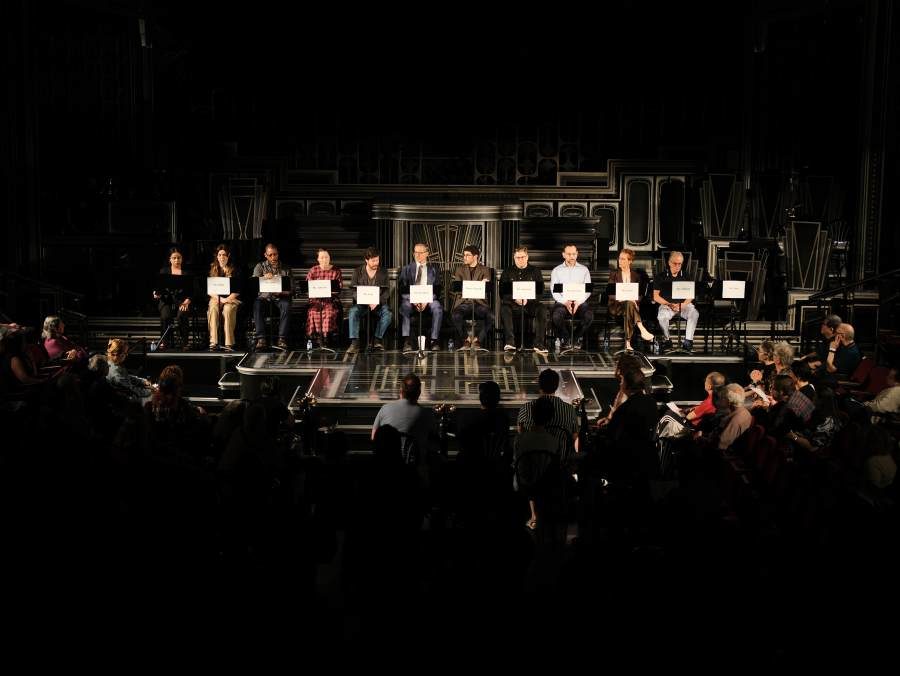
Q: You, yourself, are in the very first show [The Minutes] as this douchey town council member, Mr. Assalone. What made you want to pick that part?
Jonathan Judge-Russo: I think that one is especially fun because, I mean, I see guys like that, and they drive me crazy. But I also look at them, and I wonder, “what if I just didn’t care?” What if I just didn’t care, and acted like that? Like, what if I didn't give a shit what anybody thought and I just said what was on my mind and I only cared about my own agenda? And then I realized, oh, I probably do do that. I just don't do it exactly like that. But I'm sure I do it.
Q: What was Tracy Letts’ reaction to you wanting to stage a marathon reading of his work?
Jonathan Judge-Russo: When I made the immediate, initial approach, I think the response was, like, "Why would you want to do that? (LAUGH) Why would anyone want to sit and watch 12 hours of my shit?" So I think that there is humility there. There's an unease there. But there is also a recognition that it's for a good cause. He knew some of the earliest people that we had involved, like Jeff Still and Andrew Rothenberg. Some of the earliest people we had involved are some of his old cohorts from Chicago. But the initial response was, like, “Why would you want to do that?”
Q: And then – what is next for Animus?
Jonathan Judge-Russo: There’s a couple of new plays that we’re kicking around. This festival was an announcement that we have returned, post-pandemic. So you can count on this festival happening again. But I think, at our core, we just want to get back to getting together and reading plays. I think just getting together, even if it's in somebody's living room with a few bottles of wine and books in hand, is really important for us right now.
Q: I wanted to ask one more question about Tracy Letts. You are kind of a scholar of his work by now. What do you feel like you’ve learned about Tracy Letts when he’s poured into different types of glasses?
Jonathan Judge-Russo: That's interesting. I feel like he looks like one of those layered drinks, the ones that were hugely popular in the early 80s. So that’s how I would describe him, as a cocktail. I think what we learn from him is that normalcy lives within the extremes. You’ve got plays like August: Osage County, which is a family melodrama. And then you’ve got Killer Joe, which is like, what in the holy hell is going on in that trailer? And then you’ve got The Minutes, which is more in the middle. And somewhere in that range is Man from Nebraska and Linda Vista. And I think his ability to show people at their extremes, whether it's a plot to have somebody killed, or it's an attempt to get their mother off of drugs and then realizing that they are just like their mother, or whether it's, fighting for whatever you think you need to be fighting for in a town council meeting, it may feel like extreme behavior. But I think extreme behavior is simply normal. But it all comes back to a place of, what is normal for these people? And I am in no way a scholar of Tracy Letts, or just about anything at this point. But I think that's how I would think about it.
Directed by Mark Armstrong, Jeanne Slater, Benita de Wit, Victor Malana Maog and Eric Tucker
Plays by Tracy Letts
Produced by the Animus Theatre Company in association with the Circle in the Square Theatre School
Performers included: Constance Shulman, John Gallagher, Jr., Adam Rothenberg, Thomas Sadoski, Beanie Feldstein, Katrina Lenk, Brad Lemons, Ace Lillard, Sam Tutty, Matthew Lillard, Samantha Sloyan, Kammy Ibarra, Eric William Morris, Dylan Mulvaney, Jason Biggs, Milly Shapiro and other performers