



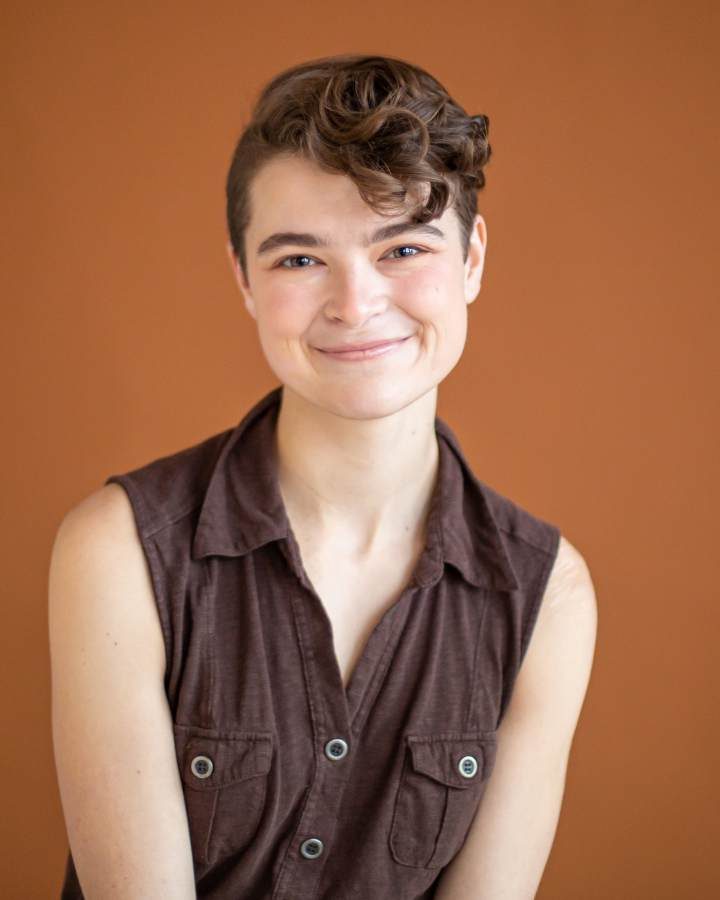
Q: benevolent is wrapping up its run. How are you feeling about everything?
SOPHIE MCINTOSH: Oh, man. I mean, it's been really awesome. Like, I'm really grateful that we did it with a really great team and it's been awesome to get to share that with the whole team. And just I don't know, we roll up to the theater every day-- 'cause it's such a small operation, you know.
I wrote the play. I also sometimes take out the trash. I usually operate the elevator when we have ADA access needs. So I'm there all the time, and I just get to share in it with the cast and the team every day.
We're like, "Oh, my gosh," you know? Like, it's just-- the buzz becomes very infectious and positive in the space in a way that I really cherish 'cause, you know God knows I hope to someday get to make theatre at a big scale where there's lots of money involved, but I feel like the more money there is the more distance there becomes between the person who originated the thing and the people who are enacting it. And I do really like working at this scale where it's just everybody knows everybody and we're all in it together.
Q: In benevolent, there really isn't a big distance from the stage and the audience. Were you hoping that there would be that feeling of physical, intimate connection between what's happening onstage and people watching it?
SOPHIE MCINTOSH: Yeah, absolutely. We've been running this company, Good Apples, and that's me and Nina Goodheart, who directed benevolent and has also directed my last three plays. And so with this play especially, there are some very intimate moments that the audience has a very intimate perspective for. And I knew that you know, we were gonna be doing it at this theatre with-- it seats you know, 60-some people. And I knew that that was gonna make a big difference in terms of just we're all right up in it, you know? And that's something that I really enjoy.
Q: Tell me a little bit about Good Apples Collective. How you and [director Nina Goodheart] work together sounds like a very different experience of having a play, putting it out there and having it be absorbed into the mothership of a huge production.
SOPHIE MCINTOSH: We started Good Apples almost five years ago now, and it came, in large part, from my great desire to work with Nina, because we had worked on a couple of readings and workshops. We found that it was really hard to get anyone to take a chance on two twenty-something women who wanted to put up a full production together. People were like, “Um, well, maybe…”
Q: “We could do one, but two…”
SOPHIE MCINTOSH: Exactly. There’s a lot of intention to split us up and pair us up with more experienced people. As much as I love working with other directors and learning from people more experienced than me, Nina and I have a unique collaborative relationship, and it was great to find a platform for that.
But even more than subject matter, I think the unifying sort of principle of Good Apples is we're really, really trying to show that you can treat people well and still make good art. There’s this idea of the uber-director, the auteur, who’s like, “Everything is gonna be my way,” treating people a bit callously and being like, “Well, those are the corners we have to cut in order to make art.” At the scale we’re working, nobody is being paid enough to have a bad time.
Q: What made you settle on an early 20th Century reformatory as the setting for this play? How did you come up with the idea?
SOPHIE MCINTOSH: I first learned about it through there's this local historian up in Inwood whose name is Cole Thompson, and he runs this really extensive blog on local history.
I found an image of this almost Magdalene laundry in Inwood. And I thought, "Okay. I knew that they had those in Ireland. I did not think that was a thing here, especially not at that particular period in history," and I was really interested in it. I would walk up to Inwood; I wanted to see the ruins of this building. And there aren’t really anymore. It's all covered in forest. It's a park now. But I would walk up there and just sort of say to myself, "I feel a very spiritual attachment to this place and to these people," and that I feel like something is calling to me through all the years and years and years in between me and these girls.
And it's very, you know, woo-woo, but it was affecting to me. I did a ton of research, and the themes of the play evolved a lot between different drafts. This play used to have ghosts and séances and spiritualism in it, and I realized that was pulling the play in two different directions.
Q: Interesting.
SOPHIE MCINTOSH: I had a séance and an abortion. And I realized, “We’re losing the plot here,” you know? I figured out which of those I was the most drawn to and how to shape the play around that.
Q: You read a book while researching benevolent, by Saidiya Hartman [Wayward Lives, Beautiful Experiments: Intimate Stories of Social Upheaval]. What did you take from her writing? Were there any interesting or surprising details?
SOPHIE MCINTOSH: Oh gosh, that book is incredible. It’s about the experience of Black women at that period of time [early 20th century]. They faced different standards than white women. There are so many heartbreaking stories of Black women who were lingering outside a bar because their boyfriend was inside the bar drinking, and they were waiting to go home, and then she would get arrested for soliciting because she was a Black woman standing outside a bar, so obviously she was a prostitute. So many stories like that. You could get abducted as you're walking home at night, because they could just use the flimsiest pretext to bring you in. I was like, “I don’t even know that I can put this in the play, because I think people won't believe it," you know?
Q: It's really interesting to me that you made the writing decision to veer away from ghosts and séances, and keep it to the physical realm, because the play itself is so granular and realistic in what's happening moment to moment. Did you feel like you wanted to keep your setting to just one room with four women? What was it about immediacy that was attractive to you?
SOPHIE MCINTOSH: I love a small container, and I think it’s challenging, in a useful way, dramatically, because you have to think about how all of your action unfolds in one very concentrated place. And I think in the case of this play, it also served the purpose of these characters, who are really, really trapped in the same way. I think also our scenic designer Charlotte Shi, she did an amazing job just making it this horrible, dank basement.
Our amazing assistant stage manager, Jenna Rowell, pre-stains every single item of clothing that is touched and used by the actors. And they actually wash out the stains over the course of the show. So they aren't scrubbing at a fake stain that's never gonna come out. The stains really do come out, and they really do clean the clothes, and that’s just something that makes it feel more theatrical. Like, they do come out and they do clean it and that's something that I think is just theatrical in a really fun way.
Q: The characters are all really concerned with social control and what people will think of them and what will happen outside of this horrible, cramped laundry room. Was that a tension you wanted to explore? Like a normal, crappy job with coworkers who you don’t like very much, who have dirt on you? Like, “Did you tell them what I did, now I won’t be able to work at any Jamba Juice location…”
SOPHIE MCINTOSH: I think the fun thing about these kind of situations is that you're thrown together with people who you wouldn't otherwise choose to hang out with; especially in this show, where class is such a big boiling point. There are big, life-altering stakes at play in what is going on, but also, day to day, your world has shrunk to the size of this room.
Q: One thing I was thinking about when watching the character is that they’re kind of a classic four-girl ensemble. I know they’re not having fun in the sexy streets of New York City, but there’s the audience stand-in, the adventurous one, the nervous one. It’s like if the Golden Girls were consigned to a repressive cloister. Was that something that you were thinking about?
SOPHIE MCINTOSH: Oh, absolutely. I love genre and tropes and I'm interested in how they can be subverted, but I also think it's really useful and interesting that approaching a situation like this, you know that the audience carries in immediately this memory of other four-person ensembles. Our assistant stage manager Jenna has created a list of four-person characters and teams, and before every show she goes into the dressing room and she picks a group and says, "Okay. Which character are you in this foursome lineup?"
And last time it was like the penguins of Madagascar. And I think we said Sarah is Rico and then Emma's Kowalski and Skipper is Margaret, you know, like that, you know. Playing with those tropes is a lot of fun, and we liked making Abby seem like the sweet, naive, helpless one and then letting her be duplicitous. When people assign her a role in their heads as audience members, that makes the backstabbing all the more richer and interesting.
Q: I was trying to challenge myself to see if I remembered what all the penguins are and what they do. I know Kowalski hacks into the mainframe.
SOPHIE MCINTOSH: I think Rico is the one who vomits up the bombs, you know? (LAUGH) Like, they're like, "Rico, we need whatever," and he's like, "Bleh," and the tool they need comes out. [LAUGHS]
Q: Since you mentioned Abby – I thought Livvy Marcus's performance was really interesting. It was so comical and expressive – she was like an adorable cartoon rabbit. But it still fit into the world of the show. What was the process of developing that character with her like?
SOPHIE MCINTOSH: So, Livvy's been with the show since I think the very first in-class reading I did in grad school. And that’s back when it still had ghosts. And she's been with it ever since. And I really do think that her sweetness is part of the special sauce that really makes Abby work as a character, especially in this production. I think that sometimes the innocent, sweet, wide-eyed white girls are the most dangerous of all of us, especially when they weaponize that aspect of their nature, intentionally or not. So many people have sent me the Tyra Banks GIF about Abby where she’s yelling, "We were rooting for you. (LAUGH) We are all rooting for you," after the show.
Q: I really like to ask playwrights about their influences – who are some of your kind of north stars as a writer?
SOPHIE MCINTOSH: Yeah. I would say one of my big ones is actually for sure Annie B [Annie Baker]. She's amazing. And one of the things that really, really stuck with me from a props job that I did in undergrad where I was working on The Flick was – I don't know how familiar you are with the show, but in between every scene, there's new trash that they have to sweep up.
And so, what we did for our production was I stayed underneath the risers for the whole show, and the risers were our set. So, I was just crouched underneath – and then in between scenes I would go flat on my belly, army crawl, throwing out my fake popcorn in the total darkness, and then withdraw.
And then the lights would come up and people were like, "How did that happen?,” you know? And that was so fun, but part of what was really useful and amazing from just a learning perspective was that Annie is so great with her extended, tension-filled silences.
And when I was watching from under the risers I couldn't see any of it. I could only just hear it, and hear their footsteps above me. And I just got to marinate in those silences in a way where I was kind of like, "This is awesome." It lit up something in my brain and I think about it a lot with this play, especially at the top of scene two, where there’s almost five minutes with minimal dialogue, and it’s mostly just people doing their washing with various levels of expertise, shooting glares and loaded looks or smiling and trying to make friends, you know?
Q: There are two scenes in benevolent which are really audacious – the scene where Mia Fowler helps Livvy Marcus with a medication abortion, and the scene where Chani Reeves and Rachel Ravel are having this tentative sexual encounter. They’re both very visceral and real, almost hyper-real. What kind of effect did you want those scenes to have on the audience?
SOPHIE MCINTOSH: I wanted to make sure that these moments didn't feel shocking for the sake of being shocking. I wanted them to feel grounded in the characters' circumstances and lives as much as possible. With the sex scene, to start with, I had never written an onstage sex scene. Or never written one that hadn’t just faded to black at some point. It’s really interesting how, in the staging of it, there’s a point where the audience realizes, “Oh, we’re going to see this through to completion.” It was important to me that we allowed it to be awkward, but also very tender and intimate and lovely.
The first time we saw it staged – the intimacy coordination was by Willow Funkhouser, who’s fantastic at her job and handled both of the physically intimate scenes in the play – I remember crying, because I couldn’t think of other lesbian on-stage sex scenes. And for the other scene [about a medicated abortion], I felt it was important that we see it through in its entirety and that we don't look away from it, because so many people are looking away right now, you know? With the state of reproductive autonomy and reproductive rights in this country, it felt really important that we stayed with it the whole time. You are focusing on them. We're focusing on their faces and what they are experiencing and that was important to me. I didn't want to black out or fade away or cut away from that, you know? It was important to me that we sat in it and lived through it with her.
I think the thing that has been most meaningful for me has been people who have experienced abortions and who have reached out to me after the show and been like, "It was really powerful and important for me to see that on stage." And those are the reactions that I think stick with me the most and make it all 100% worth it for me.
Q: What has been your journey like to get here – when did you start feeling like you could be a real playwright and put your work out in the world?
SOPHIE MCINTOSH: I started writing in high school. I had really wanted to be a YA novelist – like, “yeah, I'm gonna write The Hunger Games," you know? I loved writing, and I also loved theatre. But I had too much stage fright. I never did theatre until I dipped my toe in in high school, you know? It never occurred to me that I could combine those two interests until I was 18. And so, then I got really, really into it. I started writing every day, and I've kept that practice up for ten years now, which has been really useful.
In terms of the first moment that I ever realized I could work as a playwright – in 2019, I won a playwriting competition with the Kennedy Center American College Theatre Festival (KCACTF), which was huge for me, and really special. Because going to undergrad in Wisconsin, it's not New York where there’s a ton of theatre schools, a ton of theatre all in one central place. Like, I could see the main stage shows at our colleges, I could go see Central Wisconsin Area Community Theatre's production of The Addams Family, and that was kind of the extent of the theatre immediately accessible to me where I was. And when I won that playwriting contest I was sort of like, "Oh, wow. Like, maybe I can keep doing this." And then everything around McBitches and kind of getting my first play licensed and published was a really big thing where I was sort of like, "Oh we're doin' it. Like, we're actively doing it." And from there founding Good Apples with Nina was really, really crucial and was sort of like, "I am gonna just take myself seriously now and take this work seriously because other people are starting to and so I really have to."
Q: What do you hope people are going to walk away from benevolent feeling?
SOPHIE MCINTOSH: I hope that people will think, “oh, the humanity of it all,” in terms of how similar these girls are to us, in some ways. They’re fighting over zits and stuff in the same way that teenagers today would do, but I also want people to think about how little has changed from then to today, especially in terms of reproductive access and rights. That’s something that I hope people leave sparing a thought towards.